


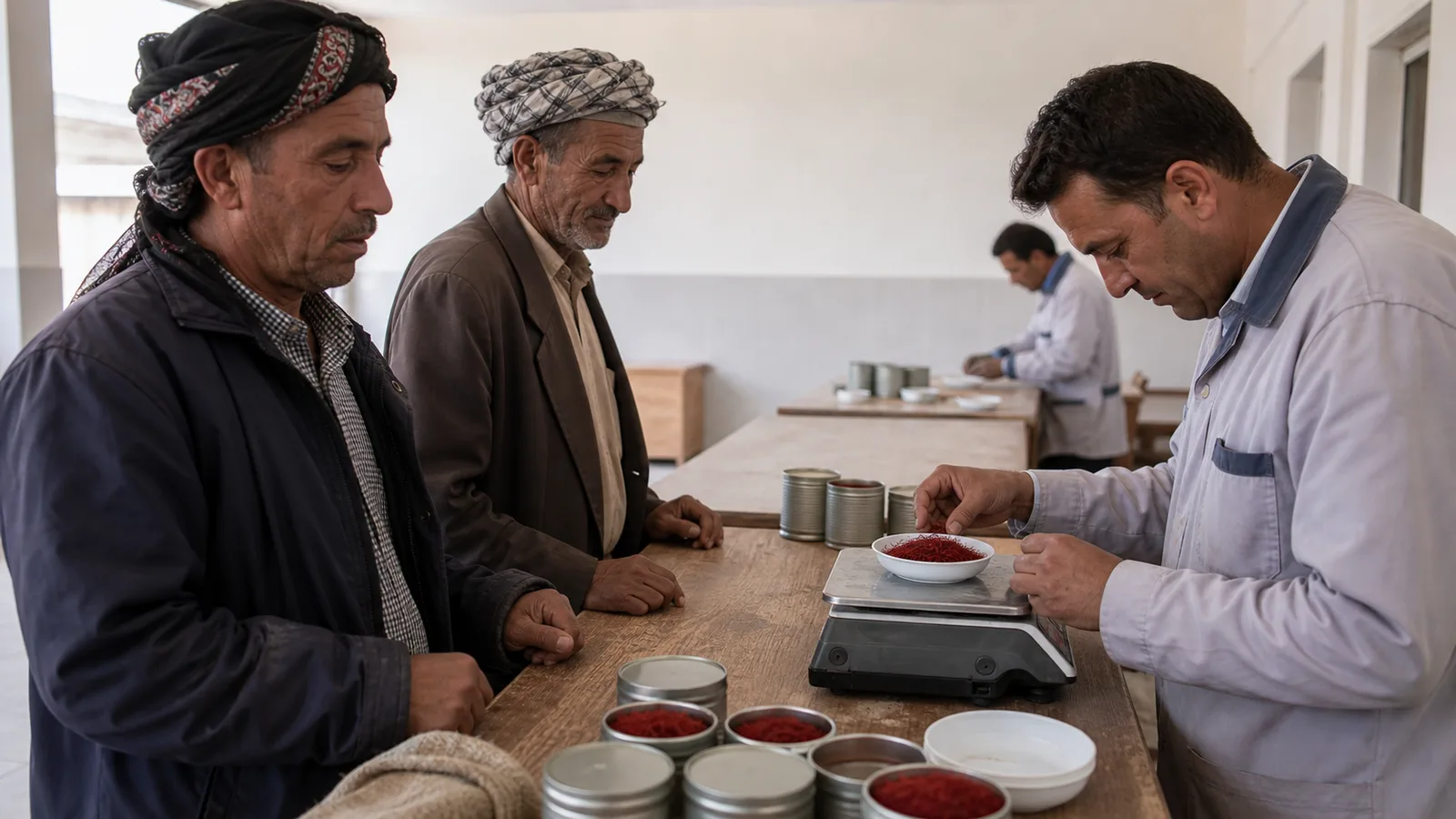
The Khorasan Razavi saffron purchase programme described here operated as an agreement purchase, not a permanent guaranteed-price scheme. Rural cooperative committees assessed saffron against the market conditions of the day, while farmers also had an option to place product with the cooperative and wait for a more balanced market before deciding to sell.
These were historical arrangements and prices from the Iranian years 1395-1396, roughly 2016-2018. They are useful for understanding how the province tried to reduce harvest-season pressure, but they are not current buying offers, current saffron prices or current cooperative rules.
How the farmer purchase programme worked
Majid Chalak of the Khorasan Razavi Rural Cooperative Organization said provincial buying committees were active daily. Saffron was valued according to that day’s market conditions, and purchases were made with the cooperation of the Agricultural Bank.
The archived account also describes an entrusted or consignment-style option. A grower could deliver saffron to the central cooperative system, leave it there while the market stabilised, and later retrieve it for sale. The translation is not precise enough to define storage fees, insurance, title to the goods or every condition of return, so those terms cannot be reconstructed.
Chalak said purchase centres were prepared to receive saffron from the province’s growers without a stated overall limit. That was an announcement for the programme at the time, not a promise that any centre must accept any lot today.
The reported grade prices at launch
A related announcement gave the programme’s opening agreement-purchase prices per kilogram:
- Negin saffron: 6 million tomans;
- first-grade saffron: 4.95 million tomans; and
- ordinary saffron: 4.9 million tomans.
Those are nominal prices from the period reported, without an inflation or exchange-rate conversion. The source does not provide the grading protocol, moisture limits, test method, deductions or rejection rules behind the three labels. It would be unsafe to use the figures to price a present-day lot.
The source page carrying these saffron prices was mistakenly titled “Purchase Guaranteed Wheat in Razavi Khorasan.” Its body is about saffron, not wheat, and repeatedly calls the mechanism an agreement purchase.
No guaranteed price had been announced
Another report from Chalak said no guaranteed saffron purchase price had been announced for Iranian year 1396. Cooperatives were instead buying by agreement at the daily market price in several cities. He said that approach would continue unless the relevant economic authority approved a guaranteed purchase.
This matches the distinction in the Torbat Heydarieh report: a cooperative can participate in a seasonal market without creating a statutory floor price. The article on the Torbat Heydarieh saffron purchase plan explains what the 2017 announcement did and did not guarantee.
Production was reported at 250 to 257 tonnes
The two source reports put Khorasan Razavi’s annual saffron production at about 250 tonnes and 257 tonnes. Chalak said the 257-tonne result was 9% below Iranian year 1394 because frost had reduced output. The difference between the two totals may reflect rounding, reporting dates or coverage, so they are better read as a historical range than forced into one exact number.
One source also claimed the province accounted for 95% of global saffron and exported 80% of its crop. Those statements are not sufficiently clear: the translation mixes provincial production, Iranian market share and export share, and it provides no dataset or year-specific denominator. They should not be repeated as current facts.
Why the cooperative intervened
The stated purpose was to support growers during harvest, when a large volume reaches the market in a short period. The cooperative expected daily-price purchasing and temporary holding to reduce forced selling and help the market find a balance.
Officials pointed to an earlier programme in Iranian year 1386, when the organisation reportedly bought and exported about 25% of production. They credited that intervention with helping market balance. The report gives no independent price series or comparison group, so the effect remains an official assessment rather than a measured causal result.
Export context was part of the concern. Earlier annual shipments were described as 120 to 140 tonnes, with a record near 160 tonnes in Iranian year 1393 before a later fall to 113 tonnes. The original Persian says a 160-tonne export record; the old English translation incorrectly turned this into a “160-tonne decline.”
Khorasan Razavi export figures for year 1395
Masoud Atefi, identified as a provincial customs supervisor, reported 128,479 kilograms of saffron exported through Khorasan Razavi customs offices and border markets in Iranian year 1395. The stated value was $180,728,444. Dividing value by weight gives an average near $1,407 per kilogram across that reported flow, although product grades, package sizes and destinations would have varied.
The report described increases of 145% by weight and 150% by value compared with year 1394. An earlier sentence said customs and border-market exports rose by 1.5 and five times, which does not match those percentages and may refer to two different channels. The surviving translation does not resolve the discrepancy.
Packages above 30 grams were said to dominate the saffron flow. Named target markets included Afghanistan, Turkmenistan, Tajikistan and other Central Asian countries. These are historical customs figures and destinations, not a forecast of where a Khorasan exporter should sell now.
What commodity-exchange trading was expected to improve
The source presented organised commodity-exchange trading as a possible way to improve price transparency, standardise delivered lots, reduce dependence on intermediaries, deter origin and quality fraud, support Iranian branding and make financing and distribution more orderly.
Those are potential benefits, not proof that listing alone fixes the market. They depend on reliable grading, warehouse controls, representative participation, transparent fees and contracts that growers can understand. The source’s separate claim that producing 58% of a product creates a special international-exchange right under World Trade Organization rules is unsupported and has been removed.
Organised trading also cannot replace product identity. Buyers still need traceable lots, defensible grades and consistent packing. Those requirements connect the programme to the wider challenge of building a credible saffron brand and export chain.
How to read the old programme today
A farmer or buyer should not treat any figure on this page as a current quote. Before using a cooperative programme, verify the current official notice, authorised centre, eligible grades, sampling method, price basis, storage terms, fees, payment timing and complaint route.
The archived reports do establish a useful sequence: Khorasan Razavi used agreement purchases at daily prices, announced grade-specific opening prices for one season, offered a holding option, and linked the intervention to a large provincial crop and changing export volumes. Preserving that history is more accurate than calling the programme a timeless guarantee.

![Exporting Saffron to Turkey + Price Guide [Complete 0 to 100]](https://img.rowhanisaffron.com/20260827003933/saffron-export-turkey-quality-inspection.webp)



