


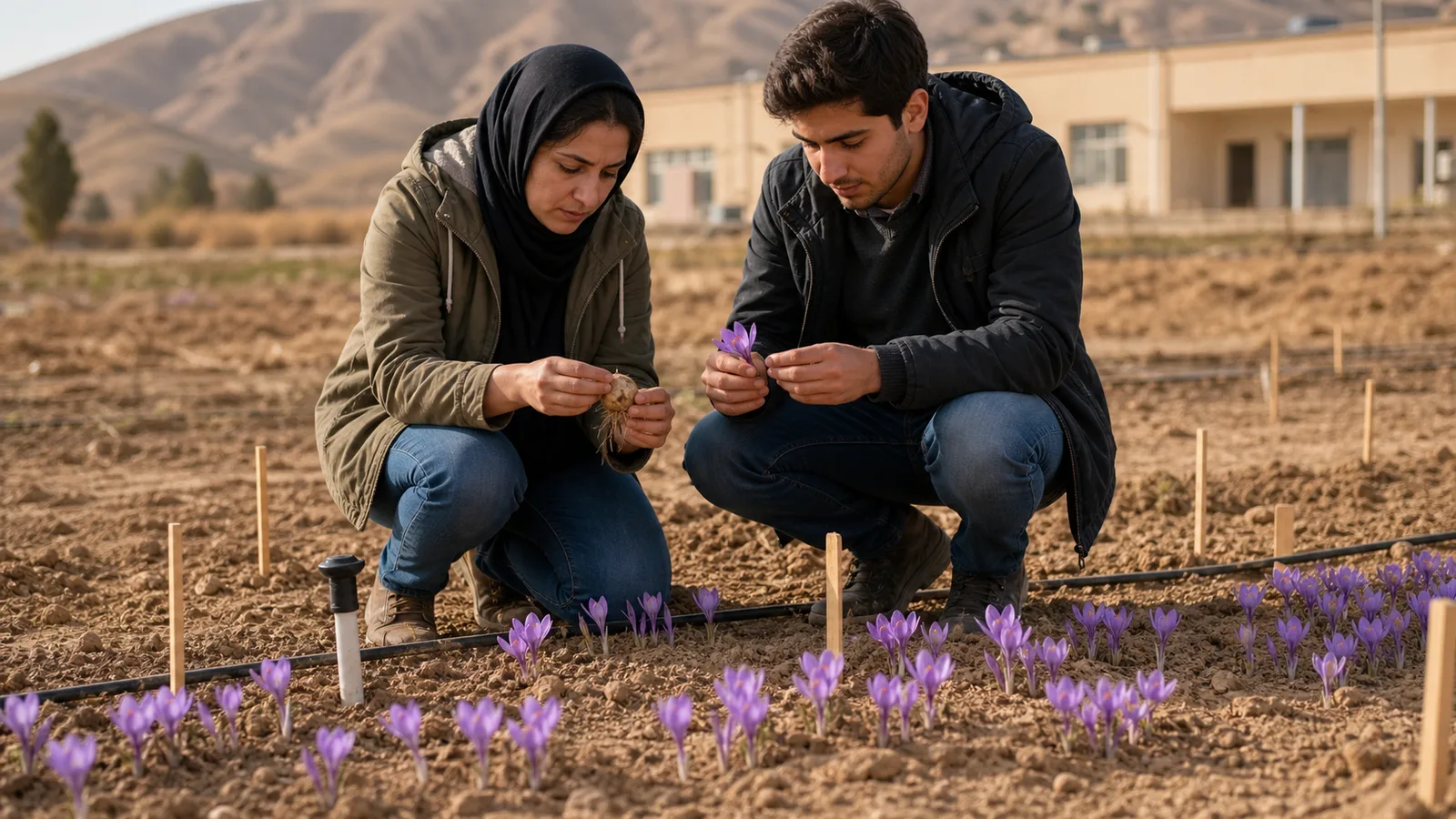
“Increased cultivation of saffron in Babak” referred to a plan at Islamic Azad University’s Shahrbabak branch, not a documented increase across the entire county. In a report about its Iranian year 1396 programme, the university said it would continue developing a research farm for Shahrbabak saffron, quince trees and medicinal plants.
The original post mixed that one agricultural project into a long, poorly translated list of university activities. Separating the research-farm purpose from the institutional report makes it clearer what the announcement established—and what it did not.
The Shahrbabak saffron research-farm plan
Dr Hossein Sabzaliani, then acting head of the Islamic Azad University Shahrbabak branch, told ANA that further development of the university farm was among its plans for 1396. The farm included saffron, quince and medicinal-plant plots.
The report said the unit had already “reformed” or improved those cultivation areas during 1395. It did not publish the saffron plot size, cultivar or corm source, experimental design, irrigation schedule, soil data, yield or research result. “Increased cultivation” was therefore a plan and management statement, not a measured production statistic.
What a university saffron plot should investigate
A research farm can answer local questions that a general planting guide cannot. Shahrbabak has its own soil, elevation, temperature pattern, water constraints and labour conditions. Useful trials would record:
- corm size, health, density, planting depth and source;
- soil texture, salinity, organic matter and drainage;
- irrigation timing and volume for each treatment;
- flower count, fresh flower weight and dried stigma yield;
- drying method, moisture and saffron quality measurements;
- weed, pest and disease pressure;
- labour and input cost over several field years.
Without a control and repeatable records, an attractive field remains a demonstration rather than an experiment. Publishing negative or modest results is also valuable because it prevents growers from expanding a system that works only under exceptional conditions.
How saffron fits the wider farm
The Shahrbabak announcement grouped saffron with quince orchards and medicinal plants. That mix could let students compare perennial crop management, irrigation timing, soil care, plant health and post-harvest value. It does not mean the same treatment suits all three.
The university also reported improving a fish-farming pond. Aquaculture, orchards and saffron use water in different ways, so a serious research programme should account for the whole farm’s supply rather than describing any one activity as automatically water-efficient.
Other research and workshop work reported
Sabzaliani’s review of 1395 included upgrading workshops, particularly an electrical workshop, and equipping practical nursing and midwifery facilities. He also cited faculty research projects, recognition of local high achievers with the governorate and representative’s office, registration of several inventions in the central organisation’s system, registration of laboratories and equipment in the SAHA system, and additions to the library and its books.
These institutional details are not evidence about saffron yield, but they explain the research-farm announcement’s setting. The original news item was a broad annual report by a university branch, not a standalone agronomy study.
Education and industry links
The university listed student-martyr memorial activities, a week-long faculty hospitality programme, participation in Shahrbabak County commemorations and meetings with martyrs’ families. It also reported student internships at Shahid Gharazi in Sirjan and memoranda of understanding with several industrial centres to expand educational cooperation.
The translation rendered the institution and names inconsistently, including “Doctor Hussein Sbzlyany,” “Shahr-e Babak,” “Sharababak” and “Shahid Gharzai.” They refer to Sabzaliani, Shahrbabak and the Sirjan training organisation named in the source.
Student loans in the annual report
Sabzaliani said 3.5 billion rials in student loans had been allocated to 425 students. He also reported one billion rials in long-term loans from the approved government budget to 182 students. These are historical welfare figures for the university’s 1395 activity, not financing for the saffron farm.
The cultural and sports building
The report described an unfinished 2,300-square-metre cultural and sports building. Of that area, 1,800 square metres were assigned to the sports hall and 500 square metres to cultural space and an amphitheatre. Construction had begun early in the previous year and was expected to finish by the end of 1396.
Completion of that building was again listed among the next year’s plans. The original article does not verify whether it met the deadline, so the announcement should not be rewritten as a completed project.
The university’s other plans for 1396
Alongside expanding the farm, the branch planned further investment around inventions registered with the central organisation. It also intended to seek approval for postgraduate master’s programmes that had not been approved the year before, register knowledge-based companies and develop revenue from that work.
Those goals suggest why a university farm can matter. If saffron trials generate documented local knowledge, they can support teaching, farmer guidance or a carefully defined commercial service. If they only increase planted area, they do not yet demonstrate research impact.
How to judge the saffron project
A later review should ask for the field area, years observed, treatment design, full-area dried yield, irrigation used, quality results, costs, publications and how growers used the findings. Those measures are more informative than a photograph of flowers or a promise to expand.
The 1396 announcement established that Islamic Azad University Shahrbabak was maintaining and planning to develop a saffron research plot within a broader farm. It did not establish that saffron cultivation had increased throughout Shahrbabak, nor did it report a production breakthrough. That narrower conclusion preserves the real achievement without turning an institutional plan into an agronomic claim.
Historical source: ANA News Agency, as cited in the original post.

![Exporting Saffron to Turkey + Price Guide [Complete 0 to 100]](https://img.rowhanisaffron.com/20260827003933/saffron-export-turkey-quality-inspection.webp)



