


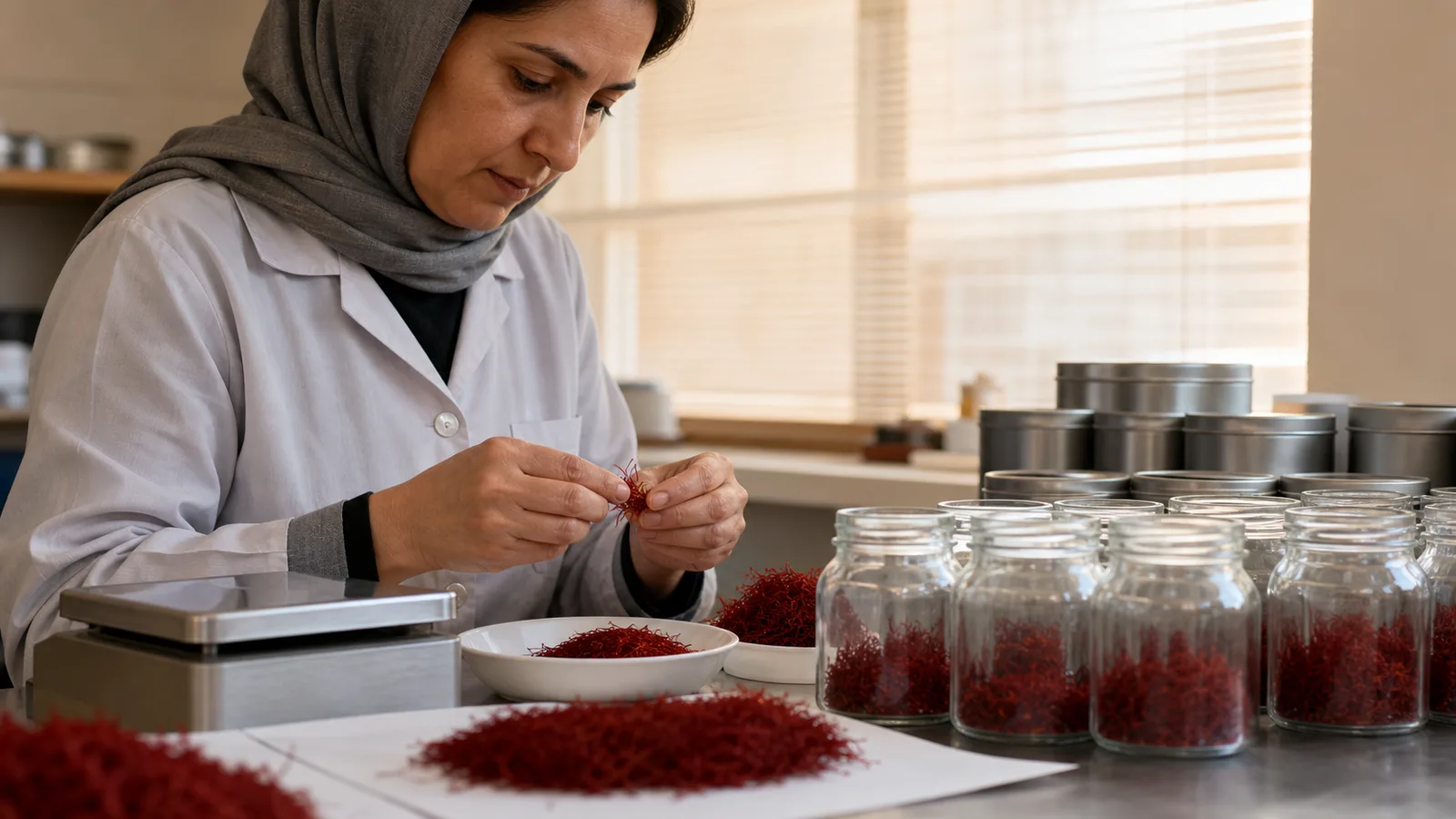
The central problem in the archived Lorestan saffron export report was not the crop itself. It was the gap between growing saffron and presenting a consistent, traceable product that a buyer could identify and trust. The provincial agricultural department pointed to limited processing, packaging and branding capacity as the main obstacle to reaching export markets.
A parallel report from South Khorasan described the same weakness at a much larger production scale: saffron and other regional crops were leaving in bulk, while much of the commercial benefit and product identity moved elsewhere. Read together, the two accounts make a practical point. A name or attractive box cannot fix the export chain on its own; the brand has to rest on verified quality, origin control, careful processing and repeatable delivery.
What the Lorestan saffron export report said
Genghis Ebrahimi, then deputy for crop-production improvement at Lorestan’s agricultural organisation, said the province had the capacity to produce saffron but lacked enough processing and packaging infrastructure. In his account, this was the most important problem facing Lorestan saffron exports.
Ebrahimi described the local crop as competitive in aroma, flavour and quality. That was an official’s promotional assessment, not a published laboratory comparison, so it should not be treated as proof that every lot from Lorestan outperforms saffron from another origin. For an export buyer, quality needs to be demonstrated batch by batch.
The report also said Lorestan’s planted area was still relatively small and that a large share of production was consumed within the province. Farmers had shown growing interest in saffron, encouraged by local agricultural programmes and the crop’s seasonal water pattern. No acreage, output, export volume or tested irrigation saving was supplied, so the account cannot support a numerical claim about Lorestan’s current industry.
South Khorasan faced the same loss of product identity
South Khorasan governor Seyyed Ali Akbar Parvizi gave a sharper description of the branding problem. According to the archived report, saffron, barberry and jujube were leaving the province in bulk because the products lacked sufficiently established regional brands and processing channels. He argued that dealers captured too much of the return and called for greater support for growers, processors and packaging investment.
The translation also suggests that saffron from other provinces could be sold under South Khorasan’s name. Whether the problem was loss of the province’s own identity, misuse of its reputation, or both, the underlying issue is traceability: buyers need a defensible connection between the name on a package and the lot inside it.
Parvizi announced that the Barakat Foundation would invest in branding the province’s saffron. The surviving page is inconsistent about the amount. Its opening English line says 300 million tomans, while the embedded Persian text and a later translated line say 300 billion tomans. Without a reliable original announcement or funding record, neither amount should be presented as settled fact.
The source also discussed knowledge-based companies, an irradiation facility in Birjand and electricity at a border terminal. Those may have belonged to the same official meeting, but they do not explain saffron branding well enough to earn space in this article.
Branding is more than a logo
For saffron, a credible brand is the visible end of a production system. It tells a buyer who is responsible for the product, where it came from, what form and grade it is sold in, how the lot was handled and how a complaint can be traced. If those answers change from one shipment to the next, graphic design cannot create lasting trust.
The work normally begins before a retail label is designed:
- Define the product: keep clear specifications for filament, cut filament or powder, along with accepted tolerances and storage requirements.
- Control each lot: record origin, harvest or intake date, processor, test results, packaging date and the path to the buyer.
- Protect identity: prevent unverified mixing of origins or grades and avoid claims that cannot be supported.
- Use suitable packaging: choose food-contact materials and a closure that protects the dried saffron from contamination, moisture and avoidable light exposure.
- Label honestly: identify the responsible business, net quantity, lot and required market information without disguising bulk product as a different origin.
- Deliver consistently: keep the same documented standard across repeat orders rather than relying on one impressive sample.
Measured quality must support the regional story
Lorestan and South Khorasan can each tell a genuine story about place, growers and production. The quality claim still needs an objective base. ISO 3632-1:2025 specifies requirements for dried saffron in filament, cut-filament and powder forms, with storage and transport recommendations. It is more useful to a serious buyer than an unsupported claim that a province’s saffron is simply “unique” or “the best.”
Testing does not replace origin; it makes the origin claim more credible. A regional programme can connect verified lots with named growers or processors, consistent drying and storage controls, and packaging that preserves rather than merely advertises the product.
A place name is not automatically protected
Regional branding can involve an ordinary commercial trademark, a collective or certification mark, or in some jurisdictions a protected geographical indication. These are not interchangeable. The World Intellectual Property Organization explains that a geographical indication identifies a product whose quality, reputation or other characteristic is essentially linked to its place of origin, and that authorised users must comply with the applicable standards.
That means putting “Lorestan” or “South Khorasan” on a package is not, by itself, proof of a protected geographical indication. A future regional strategy would need defined product standards, governance, authorised use and protection in the markets where rights are sought. This article does not claim that either province currently has a particular registration.
Processing and packaging close the value gap
Bulk sale is not automatically wrong. It can be efficient when a producer deliberately supplies a processor or industrial buyer under a transparent contract. The loss described in these reports occurs when bulk sale separates the crop from its origin, leaves growers with little bargaining power, or allows another business to capture the reputation without carrying the production responsibility.
Local cleaning, drying, sorting, testing and packaging can retain more of that work near the producing area, but only if the operation is technically capable and commercially viable. Installing equipment without demand, quality controls or trained operators would not solve the problem. The aim is a functioning route from grower to buyer, not packaging for its own sake.
What an export-ready saffron brand should prove
A buyer considering Lorestan saffron should be able to verify the following without relying on promotional language:
- the seller and processor responsible for the lot;
- the stated geographic origin and the records that support it;
- the saffron form, specification and relevant test documentation;
- the lot code, packing date and trace-back route;
- the packaging format and storage instructions;
- the consistency available across the requested volume; and
- the labelling and documentation required by the destination market.
This is also why an export article should not publish a timeless checklist of legal requirements. Import, labelling and customs rules depend on the destination and can change. A business preparing a shipment must verify the current official requirements for the buyer’s market and product format. Our guide to exporting saffron to Turkey illustrates how destination-specific commercial questions differ from the regional branding issue.
The lesson from Lorestan and South Khorasan
Lorestan’s smaller sector and South Khorasan’s established production base were not identical, yet both reports arrived at the same structural weakness. Saffron can be grown successfully while the producer’s name, origin and share of the value disappear further along the chain.
The safe response is not to declare a new “premium” brand before the evidence exists. It is to build the evidence: documented origin, repeatable processing, relevant testing, honest labels, protective packaging and dependable sales relationships. Once those pieces work together, branding becomes a useful promise rather than a decorative one.

![Exporting Saffron to Turkey + Price Guide [Complete 0 to 100]](https://img.rowhanisaffron.com/20260827003933/saffron-export-turkey-quality-inspection.webp)



