


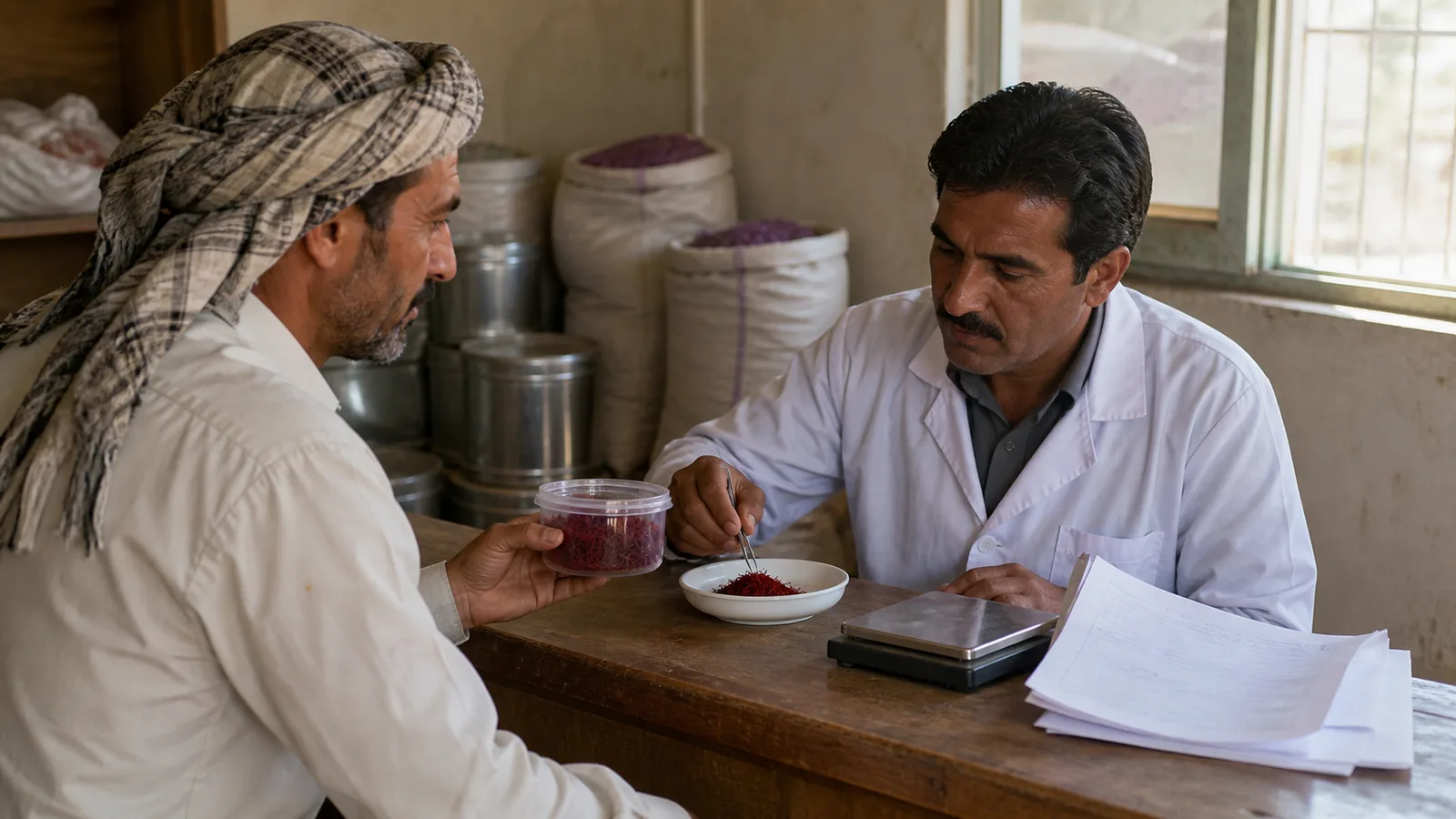
“Buy guaranteed saffron from Torbat Heydarieh” was the headline attached to a 2017 support-purchase announcement. The programme did not, however, guarantee farmers a fixed price. Saeed Bastani, then the area’s representative in Iran’s parliament, said the Rural Cooperative Organization had agreed to enter the market and that financing would be provided, but no guaranteed purchase price had been set.
That distinction is the key to reading the old report accurately. It described an agreement purchase intended to support farmers during harvest, not a permanent guarantee and not an offer available today. A second report from the head of the national rural cooperatives explained that, at the time, a true guaranteed-purchase programme for saffron would require parliamentary approval.
What the Torbat Heydarieh purchase plan actually offered
Bastani said an agreement with the agriculture ministry would allow the Rural Cooperative Organization to buy saffron from farmers in a major production area. Saman Bank was expected to provide funds to the organisation so purchases could be made at what the report called an “appropriate” price.
He was also explicit about the limit: the purchase amount was not guaranteed, and the cooperative agreement had not fixed a price. That means the scheme should not be described as a government promise to buy every eligible lot at a predetermined floor.
The announcement followed a letter from 14 members of parliament representing Khorasan Razavi, South Khorasan and North Khorasan. They asked the agriculture minister and the vice president responsible for planning and budget matters to involve the rural cooperative system. Their concern was that traders entering at harvest could push prices below a level farmers considered economic.
Agreement purchase and guaranteed purchase are not the same
An agreement purchase can bring a public or cooperative buyer into the market under terms set for a particular season. The buyer, funding, quality requirements, quantity and price method should be stated in that programme. The existence of an agreement does not automatically create a statutory minimum price.
A guaranteed purchase is a stronger commitment. It normally identifies the eligible product, responsible buyer, approved price or price-setting mechanism, delivery conditions and legal authority behind the obligation. Using the word “guaranteed” without those elements can give farmers and readers the wrong expectation.
Why the old programme had no guaranteed price
Speaking during a visit to Gonabad, Seyyed Hossein Safai, then head of the country’s Rural Cooperative Organization, said the organisation could conduct guaranteed purchases only for products approved by the Islamic Consultative Assembly. He used wheat as an example of a crop covered by a parliamentary resolution and said saffron would likewise need legislative approval.
This was his explanation of the legal position in 2017. It should not be converted into current legal advice without checking later legislation and official programme notices. It does explain why the Torbat Heydarieh announcement used a seasonal purchase agreement without naming a guaranteed floor price.
Safai’s source also discussed stored citrus being released for the Eid market. That was a separate market-regulation story and adds nothing to the saffron question, so it is not included here.
Why Torbat Heydarieh mattered to the intervention
The purchase plan focused on Torbat Heydarieh because the area was a major saffron centre. The archived report recorded 8,000 hectares under saffron and a 33-tonne harvest for that season. Dividing those figures gives about 4.1 kilograms per hectare, a plausible relationship between the stated area and output, although the source does not say how much of the area was bearing.
It also said the county accounted for 12% of Khorasan Razavi’s saffron area, supplied saffron to 45 countries and involved 15,000 farming households. A separate statement attributed 70,000 direct jobs to the crop. That employment figure is not defined; it may include seasonal work and household participation, so it should not be treated as a count of full-time jobs.
The wider Torbat Heydarieh production region was described as including Torbat Heydarieh, Zaveh, Mahvelat and Rashtkhar. Claims that it was the largest saffron-producing region in Iran and the world were officials’ descriptions from that period, not a current ranking verified in this article.
Was saffron being imported into Iran?
A related rumour claimed that imported saffron was entering Iran and affecting the domestic market. Bastani rejected that account. He said a tariff code existed for saffron imports in packages below 10 grams, but that no import licence had been issued for any application at the time.
He argued that exporting Iran’s crop and buying it back at a higher price would make little economic sense. He also alleged that some market participants circulated import rumours to create downward price pressure and said he and other representatives would pursue the issue.
The statement establishes what the MP and the licensing information available to him said; it does not prove that no unofficial or undeclared movement ever occurred. It is also a 2018-era account, not evidence about today’s import rules or licences. The article on saffron corm movement and historic tariff claims explains why planting material, dried saffron and customs treatment must be kept separate.
How rumours can affect a harvest market
Saffron is harvested during a short, labour-intensive period. When many growers need to sell while fresh flowers are being processed, information about buyers, prices, imports or government support can influence decisions quickly. A rumour may make a farmer hold stock, accept an offer too early or expect a public buyer that is not actually operating.
The safe response is publication of verifiable programme terms. A notice should name the responsible organisation, authorised buying centres, dates, eligible grades, test or inspection method, quantity limits, price basis, payment schedule and complaint route. If those details are absent, the word “guaranteed” is not enough.
What a farmer would need to verify before delivery
The 2017 announcement should not be used as a current invitation to sell. Before taking saffron to any cooperative or support-purchase centre, a farmer should obtain the current official notice and confirm:
- the exact buyer and authorised delivery location;
- opening and closing dates;
- whether the programme is guaranteed, supportive or agreement-based;
- eligible saffron forms and quality requirements;
- how sampling, grading and weight are recorded;
- the price or transparent price-setting method;
- any deductions, fees or packaging conditions;
- the payment timetable and proof of delivery; and
- the process for disputing a grade, weight or rejected lot.
These checks also strengthen regional identity. A purchase programme that records origin, lot and quality can support the traceability needed for credible saffron branding and packaging.
What the archived reports establish
The Torbat Heydarieh plan was a response to harvest-season price pressure. Cooperative purchasing finance had been arranged, but a guaranteed price had not. The rural cooperative leadership separately said parliamentary approval would be needed for a true saffron guarantee, while the area’s MP rejected import rumours and called them an attempt to weaken prices.
Those points can be preserved without turning an old programme into a current offer. The destination URL and original headline remain because people still find the report under that wording; the article now makes clear what was—and was not—guaranteed.

![Exporting Saffron to Turkey + Price Guide [Complete 0 to 100]](https://img.rowhanisaffron.com/20260827003933/saffron-export-turkey-quality-inspection.webp)



