


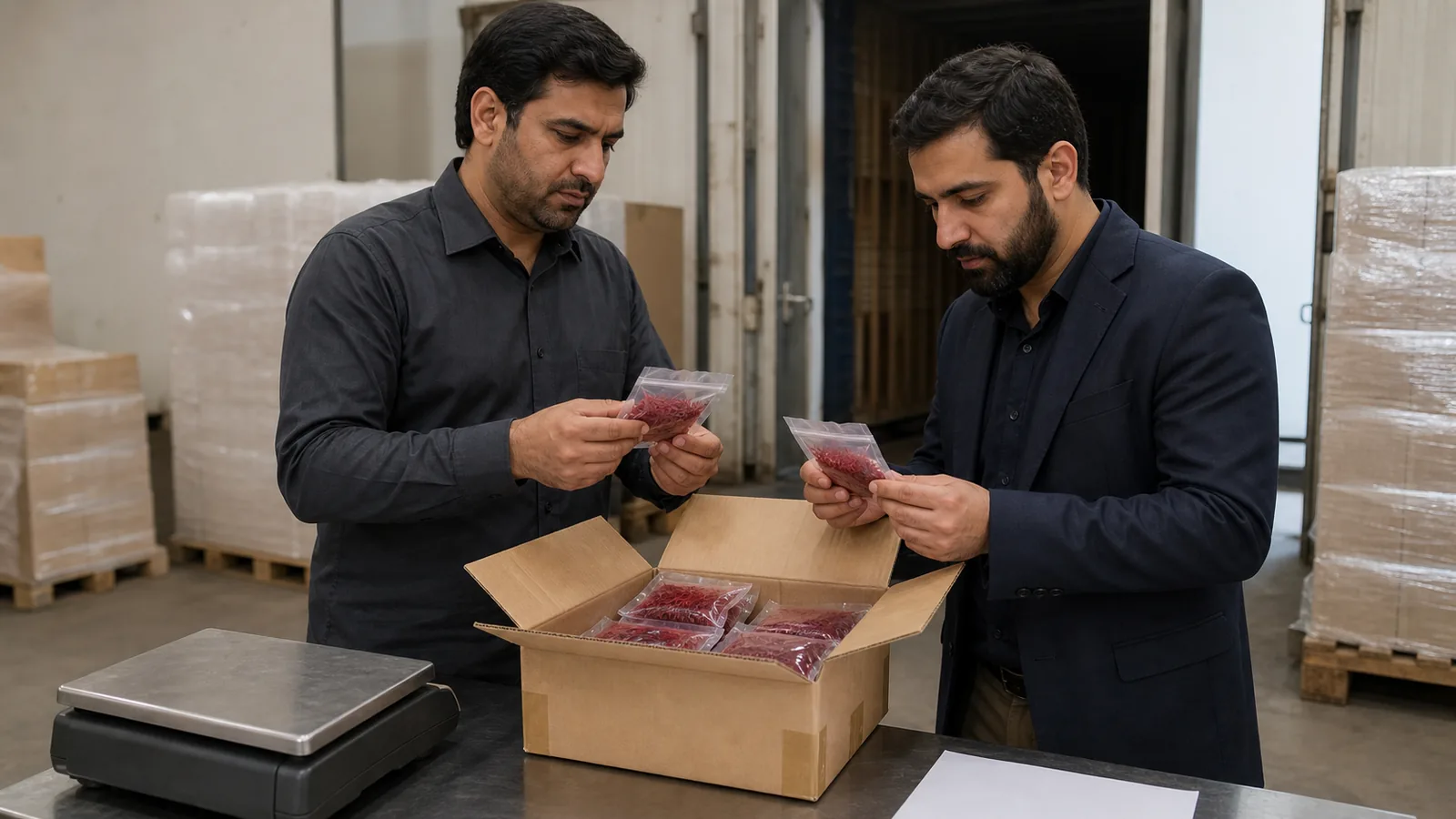
Iran’s first reported direct saffron shipment to the United States after roughly 15 years was a small one: about two kilograms, packed in units below 10 grams and valued at approximately $2,682. It arrived during the sanctions relief that followed the nuclear agreement. Companion reports later said direct shipments reached 41 kilograms, worth more than $68,000, during the final 53 days of the reporting year.
This was a historical trade opening, not a description of today’s import rules. The US authorisation for certain Iranian-origin foodstuffs was wound down in 2018, and sanctions, counterparties, payments and customs requirements must be checked against current official guidance before any transaction.
The first direct shipment
The original account said exporters had not sent Iranian saffron directly to the United States for about 15 years. American buyers still obtained the spice during that period, but often through intermediaries in places such as the United Arab Emirates and Spain. Bulk saffron could be repacked and sold under a third-country brand, obscuring the Iranian origin and separating growers and processors from the final buyer.
The first reported direct consignment changed that route. It consisted of approximately 2kg in retail packages below 10g. The article gave a value of 7,895,000 tomans, equivalent at the time to about $2,682. An opening sentence rounded that value to $2,600; the more specific figure is retained here.
The report connected the shipment to implementation of the Joint Comprehensive Plan of Action, or JCPOA. Mohammad Javad Rezaie, then head of the Saffron Export Development Fund, had previously announced that a first direct cargo was expected following the agreement.
After the first shipment: what the 41kg report says
Two follow-up posts carried headlines stating that the United States had received 41kg of Iranian saffron. They described packages in three bands—below 10g, 10–30g and above 30g—with a combined value above $68,000.
The machine-translated body is internally inconsistent. It says “one kilogram” in one place, while its headline and companion version say 41kg. It also says the exports occurred during the final 53 days of the year. The number 53 describes days; it is not a 53kg shipment.
At 41kg, the stated value works out to roughly $1,659 per kilogram. At 1kg it would be more than $68,000 per kilogram, which is implausible in the surrounding national export context. The evidence therefore favours 41kg, but the figure should still be understood as a news report rather than a customs record independently reproduced here.
Iran’s national export context in that period
The follow-up report placed the American sale inside a much larger annual trade. It said Iran exported 113 tonnes and 579kg of saffron, worth more than $165.3 million, to 42 countries. Compared with Iranian calendar year 1393, export weight was reportedly down 28.5% and value down 27.4%.
The first-shipment article used a broader annual range of 250–300 tonnes produced and 130–150 tonnes exported. These figures were estimates from the period and should not be combined as if they share one reporting cut-off. Current production context belongs in our article on saffron cultivation in Iran, where every output figure is kept with its date.
During the first nine months cited in the destination report, 27 markets were named as buyers of Iranian saffron: Germany, Jordan, Spain, Australia, Estonia, Afghanistan, the United Arab Emirates, Italy, France, the United States, Bahrain, Belgium, Taiwan, Turkey, Turkmenistan, the Czech Republic, Singapore, Kuwait, the Netherlands, Canada, Norway, Pakistan, China, the United Kingdom, Sweden, Saudi Arabia and Oman.
That list is a historical market snapshot, not a current ranking. A country appearing as a destination can be a consumer, processor, packaging hub or re-exporter. Shipment weight, declared origin and final market are separate questions.
Why direct trade mattered
A direct sale can keep the producer’s identity with the product and shorten the commercial chain. It can also make specifications, laboratory documents and buyer feedback easier to connect to the shipped lot. Those benefits are not automatic: the exporter still needs consistent quality, traceability, compliant packaging, reliable payment and a buyer that can lawfully receive the goods.
The old article assumed better packaging would necessarily create more foreign-exchange income. Packaging can add value, but only when it fits the target customer, protects the spice and carries verifiable origin and quality information. A costly box does not compensate for weak testing or an uncertain payment route.
The corm-smuggling warning and Afghan competition
A 2014 interview with Gholamreza Miri, then chairman of the Saffron Exporters Association, raised a different export risk: unrecorded movement of saffron corms from Iran into Afghanistan after the mid-June lifting season. The old translation called corms “onions.”
Miri argued that planting material and cultivation knowledge could help a neighbouring producer compete for the same markets. He referred to international efforts to develop Afghan saffron as a legal alternative to opium poppy. That policy context is real: a UNODC evaluation noted saffron’s potential as an alternative livelihood while also warning that it requires careful processing, quality control and reliable marketing.
The interview described returning Afghan workers as familiar with Iranian growing methods. That observation should not be turned into blame for a workforce or a claim that Afghan production is illegitimate. Agricultural knowledge crosses borders. The trade question is whether planting material moves lawfully, with plant-health controls and traceable origin.
Miri estimated the US saffron market at 40 tonnes and warned that Iran could lose it to competitors. The source supplied no demand study behind that number, so it remains an association estimate—not measured US consumption.
What the Spain comparison can and cannot show
Miri used Spain as a cautionary example. He said Spain had produced 120 tonnes about three decades earlier, when Iran produced 30 tonnes, but had fallen to roughly 700kg as Iran approached 300 tonnes. The interview did not cite the datasets or years behind those figures, and they should not be used as a verified production series.
The strategic point survives without treating the numbers as exact. Leadership can shift when corm health, labour, production knowledge, quality consistency, branding and routes to market change. Iran’s scale is a major advantage, but scale alone does not guarantee access to a particular buyer.
The proposed response: licensing and border controls
The association called for licences covering saffron-corm planting and lifting, together with stronger border controls. This was a proposal reported in 2014, not proof of a current Iranian licensing rule. A present-day grower or exporter would need to verify plant-material and customs requirements with the responsible authorities.
A good control system should do more than restrict movement. It should document corm source and health, field destination, quantity, inspection and custody. That protects farms against disease and preserves origin evidence without confusing legitimate competition with smuggling.
Why this story is historical, not current trade advice
The direct shipment belonged to the 2016 sanctions-relief period. In June 2018, the US Treasury amended the Iranian Transactions and Sanctions Regulations to wind down the authorisation for imports of certain Iranian-origin foodstuffs and carpets by August 6, 2018. The official Federal Register notice records that change.
As of this article’s review in August 2026, the US Treasury still maintains an active Iran sanctions programme. Rules can depend on the product, parties, banks, ownership, shipping route and licences. Neither the 2016 shipment nor this article authorises a current import. Businesses should obtain current customs and sanctions advice before contracting, paying or shipping.
The historical sequence is nevertheless clear: a direct 2kg shipment reopened a route after about 15 years; follow-up reporting put the volume at 41kg in the final 53 days of the year; and the wider export sector was simultaneously reporting falling annual weight and value. It was a promising opening, but lasting market access required more than the first cargo.

![Exporting Saffron to Turkey + Price Guide [Complete 0 to 100]](https://img.rowhanisaffron.com/20260827003933/saffron-export-turkey-quality-inspection.webp)



