


This profile was reported in 2017. Ages, wages, cultivated area and family details describe Effat Jalali’s saffron farm at that time.
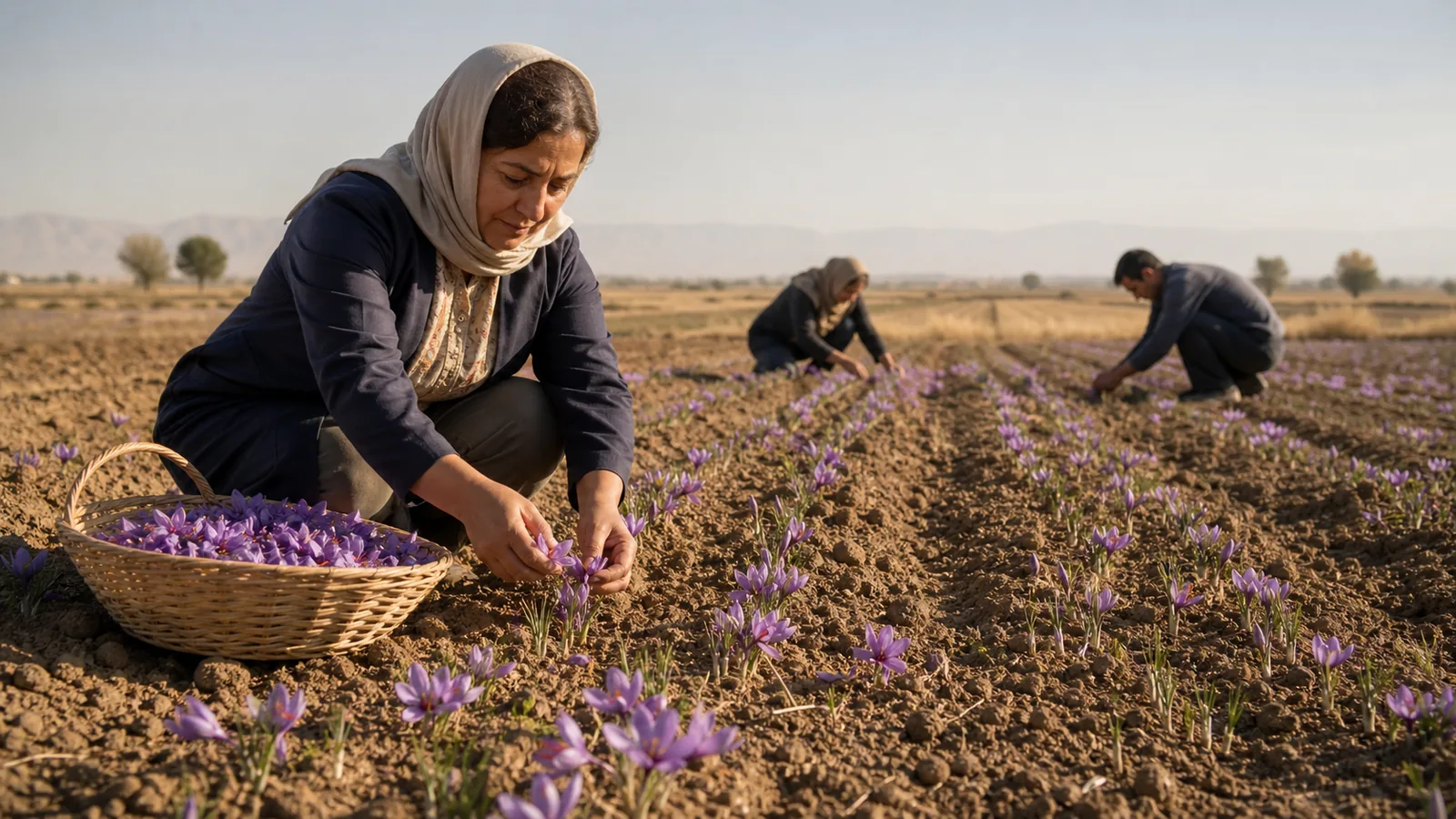
Effat Jalali lifted a handful of lilac crocuses, breathed in their scent and said, “These are my whole life.” Then she smiled and walked back into the field. At 55, the Iranian farmer visited the land every day, and planting and harvesting saffron had become the work around which her family life was organised.
The Jalali farm in Khomein began with an experiment her father made roughly 30 years before the interview. His children later divided the work across the family’s five hectares, and Effat developed the largest saffron area among them. What started with about 20 kilograms of saffron corms became a livelihood shared across generations.
How saffron reached the Jalali family farm
Effat’s father had grown familiar crops: cucumbers, tomatoes, onions, potatoes, squash and wheat. During a journey to Mashhad, he visited Khorasan farmers and asked how they planted and harvested saffron. When he came home, he brought nearly 20 kilograms of planting material.
The original translation repeatedly called these “seeds.” Saffron is normally propagated with corms, and that is the practical meaning here. His plan to grow a crop associated with Khorasan on land in Khomein surprised the family and neighbouring farmers in Rashidabad.
No one knew whether the field and local climate would suit it. Some people urged him to abandon the idea. He planted the full trial anyway, followed the Khorasan growers’ instructions closely and waited.
“Nature gave us a very good answer,” Effat recalled. The first crop encouraged the family to continue, and her father taught his children what he had learned about planting, field care and harvest.
From a family experiment to an income
The Jalalis packed their first saffron and gave it to friends and relatives. Only later did they ask whether the field could become a real business. The corm stock multiplied, allowing them to replant and expand. Effat said the original planting material had increased about fivefold.
She had six sisters and one brother, and the report said five of her siblings worked with saffron on the family land. Some had previously followed other paths, including homemaking and teaching, before returning to work on the farm. Their father’s experiment had become a source of income for several households.
Harvest brings more women into the field
Effat managed about two hectares herself. At first she found it difficult to recruit women for field work in a small town. She and her sisters had worked beside their father for years, so neighbours were accustomed to seeing them farm, but other families were less certain about the opportunity.
Over time, attitudes changed. By the date of the profile, women were keen to join the short harvest. Effat hired daily workers and paid according to the amount of flowers picked. She also arranged transport and sometimes provided lunch.
Her figures show the scale of the labour:
- she said she could need about 60 workers per hectare during harvest;
- one worker had picked 20 kilograms of flowers in a day; and
- that worker received 120,000 tomans, a historical wage from the time of the report.
The family planted on a multi-year cycle, which Effat described as about seven years, but gathered flowers every year. Their harvest fell in the Iranian months of Aban and Azar, roughly across parts of October, November and December. Once flowering began, there was little time to spare.
A long day does not end with picking
Effat reached the field before sunrise. On a manageable day, the group could finish picking by noon; a heavier flush could keep them working until evening. The flowers then had to be separated, and the stigmas dried and packed.
Selling could be harder than the field work. The profile described her dealing with intermediaries after drying and packaging. To make the farm known beyond Khomein, she took its saffron to exhibitions in Arak and Isfahan and to events focused on women entrepreneurs and the “resistance economy.”
She also shared her experience through local agricultural meetings. Her identity in the story was not simply “a woman helping on a family farm.” She managed land, hired and supported workers, introduced the product to buyers and advised other women as an agricultural entrepreneur.
Care for the field throughout the year
The work continued outside harvest. Effat watched for frost, controlled weeds and kept grazing animals away from the crop. She spoke about rodents as the main pest concern on her land and described using timely control measures. That is her historical account, not a recommendation to apply pesticide without current local advice; safe pest control requires identification, an approved product and label-compliant use.
She also paid close attention to irrigation and fertilisation. Her larger cultivated area, she believed, reflected the time she gave to those routine tasks. Saffron may flower for a brief period, but a productive field depends on care long before the first purple bloom appears.
The rainy harvest Effat remembered
One memory made her laugh. She and the workers once picked in heavy rain until the field became deep mud. Their boots stuck so firmly that they would take a step while a shoe stayed behind.
Effat did not stand at the edge while other people worked. She tried to keep pace with the pickers because being in the field and gathering saffron flowers made her happy. That detail gives the profile its warmth: the farm was a business, but it was also where the family spent time together.
What this Iran saffron farm meant to the family
The land remained connected to Effat’s ageing father. His children helped care for his section, and she watched both her own crop and his. She said he was happy to see three decades of effort continue through them.
Even if life ever required her to move to a city, Effat could not imagine selling the farm or her home in Khomein. Those were the two things she wanted to preserve in her birthplace. Her story is ultimately less about a crop moving from Khorasan to a new field than about knowledge moving from a father to his children—and the children choosing to keep it alive.
Historical source: Hamshahri Online profile cited by the archived post.

![Exporting Saffron to Turkey + Price Guide [Complete 0 to 100]](https://img.rowhanisaffron.com/20260827003933/saffron-export-turkey-quality-inspection.webp)



