


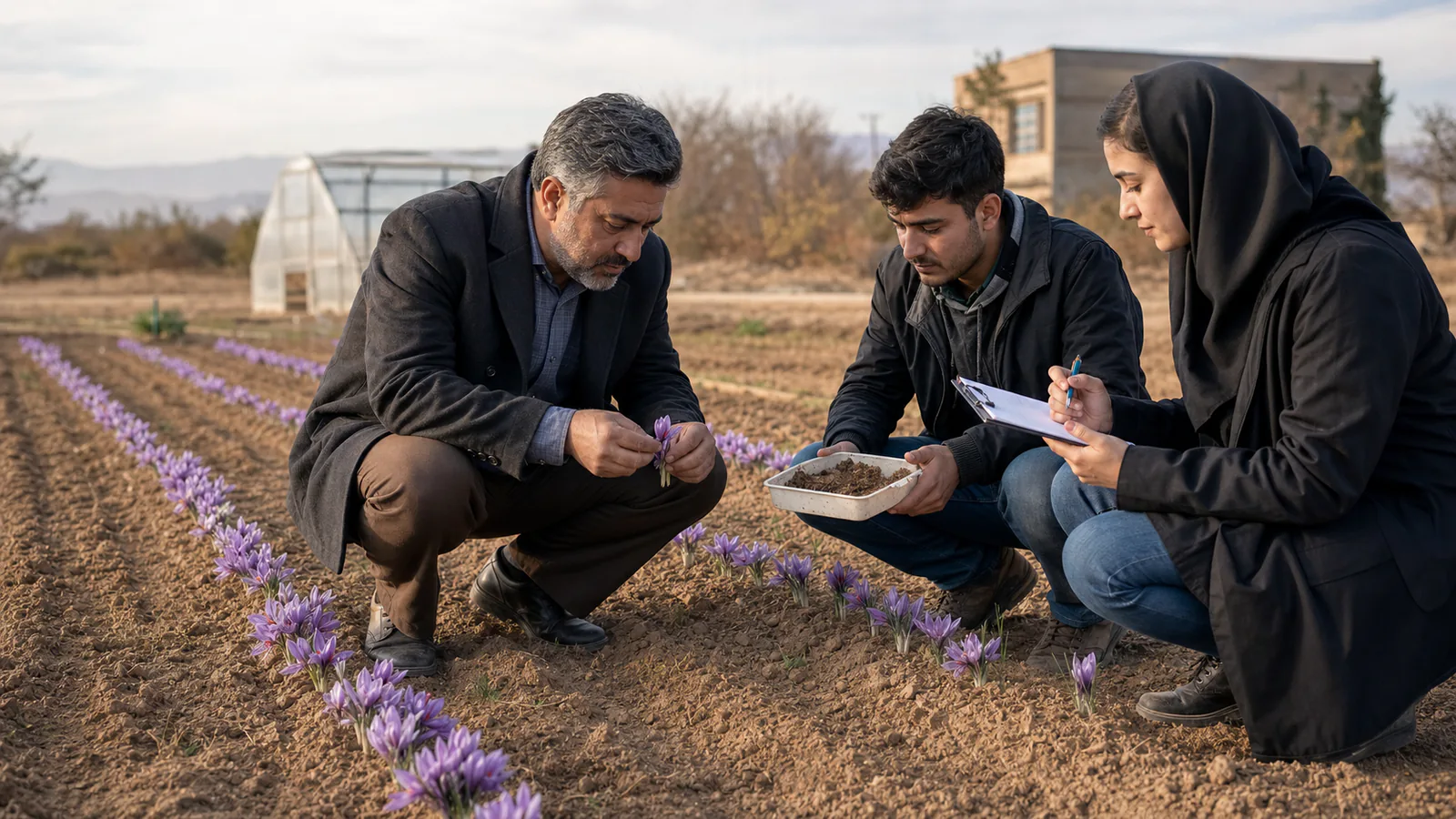
Islamic Azad University branches in Dehaghan and Sabzevar explored saffron farming as a practical link between research, regional agriculture and non-tuition income. One branch reported harvesting its first crop from a one-hectare research farm; the other had land and a proposal but had not yet reported a saffron harvest. Keeping that distinction makes the two projects more useful as case studies instead of turning an old plan into a claim of completion.
Correcting the original “tobacco saffron” headline
The old English pages called these projects “Tobacco Saffron” and “Tobacco cultivation.” That was a translation error. The Persian source text referred to experimental saffron cultivation; neither report described tobacco. The subject is how university land could be used to test saffron production and support education, research and local enterprise.
The Dehaghan research farm
In the 2017 report, Dr. Ahmad Reza Yalmeh, then head of Islamic Azad University’s Dehaghan branch, said the university had converted one hectare of previously unused land into a saffron research farm. The project had begun the previous year, produced its first harvest and sent the crop to market after packaging.
The branch presented the farm as both a scientific project and a way to diversify income. That combination is sensible for a university plot: the field can generate observations about local performance while giving students and staff experience beyond a classroom. A commercial result, however, should be judged after recording the full costs of corms, soil preparation, irrigation, labor, flower picking, stigma separation, drying, packaging and marketing—not only the value of the harvested saffron.
Why Dehaghan was considered suitable
Yalmeh said local studies found saffron compatible with Dehaghan’s mild winters and hot, dry summers. He noted that the crop develops through autumn, winter and early spring and described its water requirement as an advantage in an area concerned about scarcity.
Saffron can suit dry regions, but “low water need” should not be read as “no water needed.” Site drainage, soil condition, healthy planting material and well-timed irrigation still determine whether a field establishes and flowers reliably. A university demonstration farm is valuable precisely because it can test those factors under local conditions rather than assume that a regional climate label guarantees success.
FAO’s description of the qanat-based saffron farming system in Gonabad likewise connects saffron with arid and semi-arid landscapes and reliable, limited irrigation. It treats water management, livelihoods and inherited knowledge as parts of one agricultural system. See FAO’s saffron farming-system profile.
The Sabzevar proposal
A companion report described a different stage of work at Islamic Azad University’s Sabzevar branch in Razavi Khorasan. Dr. Mohammadreza Saeedi Asl, then head of the branch, welcomed a proposal for university units in the province to enter saffron and jujube cultivation. He said Sabzevar had a greenhouse and about 200 hectares of agricultural land, then used for watermelon and melon, and could allocate part of it to the proposed crops.
This was a plan, not a completed conversion of all 200 hectares. The article did not state how many hectares would be planted, when work would begin or what later results were achieved. It is therefore accurate to say that the branch had capacity and interest, not that it had already established a 200-hectare saffron farm.
Why pair saffron with jujube?
The proposal linked both crops with the province’s dry conditions and the university’s search for non-tuition revenue. They would not be managed as interchangeable plants: an orchard and a saffron field have different establishment periods, labor calendars, markets and risks. A sound feasibility study would assess each separately and then ask whether their seasons and facilities complement one another.
Saeedi Asl also said the branch needed specialist advice for jujube cultivation. That admission strengthens rather than weakens the proposal. Agricultural diversification is safer when land decisions follow soil, water and market evidence instead of a crop’s reputation or high retail price.
What a university saffron project can contribute
A well-documented pilot can serve several purposes:
- Local agronomy: compare planting material, spacing, irrigation timing and field performance under the branch’s actual conditions.
- Post-harvest practice: test how separation, drying and storage affect aroma, color and cleanliness.
- Student training: connect agriculture, food science, quality control and enterprise management.
- Farmer extension: share measured results, including failures and costs, with nearby growers.
- Product development: explore packaging and uses that match verified demand rather than simply producing an undifferentiated crop.
- Water accounting: record the whole irrigation schedule so “low-water” claims can be compared fairly with existing land use.
The Sabzevar report also highlighted the branch’s food-technology teaching and laboratory capacity. That could support drying, food-safety and quality work if connected to a field trial. The source’s separate discussion of a university-complex name change and information-technology degrees does not explain saffron cultivation and has not been carried into this article.
From trial plot to responsible enterprise
A research plot should establish evidence before expansion. At minimum, the project should publish the area planted, source and health of corms, water use, flowering and dry-saffron yield, labor hours, rejected material, quality results, selling route and net return. Results from a first harvest should also be interpreted cautiously because saffron fields change as the planting matures.
If the economics are promising, expansion still needs a market plan. Universities should not encourage more planting without considering local processing capacity, buyer demand and the effect on nearby producers. The goal is not only a larger field; it is a defensible model that students and farmers can learn from.
Two branches, two stages of the same idea
Dehaghan supplied the practical example: one hectare planted, a first harvest and product sent to market. Sabzevar supplied the proposed next step: use an existing greenhouse, farmland and food-science capacity to assess saffron and jujube as regional enterprises. Together, the reports show how a university can move from interest to a pilot, then from a pilot to measured research and only afterward to responsible commercial scale.

![Exporting Saffron to Turkey + Price Guide [Complete 0 to 100]](https://img.rowhanisaffron.com/20260827003933/saffron-export-turkey-quality-inspection.webp)



