


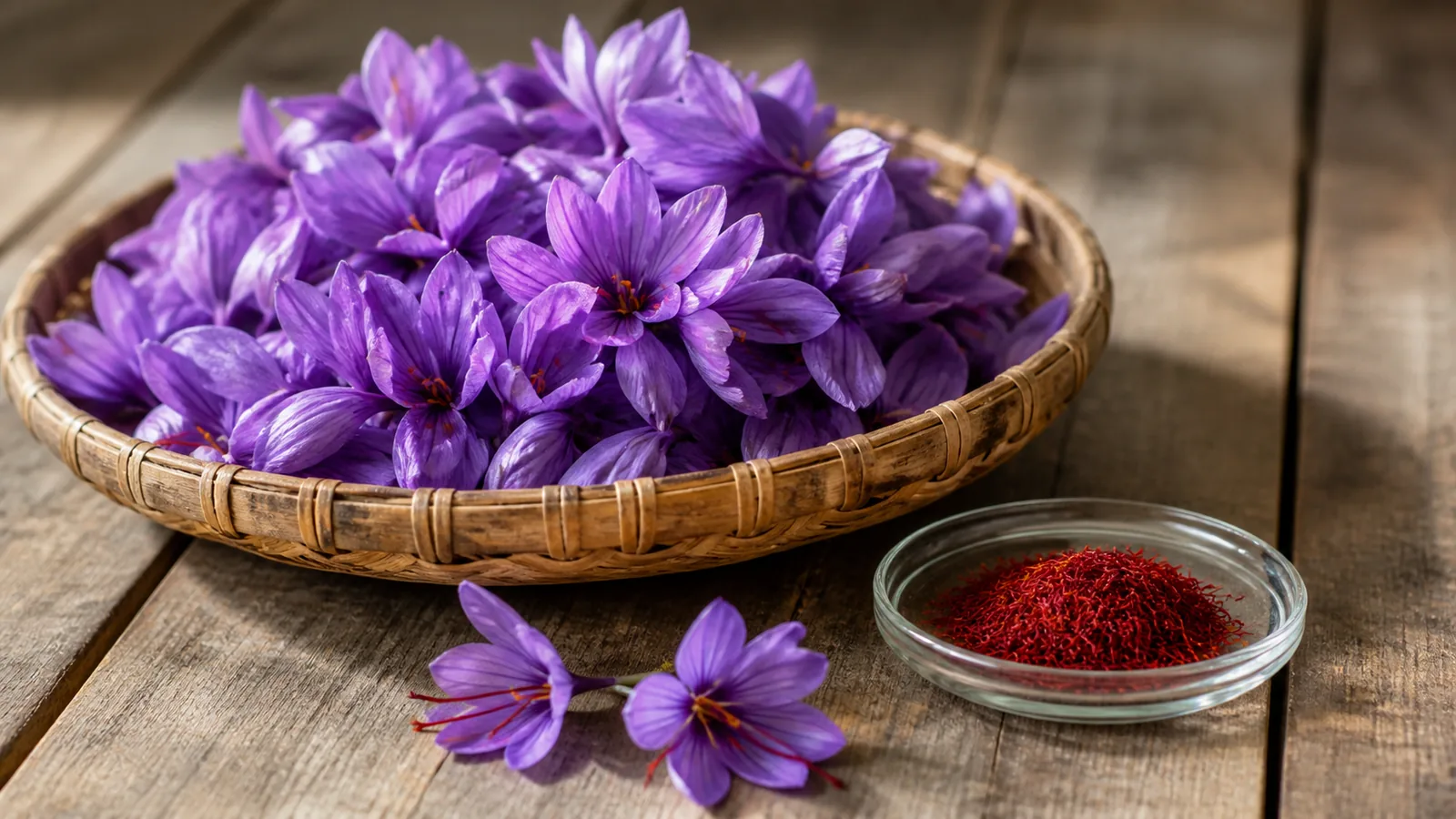
One kilogram of freshly picked saffron flowers normally yields only about 10–15 grams of dried saffron threads. A widely cited production benchmark is roughly 80 kg of whole flowers for 1 kg of dried saffron, which works out to about 12.5 grams from 1 kg of flowers. The precise result varies because flower size, stigma size, the amount of yellow style retained, and drying all affect the final weight.
That small return explains why saffron is often called “red gold.” The spice is not the whole flower. It is made from the three red stigmas at the centre of each Crocus sativus bloom, separated by hand and dried soon after harvest.
How much saffron comes from 1 kg of saffron flowers?
For a sensible working estimate, allow about 12 grams of dry saffron from 1 kg of fresh whole flowers. A batch may finish below or above that figure, so it should be treated as a planning estimate rather than a guaranteed conversion.
The calculation is straightforward:
- If about 80 kg of fresh flowers produces 1 kg of dry saffron, 1 kg of flowers produces about 12.5 g.
- If the flowers are unusually small, the red stigmas are short, or the saffron is dried aggressively, the final weight may be lower.
- If the flowers carry larger stigmas and processing retains more style, the apparent yield can be higher, although the grade and composition of the product may differ.
A peer-reviewed paper on automated stigma separation reports a production range of 110,000–165,000 flowers, weighing about 80 kg in total, for 1 kg of dry saffron. A separate review of saffron floral residues reports an even broader range of 110–300 flowers for one gram of spice. Together, these figures show why a single universal number would be misleading. See the stigma-separation study and the open-access review for the underlying estimates.
How many saffron flowers make 1 gram?
A practical estimate is roughly 150–200 saffron flowers for 1 gram of dried threads. Research ranges are wider, from about 110 to 300 flowers per gram. Each flower supplies only three stigmas, and their dry weight is tiny.
Flower count is therefore more useful as a range than as an exact promise. Growers should weigh the finished, properly dried threads from their own harvest rather than multiplying the flower count by a fixed conversion.
How many saffron flowers are needed to make 1 kg?
To answer the common question “how many saffron flowers to make a kilo?”, plan on approximately 110,000–200,000 flowers for 1 kg of dry saffron. Around 150,000 flowers is a convenient midpoint and matches the traditional estimate of about 150 flowers per gram.
This count refers to one kilogram of the dried commercial spice, not one kilogram of fresh flowers. Confusing those two weights creates an enormous error: 1 kg of picked blooms gives only a few spoonfuls of dry saffron, while 1 kg of dry saffron represents tens of kilograms of harvested flowers.
Why the yield changes from one harvest to another
Flower and stigma size
Larger, mature corms tend to produce more and sometimes larger flowers than small corms. Genetics, soil, water, temperature, plant age, and the season also influence stigma size. Two harvests with the same number of flowers can therefore finish at different weights.
How the threads are separated
Commercial saffron grades contain different proportions of the red stigma and the paler style. A careful separation that keeps only the red portion produces a visually stronger grade but less weight than a cut that retains part of the yellow or orange style. Comparing weights without comparing the cut is not meaningful.
Drying method and final moisture
Fresh stigmas contain substantial moisture. Gentle, controlled drying develops the familiar aroma and makes the product stable, but the timing and temperature influence both weight and quality. Under-dried threads weigh more yet store poorly; excessive heat can sacrifice aroma and colour. The useful figure is the weight after drying has been completed consistently, not the fresh-stigma weight.
Harvest and handling losses
Flowers left too long before separation can deteriorate. Broken threads, stigmas missed during picking, and material lost during cleaning also reduce the saleable yield. Quick processing in a clean, dry work area protects more of the harvest.
How many saffron plants are needed for 1 kg?
There is no dependable one-plant-to-one-kilogram conversion. A saffron plant may produce no flower in a poor establishment year or several flowers when a mature corm grows under favourable conditions. For that reason, a production plan should start with expected flowers per square metre and measured dry yield over several seasons, not a promise that every planted corm will provide a fixed quantity.
If a planning model uses 150,000 flowers per kilogram and assumes one flower per productive corm in that season, it would require about 150,000 flowering units. If the crop averages two flowers per productive corm, the simple arithmetic falls to about 75,000. Neither number allows for non-flowering corms, field losses, or differences in stigma weight, so it should not be mistaken for a purchasing recommendation.
How many saffron bulbs are in 1 kg?
Saffron “bulbs” are actually corms, and their count per kilogram depends almost entirely on grade and diameter. Large flowering-size corms are much heavier than small daughter corms. A seller who gives one fixed count without specifying size is leaving out the most important detail.
The reliable method is to weigh a representative sample:
- Take 20 corms from across the batch, not just from the top of the sack.
- Weigh them together in grams.
- Divide that weight by 20 to obtain the average corm weight.
- Divide 1,000 by the average weight to estimate the number of corms per kilogram.
For example, an average corm weight of 10 g gives about 100 corms per kilogram, while an average of 20 g gives about 50. Size also matters for flowering performance, so count and planting value are not interchangeable.
From flower to dry saffron
The conversion becomes easier to understand when the work is followed in sequence. Flowers are picked during the short autumn flowering window, commonly early in the day. The red stigmas are separated from the petals and yellow stamens, then dried under controlled conditions. Once cooled, the threads are protected from moisture, heat, and strong light in a sealed food-safe container.
The purple petals and yellow stamens do not become the familiar spice. Only the red stigma and, in some grades, a limited portion of the attached style are packed as saffron. That is why a large basket of flowers can produce such a small jar of finished threads.
Quality matters more than a heavier result
A higher number on the scale is not automatically a better harvest. Extra moisture, too much pale style, or foreign plant material can all increase weight without improving the saffron. Genuine threads have a trumpet-like end and vary naturally in shape; perfectly uniform red fibres deserve closer inspection.
Home tests with water can reveal obvious added dye, but they cannot certify purity or grade. Visual checks, aroma, and taste are useful screening tools, while reliable commercial authentication requires traceability and, where the stakes justify it, laboratory testing. Corn silk, safflower, dyed fibres, and added sweeteners have all been used as adulterants, so a bargain price should not replace supplier verification.
A practical estimate to remember
Keep three different quantities separate:
- 1 kg of fresh whole saffron flowers: commonly about 10–15 g of dried saffron, with roughly 12.5 g as a useful benchmark.
- 1 g of dried saffron: commonly about 150–200 flowers, although published estimates span roughly 110–300.
- 1 kg of dried saffron: approximately 110,000–200,000 flowers, depending on the crop and the finished grade.
For growers, the best number is the one measured from their own crop: record the weight of whole flowers, the flower count, the dry thread weight, and the grade retained. After two or three harvests, those records provide a much sounder forecast than any universal conversion.

![Exporting Saffron to Turkey + Price Guide [Complete 0 to 100]](https://img.rowhanisaffron.com/20260827003933/saffron-export-turkey-quality-inspection.webp)



