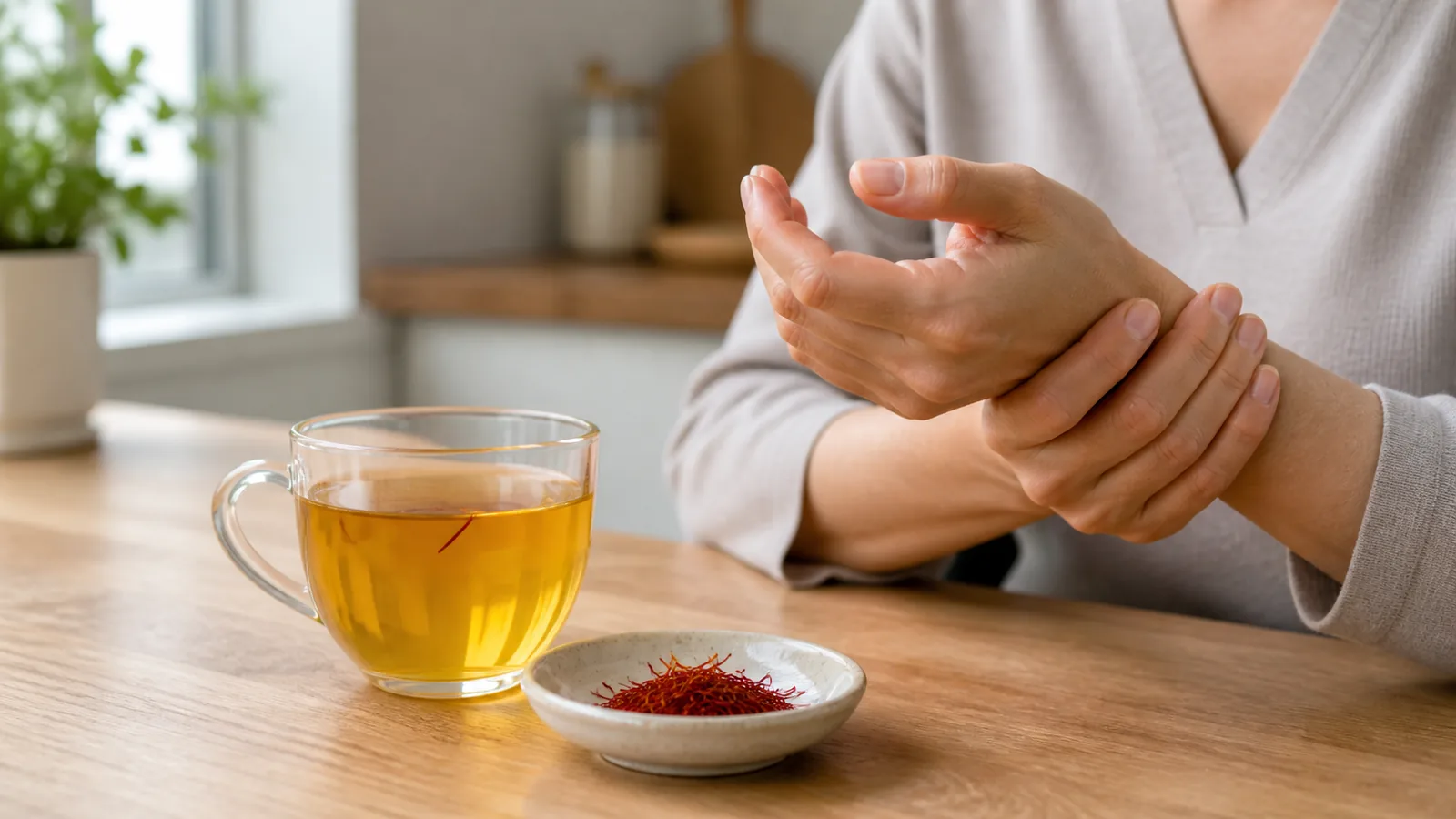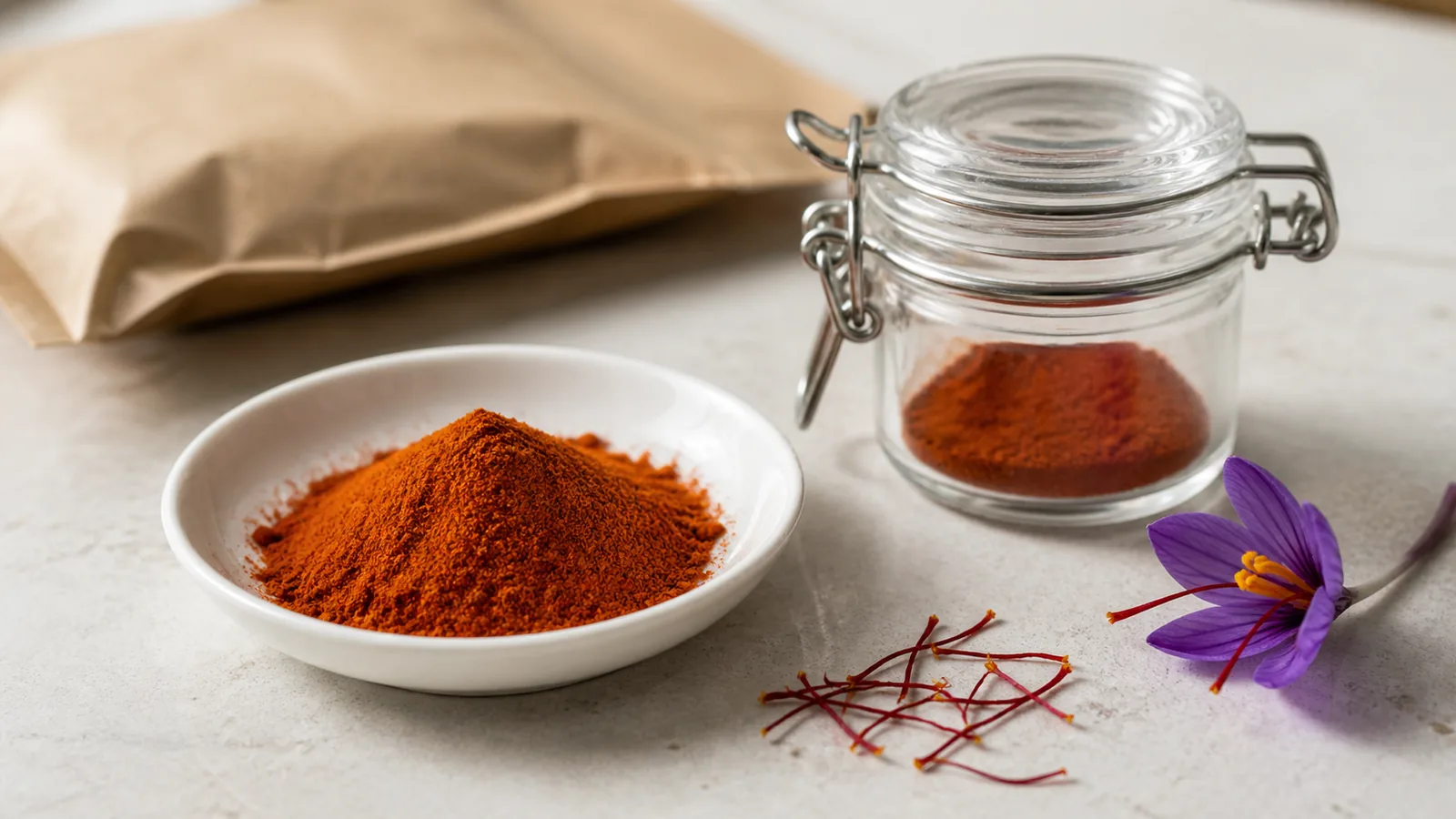
A packet labelled “saffron powder” should contain ground Crocus sativus stigmas and nothing else. Powder is convenient in the kitchen, but it is harder to authenticate than whole threads because grinding removes the flower’s visible structure. Very cheap, unlabelled powder should therefore be treated as a food-safety and food-fraud concern, not simply as a lower grade of saffron.
The phrase “cancer saffron powder” has appeared in warnings about counterfeit products containing undeclared colour. That wording needs care. A suspicious powder cannot be declared carcinogenic from its appearance, and the presence of a named food colour does not by itself prove that the product causes cancer. The defensible concern is simpler: an untraceable product may contain undeclared ingredients, colours not authorised for that use, contaminants, or no saffron at all.
Why powdered saffron is more vulnerable to fraud
Whole saffron threads retain clues that an experienced buyer can inspect: a dark-red to red-orange colour, an irregular thread shape, and a flared or trumpet-like tip. Those clues disappear after milling. A red powder made from safflower, turmeric, paprika, dyed starch, other plant material, or a mixture can look convincing in a sealed packet.
Research on saffron authentication describes economically motivated adulteration as a persistent problem and shows why laboratories use chemical fingerprints rather than colour alone. An open-access study of botanical adulterants in saffron powder, for example, used high-resolution chromatography and statistical analysis to distinguish saffron from possible substitutes.
Powder is not automatically fake. Reputable producers sell genuine ground saffron, and grinding fresh threads at home is often the simplest option for cooks. The risk rises when the powder has no producer, batch code, ingredient declaration, traceability, or realistic price.
What the original warning was trying to say
The earlier report on this page quoted a Ministry of Health laboratory official warning consumers about very cheap “prepared saffron powders” sold through informal channels. According to that report, the products had not been approved by the relevant food authority and some relied on chemical colour, including tartrazine, instead of genuine saffron.
That core consumer warning remains useful: do not assume that an unlabelled red powder is food-grade saffron. The old report, however, called tartrazine inherently “highly hazardous and carcinogenic.” That is too broad to repeat as fact. Tartrazine is also known as FD&C Yellow No. 5, a regulated colour additive in some jurisdictions. In the United States, the FDA requires it to be declared by name on food labels; its Yellow No. 5 labelling guidance also reflects concern about adverse reactions in susceptible people.
An authorised additive used within local rules is not the same as an undeclared dye in a counterfeit spice. The problem with the counterfeit packet is that the buyer cannot know what is present, how much was used, whether it is food-grade, or whether the label is truthful.
Can colour reveal fake saffron powder?
Not reliably. Authentic saffron contains crocin, the pigment responsible for its strong yellow colour in water and food. A tiny amount can colour a surprisingly large volume, so rapid colour release is not proof of added dye. Conversely, weak colour may reflect old or poorly stored saffron rather than fraud.
A home water check can sometimes expose an obvious imitation, but it cannot certify purity:
- Place a very small pinch in cool or lukewarm water.
- Watch the colour spread without stirring aggressively.
- Notice the aroma as the powder hydrates.
- Treat an instant harsh red cloud, synthetic smell, or sediment unlike plant material as a reason not to use the product.
This is only a screening observation. Added plant powders and dyes can be engineered to behave plausibly, and genuine ground saffron releases colour faster than intact threads. Laboratory methods such as microscopy, chromatography, spectroscopy, and DNA analysis offer much stronger evidence.
How to buy saffron powder more safely
Choose a traceable seller
Buy from a food business that identifies itself and can answer where the saffron came from. The pack should carry the product name, net weight, ingredient list, batch or lot information, packing or best-before date, storage instructions, and the information required by the market where it is sold.
Read the ingredient declaration
If the front says saffron but the ingredient panel lists colours, starch, salt, sugar, or another botanical, it is not pure saffron powder. A product without any ingredient declaration gives the buyer no basis for checking what was sold.
Be realistic about price
Genuine saffron comes from hand-separated stigmas and requires a large flower harvest. Powder offered at a small fraction of a credible thread price deserves scrutiny. Low price alone proves nothing, but a price that cannot plausibly cover the raw spice is a useful warning sign.
Prefer threads when traceability is weak
When the seller is unfamiliar, whole threads allow more visual inspection than powder. They can then be ground in a clean, dry mortar immediately before use. This does not replace supplier checks, but it removes one easy opportunity to hide bulk fillers.
Ask for testing when the purchase is commercial
Restaurants, retailers, and wholesale buyers should use batch documentation and risk-based laboratory testing. A certificate should identify the sample and batch; a generic sheet with no link to the goods being sold is not meaningful proof. ISO 3632 testing can help assess important saffron quality characteristics, while targeted methods may be needed to investigate particular adulterants.
What to do with a suspicious packet
Do not taste more of an unidentified powder to decide whether it is safe. Keep the packet, receipt, batch information, and photographs. Contact the seller and the appropriate local food-safety authority if the product appears mislabelled or causes a reaction. Anyone who develops breathing difficulty, facial swelling, or another severe symptom after eating a product should seek urgent medical help.
For ordinary cooking, store genuine powdered saffron tightly sealed, dry, and away from heat and direct light. Buy only an amount that will be used while its aroma remains fresh. Powder has more surface area exposed to air than whole threads, so careful storage matters.
The useful conclusion
The sound lesson behind warnings about counterfeit saffron powder is not that every powder is dangerous or that a particular colour automatically causes cancer. It is that an anonymous, unusually cheap powder cannot be trusted merely because it is red and carries the word “saffron.” Traceable sourcing, a complete label, sensible pricing, and appropriate testing provide far better protection than a home colour trick.