


Two different cross-border issues were blurred together in the old reports about Iran’s saffron trade. One concerned the illegal movement of saffron planting material through eastern borders. The other concerned dried saffron being routed through third countries because of tariff differences. They are related through the supply chain, but they are not the same product, rule or risk.
The reports also corrected a rumour: China had not imposed a blanket ban on Iranian saffron at that time. Officials described higher import tariffs and unequal market access, not a prohibition. Because these accounts date from 2017, none of their tariff rates or production shares should be read as current trade guidance.
“Bulbs” in the old report means saffron corms
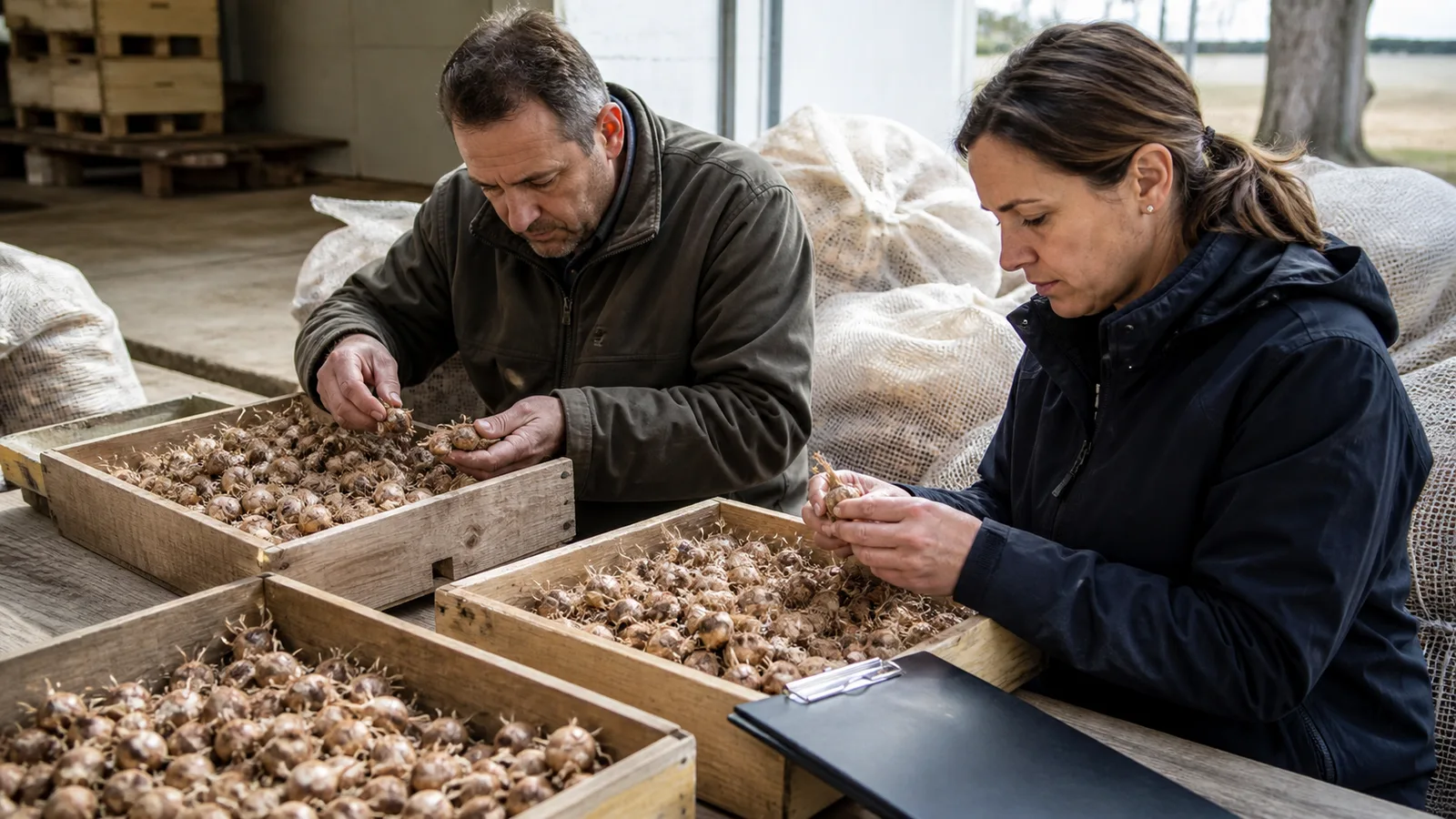
The destination article repeatedly called the planting material “bulbs.” Saffron, Crocus sativus, is more accurately described as a tuberous geophyte, and growers propagate it with corms. The difference is not just vocabulary: a corm is living material intended to establish another crop, while the traded spice consists of dried flower stigmas.
Kew’s Plants of the World Online recognises Crocus sativus L. as the accepted name and describes it as a tuberous geophyte. “Saffron bulb” remains common language, but “corm” is the clearer term for this article.
What officials said about saffron corm smuggling
An archived IRNA account quoted Seyyed Mohammad Kiyaee of Iran’s agriculture ministry saying the unauthorised removal of saffron corms from the country was illegal under the rules then in force. He said enforcement bodies were following the issue and that agricultural organisations in South Khorasan and Khorasan Razavi would help border guards identify corms moving through eastern routes, especially toward Afghanistan.
The translation is badly fragmented, so it does not support a quantity, named seizure, route map or estimate of how many corms crossed the border. It also contains broad claims about the origin and quality of Afghan saffron that are not backed by evidence. Those claims have not been repeated.
Movement of planting stock raises a separate plant-health concern from the commercial value of the material. The International Plant Protection Convention’s ISPM 36 guidance for plants for planting explains that production methods and plant age can affect pest risk. That does not establish the legal status of a particular shipment, but it shows why legitimate cross-border plant movement may require traceability, inspection and phytosanitary controls.
Dried saffron followed a different route
The same report then shifted from corms to dried saffron. Kiyaee said China and India applied import tariffs of roughly 35% to 38% to Iranian saffron at the time, while saffron entering from Afghanistan could face a rate near zero. According to the account, this gap encouraged some traders to move Iranian saffron through Afghanistan and export it under Afghan commercial identity.
This is a historical allegation attributed to the official. The surviving page provides no customs records, shipment volumes or case files with which to measure it. It should therefore be read as an explanation of the incentive officials believed existed, not proof that every intermediary or Afghanistan-origin shipment was mislabelled.
Routing a product through another country does not by itself change its origin. A credible supply chain needs lot records that connect the dried saffron to the grower or collection point, processor, test results, packaging stage and exporter. The same traceability principle applies to the regional branding and packaging problem: a name on a container must be supported by the product’s records.
China had not banned Iranian saffron
A separate Khorasan Razavi agricultural statement directly rejected reports that China had banned Iranian saffron. It described increased tariffs on Iranian agricultural products and lower rates for some other origins. Officials said preferential tariffs were one possible route to easier access and that discussions were being pursued at ministerial level.
That distinction matters. A ban prevents the product from entering under the relevant rule; a tariff allows entry but changes its cost. Either can disrupt trade, but they require different responses. Calling a tariff a ban misleads growers, exporters and buyers.
The 2017 report cannot tell a business what duty applies now. Tariffs vary by product classification, origin, partner and year, and preferential treatment may depend on specific conditions. The World Trade Organization’s Tariff and Trade Data resources distinguish legally bound rates from the rates actually applied and provide official tariff-line data for current verification.
Reading the Khorasan Razavi production figures carefully
The source added three figures to show the scale of the sector at the time:
- about 75,000 hectares under saffron in Khorasan Razavi;
- an average yield near four kilograms per hectare; and
- about 117,000 farming families involved in cultivation.
Its output line was mistranslated as “280 thousand tons.” That is impossible in the context provided. Seventy-five thousand hectares multiplied by four kilograms per hectare equals 300,000 kilograms, or 300 tonnes. The intended historic production figure was therefore likely 280 tonnes, which is close to the area-and-yield calculation. Because the original statement has not been recovered, 280 tonnes remains a reasoned correction rather than an independently verified statistic.
The report also said Iran produced about 95% of the world’s saffron. That was a time-bound official estimate, not a permanent share and not necessary to understand the corm or tariff issue. It should not be repeated as a current market statistic without current production data.
Why moving corms and relabelling saffron are different
Saffron corm smuggling concerns living propagation material. The immediate questions are legal authority, phytosanitary compliance, source records and the transfer of planting stock. Relabelling dried saffron concerns commercial origin, customs declarations, traceability and what the buyer is told.
The two can overlap when the same border corridor or broker network is involved, but evidence for one does not prove the other. A seized corm shipment does not establish that dried saffron was mislabelled. A tariff incentive does not prove that planting material crossed illegally. Keeping the claims separate makes enforcement and reporting more accurate.
What a defensible control system would record
For corms, a lawful movement record should identify the seller, buyer, origin, destination, quantity, plant-health documentation and any permit required at the time. For dried saffron, the lot record should identify the supplying farms or collection point, processor, weight, quality documentation, declared origin and export route.
Those records serve more than enforcement. They protect legitimate growers from having undocumented material mixed into their supply, help buyers verify origin and make it possible to investigate a plant-health or quality problem without accusing an entire region.
The accurate conclusion
The archived evidence supports a narrower conclusion than the original translated pages suggested. Iranian officials were concerned about unauthorised saffron corm movement toward Afghanistan and about tariff differences that could encourage indirect trade in dried saffron. They also said China had not banned the Iranian product.
The rates, production shares and negotiations belonged to that period. The durable lesson is to identify the commodity correctly, verify current rules at official sources and preserve traceability from planting material to the packaged spice. That is more useful than turning an old tariff dispute into a permanent claim about any country or market.

![Exporting Saffron to Turkey + Price Guide [Complete 0 to 100]](https://img.rowhanisaffron.com/20260827003933/saffron-export-turkey-quality-inspection.webp)



