


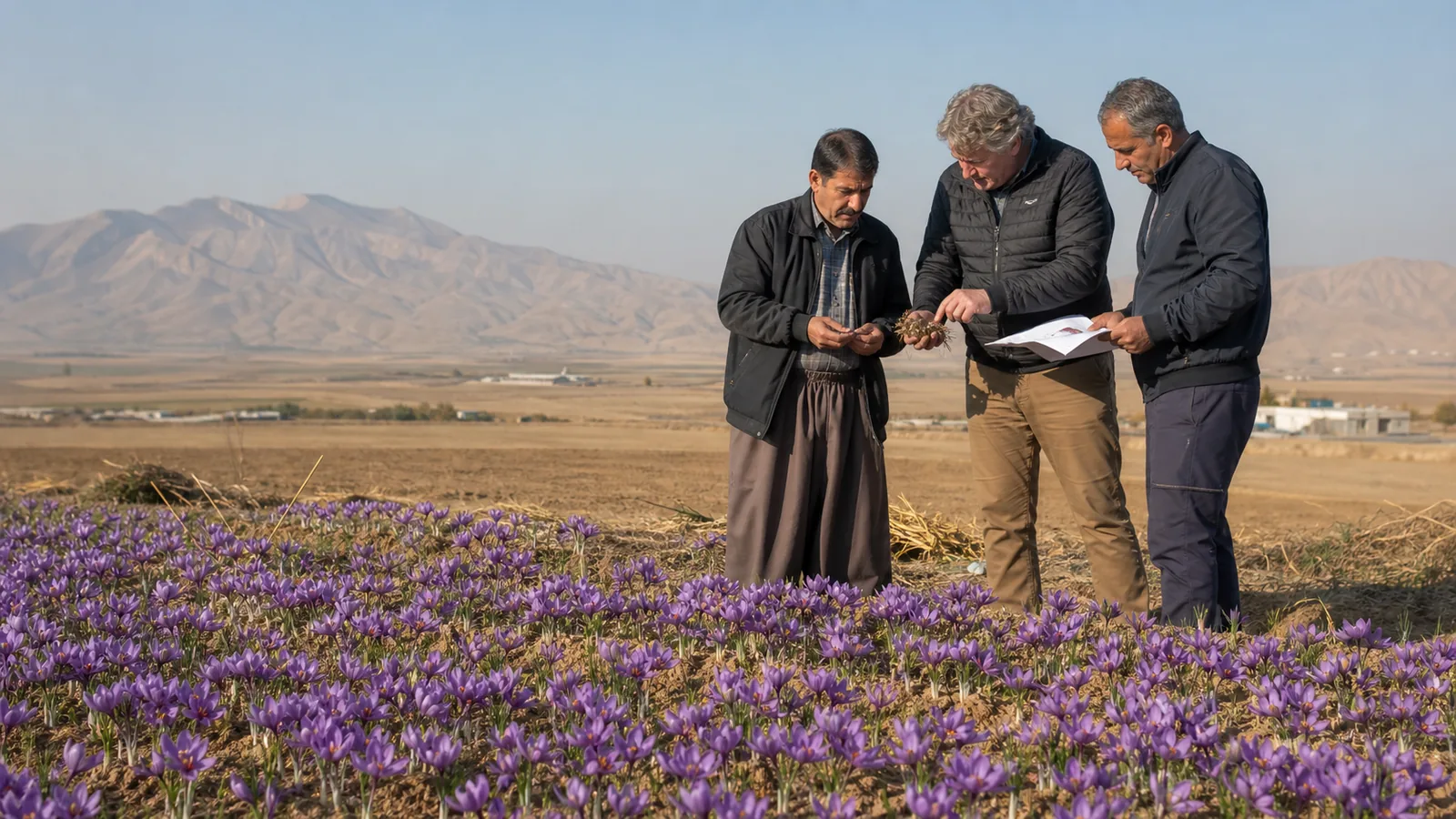
In June 2016, a five-member Dutch delegation visited Marand in East Azerbaijan to explore cooperation in saffron and other crops that can deliver value with relatively modest water use. The meeting was presented as an investment discussion, not as a completed agreement. It brought together local plans to expand saffron production in Marand with Dutch interest in cultivation technology, corm propagation, processing and export.
The surviving Persian-language account attributes the local figures and proposals to Marand governor Taqi Karami and the delegation’s comments to its leader, Robert van der Tang. Because the report describes intentions voiced at one meeting, its targets should be read as a record of that moment rather than as evidence that the investment or expansion later took place.
Why Marand was being considered for saffron production
Marand lies about 71 kilometres from Tabriz in north-western Iran. The district was described in the 2016 report as having a suitable climate for lower-water crops, especially saffron. At the time, local officials said 115 hectares of farmland in the county were planted with saffron. Their stated plan was to expand that area to 300 hectares by the Iranian year 1399, which ran from March 2020 to March 2021.
Karami also reported that 198 local growers had produced 400 kilograms of dried saffron in the preceding year. Those figures were used to support Marand’s description as a saffron-production centre in north-western Iran. They are historical, locality-specific figures, not current production statistics.
The crop’s fit with the region was central to the discussion. Saffron grows from a corm and follows a seasonal cycle that suits dry summers and carefully timed irrigation. It is often described as a low-water crop, but that phrase does not mean it can grow without water or careful soil management. Growers still need suitable land, drainage, healthy corms and irrigation planned around local conditions. Readers considering the crop can find a fuller practical overview in our guide to saffron cultivation methods.
What the Dutch delegation proposed
The delegation said its visit was intended to increase agricultural cooperation around saffron and Damask rose, known locally as gol-e Mohammadi. Both were presented as crops of interest where water efficiency and high-value production matter.
According to the report, local authorities expressed readiness to discuss several parts of a possible partnership:
- the purchase of saffron corms from the Netherlands;
- the allocation of land for cultivation in Marand;
- processing under Dutch licence or technical supervision; and
- exporting the resulting saffron under Marand’s name.
These were areas offered for cooperation, not confirmed contractual terms. The distinction matters: the report does not document a signed investment, a completed processing facility or an export programme that followed.
Van der Tang said the delegation had examined saffron fields around Bonab, in Marand County, as well as Damask-rose cultivation. He praised the quality observed and expressed interest in exchanging agricultural knowledge. The account also says the group believed Dutch technology could support a threefold expansion of saffron cultivation in Marand. That was the delegation’s forecast, not a measured result.
The corm-propagation claim in context
One of the report’s most easily misunderstood passages concerns the time needed to produce saffron corms. It says conventional propagation in Marand could take seven years, while an industrial method might produce planting corms in less than one year. This refers to the multiplication and preparation of corm material, not a promise that a newly established commercial field will reach full, stable production in a few months.
Saffron is sterile and is propagated vegetatively: daughter corms develop from planted mother corms. Field performance then depends on corm size and health, planting density, soil, climate, irrigation and crop management. Any accelerated propagation system therefore has to be judged by more than speed. It must also deliver healthy, true-to-type corms that perform reliably after planting.
The delegation contrasted Marand’s conditions with the Netherlands, where it said persistent rainfall made saffron cultivation more difficult. The report further stated that Dutch saffron reached 23 countries. The wording does not make clear whether this referred to saffron grown in the Netherlands, handled by Dutch traders or sold by the delegates’ own business, so it should not be treated as a national production statistic.
What the 2016 meeting actually established
The visit showed that Marand already had an organised group of growers, a recorded saffron harvest and a local ambition to expand. It also identified practical subjects for international cooperation: corm propagation, cultivation methods, processing, market access and technical exchange.
What it did not establish was just as important. The meeting did not prove that the proposed 300-hectare target was reached, that yields tripled or that a Dutch-licensed processing operation opened. Those outcomes would require later records. The most accurate reading is that Dutch investors were evaluating saffron production in Marand and local officials were inviting further cooperation.
Source note: The meeting details and quoted production figures come from a Persian-language reproduction of the June 2016 report. Numerical claims above are dated and attributed accordingly.

![Exporting Saffron to Turkey + Price Guide [Complete 0 to 100]](https://img.rowhanisaffron.com/20260827003933/saffron-export-turkey-quality-inspection.webp)



