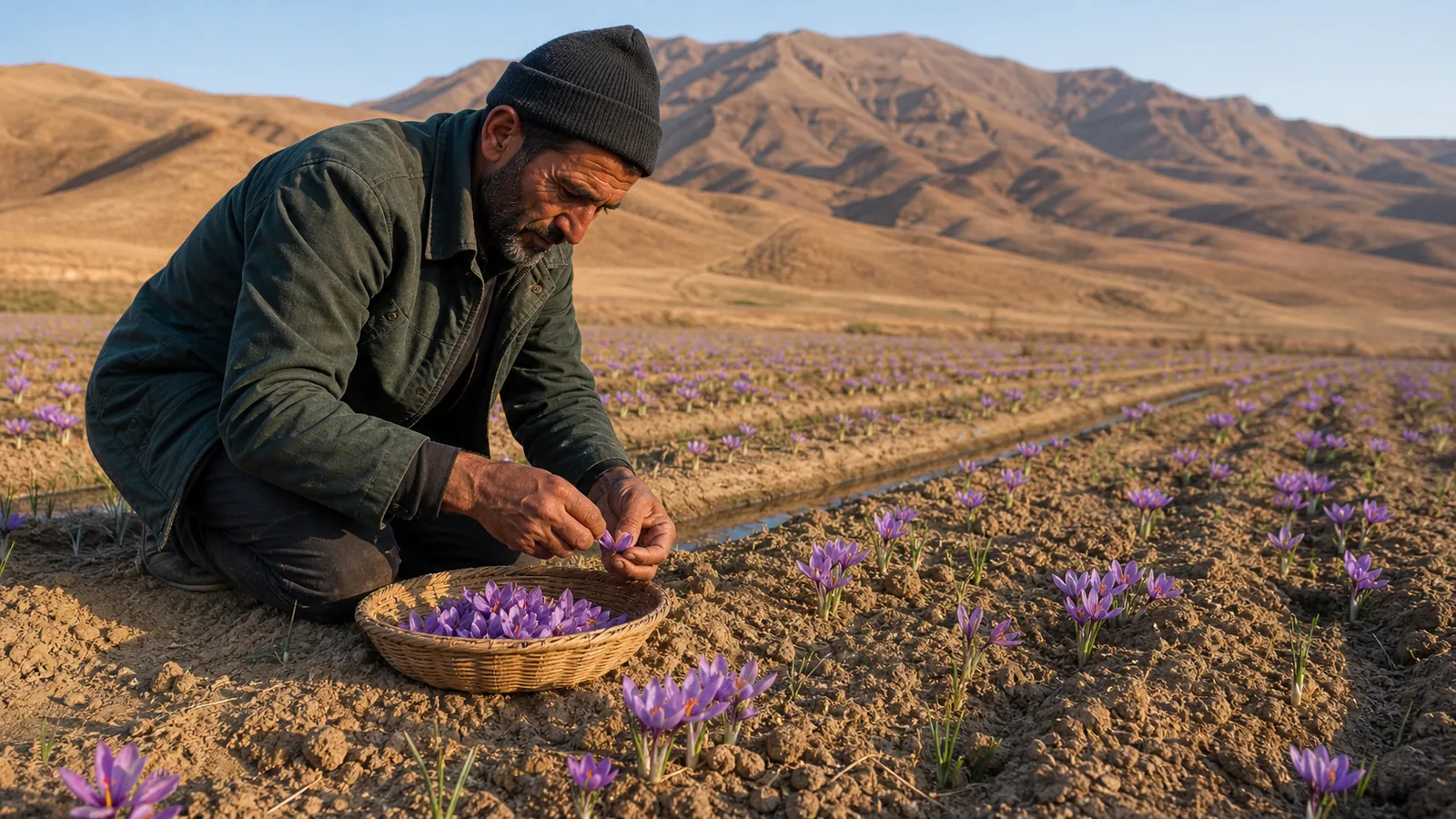
Kohbanan farmers harvested about 900 kilograms of saffron in the season covered by this 2017 report, with an average yield of roughly five kilograms per hectare. Local agriculture director Ali Akbar Majidi presented the crop as part of a wider response to drought in northern Kerman: a shift away from more water-intensive cultivation, paired with better irrigation and closer attention to farm economics.
The figures are a historical snapshot, not a current production forecast. They show why saffron attracted attention in Kohbanan, while the water warning that accompanied them remains just as important as the harvest total.
What the Kohbanan saffron harvest report said
Majidi told Mehr News that Kohbanan had produced 900 kilograms of saffron during the reported season. He put average dry-saffron yield at five kilograms per hectare and described that result as a favourable performance for the county.
The earlier English version rendered Kohbanan in several ways, including “Kuh Binh,” “Kuhbnan,” and “Kohban.” They refer to Kohbanan County in Kerman Province. Keeping the place name consistent matters because this is a regional harvest report, not general advice about saffron production across Iran.
The article did not give a field-by-field breakdown, the grade of the harvested saffron, or a final marketed volume. Its 900-kilogram figure should therefore be read as the official’s reported county total for that season.
Why growers were turning to saffron
Drought and pressure on groundwater were central to Majidi’s explanation. He said local authorities were encouraging changes in the cultivation pattern in northern Kerman, with saffron considered as an alternative to crops that demand more irrigation.
The old translation called saffron “water-insoluble.” The Persian agricultural expression means a low-water crop, not a plant that is insoluble in water. Even that description needs care: saffron still requires well-timed irrigation, suitable soil and drainage, and enough water to establish and sustain a productive field. It is not a water-free crop.
For a dry region, the useful comparison is not simply how many times a field is irrigated. Growers also have to consider total seasonal use, water quality, soil moisture, yield per hectare, the age of the saffron stand, and the return earned from each unit of scarce water.
Water management remains part of the story
Majidi described rainfall conditions as poor and groundwater resources as critical. He also called for farmers to move away from traditional irrigation methods. That makes the harvest figure more than a production milestone: it records an attempt to build a crop around the limits of the local water supply.
Changing crops alone cannot solve water scarcity. A responsible saffron plan also needs:
- an assessment of soil, salinity, drainage, and available water before planting;
- irrigation timed to the crop cycle rather than applied by habit;
- sound corm selection and planting density;
- field records that connect water use with flower and dry-saffron yield;
- maintenance that prevents leakage and uneven distribution; and
- a realistic route to labour, processing, packaging, and sale.
A crop can use less water than a previous one and still fail economically if the stand is weak, flowers are picked late, stigmas are handled poorly, or the producer has no reliable buyer.
From flowers to marketable saffron
Picking is only the first time-sensitive step. Flowers need to be collected promptly, kept cool and clean, and separated without crushing or contamination. The red stigmas then have to be dried consistently. Excess moisture threatens storage stability, while excessive heat can damage colour and aroma.
The original report mentioned providing fertiliser to farmers, but fertiliser is not a substitute for field diagnosis. Application should follow soil conditions, crop stage, and local agronomic guidance. Unmeasured inputs can waste money and may worsen soil or water problems.
Majidi also argued for a more economically and export-oriented agricultural culture. For growers, that means treating quality records, hygienic processing, grading, packaging, and traceability as part of production rather than as work that begins after harvest.
Kohbanan’s saffron area continued to develop
A later report from Iran’s Agricultural News Agency said harvesting had begun across 260 hectares in Kohbanan in 2022, with production expected to exceed one tonne. It also connected the crop’s reputation with the county’s geography and elevation. That later estimate does not replace the 900-kilogram historical figure; it provides a separate checkpoint showing that saffron remained an established local crop. See the 2022 Kohbanan harvest notice.
What the 900-kilogram harvest tells us
Picking saffron in Kohbanan brought together three practical concerns: protecting a scarce water supply, giving farmers a valuable crop suited to local conditions, and preserving quality through a labour-intensive harvest.
The reported five-kilogram-per-hectare average suggested that the crop was performing well in that season. The more durable lesson, however, is not that saffron should be planted everywhere in a dry district. It is that crop choice, irrigation, agronomy, processing, and a dependable market must be planned together. That is how a promising harvest becomes a resilient farm business rather than another demand on an already stressed water system.