


A 2016 Iranian agricultural report raised a specific trade concern: Iranian saffron was allegedly being moved in bulk to Afghanistan and then re-exported to China and India under more favourable tariff treatment. The warning came from Mohammad Ali Tahmasbi, then Iran’s deputy agriculture minister for horticultural affairs. He did not describe Afghan saffron farming itself as an immediate threat to Iran’s production. His concern was the loss of origin, export income and market identity when Iranian product left through informal channels.
The account is a historical one. Its tariffs, prices, output and export figures belong to 2015–2016 and should not be used for a current shipment or purchasing decision. They do, however, show why traceability, packaging and direct market access were already important issues for Iran’s saffron industry.
The re-export claim and the tariff gap
Tahmasbi said exporters had reported import duties of more than 30 percent on Iranian saffron entering China and India, while saffron entering from Afghanistan faced a zero tariff. According to the same interview, some Iranian saffron was moving to Afghanistan in bulk or through smuggling and was then sold onward as Afghan exports.
That statement was presented as an unofficial industry report, not a customs audit tracing individual consignments. It should therefore be read as an allegation by an official about a market route, not proof that every Afghan saffron shipment contained Iranian product.
His concern was economic rather than botanical. When origin is obscured, the exporting country captures the visible trade value and the producer’s name disappears from the final market. Iranian growers and processors may do the field and post-harvest work, yet another route, package or national label receives the commercial recognition.
Afghan production was not dismissed
The interview noted that Afghanistan’s developing saffron sector had received support from European countries, including the Netherlands, as well as China and India. Tahmasbi said Afghanistan’s planted area was still small and did not then create a major production challenge for Iran. The article’s distinction is useful: legitimate Afghan-grown saffron and the alleged re-export of Iranian saffron are different matters and should not be conflated.
Tahmasbi also argued that Iranian saffron had advantages in colour, aroma and flavour because of the day-and-night temperature range in desert growing regions. That was his comparative assessment, not a laboratory result reported in the article. Quality cannot reliably be assigned by country name alone. The crop variety may be similar, while growing conditions, harvest timing, drying, storage and adulteration control can all affect the finished spice.
Iran’s production and export figures in the report
For the year covered by the interview, Tahmasbi forecast Iranian production of 360 tonnes. The preceding year’s output was reported as 351 tonnes from 95,125 hectares across 23 provinces. The geographic breakdown attributed 95 percent to Razavi Khorasan and South Khorasan together, four percent to Fars, and the remaining one percent to Isfahan, Kerman, Yazd and North Khorasan.
Iranian customs data cited in the report recorded 113.5 tonnes of saffron exports worth US$165 million in the prior year. For the first five months of the current reporting year, through August 2016, it gave 54 tonnes worth more than US$79 million. Tahmasbi linked the higher production forecast to milder weather and less drought and heat than the year before.
These figures do not include a reliable measure of saffron carried out informally in luggage or moved through smuggling. The interview explicitly mentioned both routes, which is why production and official export totals cannot by themselves settle how much Iranian saffron reached overseas consumers under another label.
Bulk trade, branding and the Spain route
Tahmasbi described bulk export and the shortage of export-oriented Iranian brands as structural problems. He said a significant share of Iranian saffron went to Spain, where it could be packed and sold under established European brands. His reference to World Trade Organization standards was imprecise: the WTO sets trade rules, while saffron quality and conformity depend on product standards, testing and the requirements of the destination market. The central commercial point remains clear. Selling unbranded bulk material gives the final packer more control over presentation, customer relationships and margin.
Direct exports are not automatically better if the product cannot meet the buyer’s specifications. A durable origin strategy requires consistent grading, clean processing, batch records, suitable packaging and documentation that follows the saffron through the supply chain. Those safeguards also help buyers distinguish an authentic consignment from one whose origin has been changed on paper.
Historical prices and pressure on growers
The interview placed the production cost of one kilogram of saffron at 25–30 million Iranian rials, stated parenthetically as 2.5–3 million tomans. It said Negin and Sargol grades were then offered to domestic or export markets at about 65 million rials, or 6.5 million tomans per kilogram. These are 2016 nominal prices and have no use as a current quotation.
Tahmasbi connected market timing with growers’ finances. Iran’s main saffron harvest falls in October and November. Farmers who needed cash could be forced to pre-sell or release their crop during harvest, when supply was concentrated and prices were less favourable. Growers with more financial flexibility could hold properly dried saffron and sell later. He also warned that brokers buying cheaply at harvest and releasing stock afterward could upset the balance of the market.
Storage is not risk-free, so holding product only works when moisture, light, air, contamination and traceability are controlled. The categories mentioned in the report—Negin, Sargol, Poushal and Dasteh—refer to different cuts and presentations of the stigma and style. Our guide to the different types of saffron explains how those forms differ. A grade name alone is still not a substitute for batch testing.
What this episode says about origin
The 2016 warning was not simply that Afghanistan might grow more saffron. It was that a tariff difference and an informal border route could separate Iranian saffron from its declared origin. Once that happens, accurate trade statistics become harder to build, producers lose recognition and buyers cannot easily verify the chain behind a package.
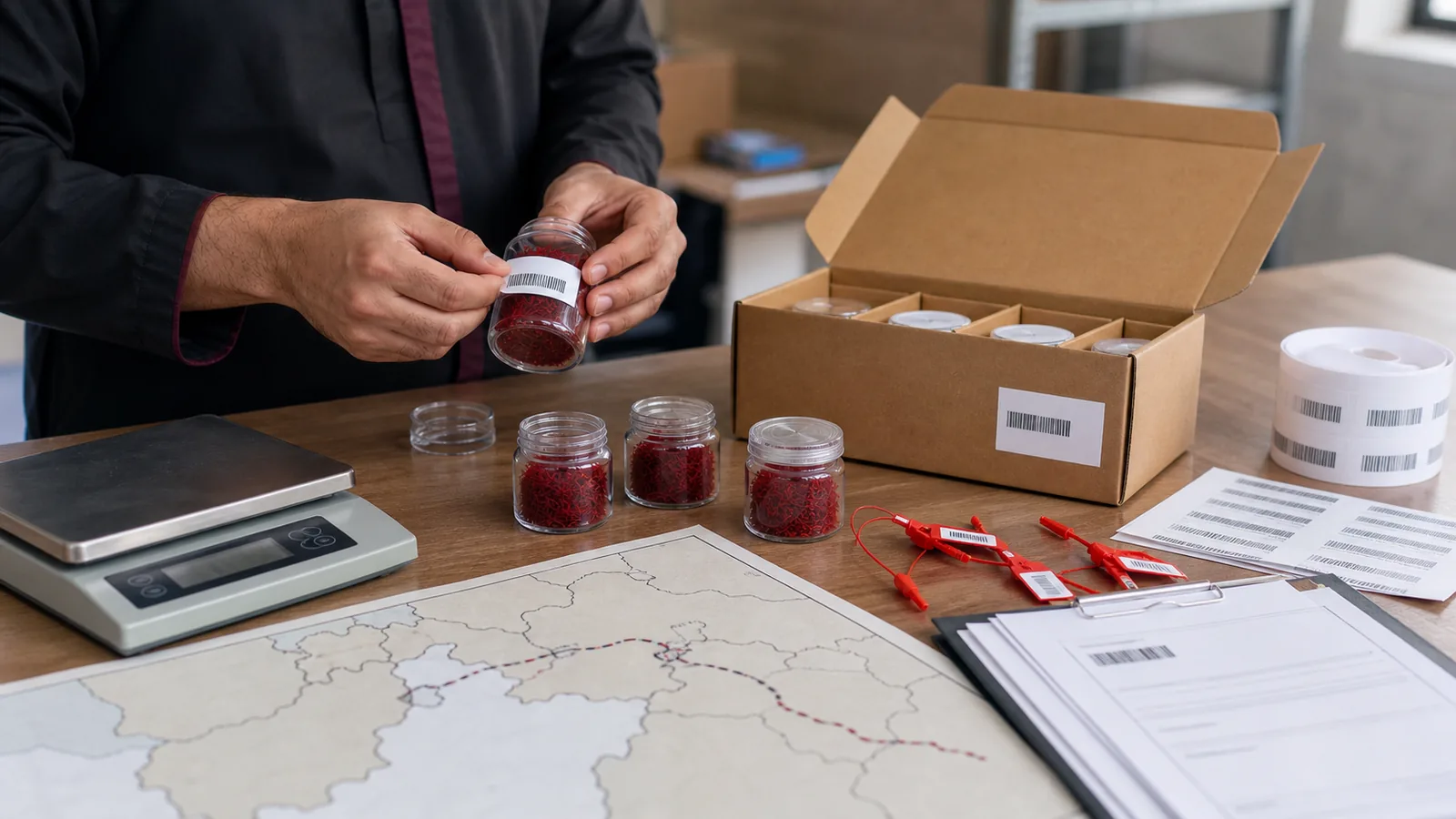
The practical answer is not to make unsupported claims about a neighbouring country’s crop. It is to make origin demonstrable: identify the producer and region, keep lot-level records, test and grade the product, use tamper-evident packaging, and maintain export documents that agree with the physical consignment. Those measures protect Iranian saffron more effectively than broad quality slogans because they give a buyer evidence that can be checked.
Source note: All historical quotations, tariff assertions and 2015–2016 figures above are attributed to the Iranian Agricultural News Agency’s reproduction of the IRNA interview. Current tariffs must be checked against the importing country’s live customs schedule.

![Exporting Saffron to Turkey + Price Guide [Complete 0 to 100]](https://img.rowhanisaffron.com/20260827003933/saffron-export-turkey-quality-inspection.webp)



