


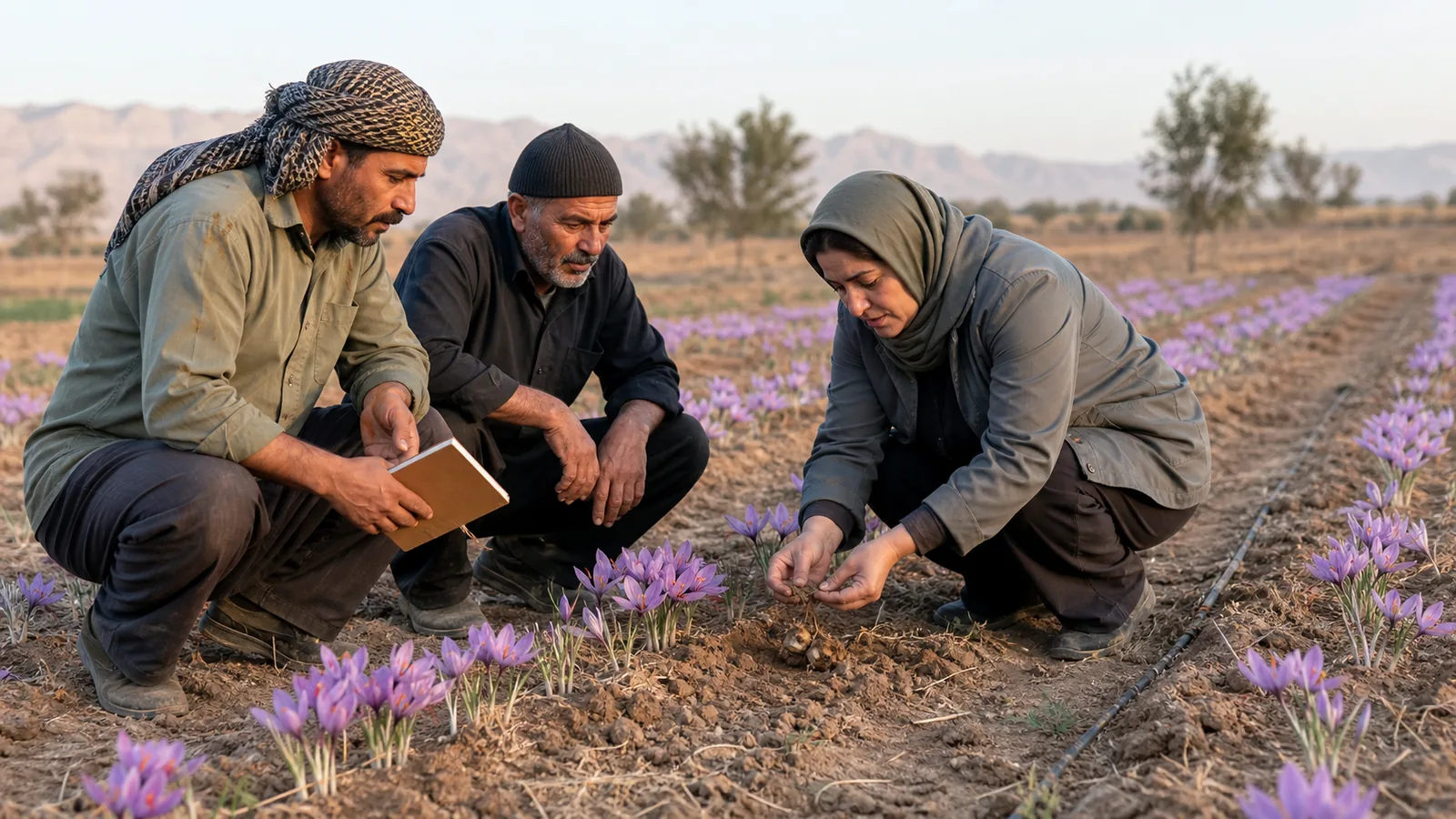
A historical Isfahan agriculture report described saffron as a promising crop for a water-constrained province. It recorded 708 hectares under cultivation, 3,907 kilograms of dried saffron, roughly 4,100 growers, and a plan to expand the area to 758 hectares.
The central idea remains useful, but it needs precision. Saffron’s growth cycle can reduce competition with summer irrigation, and established corms produce for several seasons. That does not make the crop drought-proof, guarantee a profit, or mean every Isfahan field will achieve the same yield.
What the Isfahan saffron farming report measured
The provincial horticulture official quoted in the two archived articles said saffron area had risen from 617 hectares in Iranian year 1393 to 708 hectares, with another 50 hectares expected to bring the total to 758. The report attributed the expansion to modest water demand, autumn–winter water use, and the crop’s income potential.
It also named Natanz, Tiran and Karvan, Najafabad, Kashan, Shahin Shahr and Meymeh, Na’in, and Khur and Biabanak among the province’s larger cultivation areas. Some place names were distorted in the stored machine translation; the list is retained as a historical regional outline, not a current ranking.
The figures do not include a publication-year dataset, field sample, grade breakdown, or method. They should not be used as today’s Isfahan production total. Their value is in documenting a period when saffron acreage was expanding beyond its traditional Khorasan base.
The reported yield needs an arithmetic correction
The destination says 3,907 kilograms were harvested from 708 hectares and then calls the yield “above 6 kilograms per hectare.” Those two numbers equal approximately 5.52 kilograms per hectare, not more than six.
That does not establish that every underlying number was wrong. The area and output may refer to different reporting cutoffs, or the six-kilogram statement may describe productive fields rather than the provincial average. Because the article supplies no source table, the discrepancy cannot be resolved. The safest reading is to retain all three statements with the calculation made explicit.
Yield also varies sharply among farms. A peer-reviewed multi-location study found that temperature, field age, soil texture, soil and water pH, irrigation events, growth-period length, and flower number all influenced saffron yield. A provincial average is therefore context, not a promise to an individual grower.
Why saffron can suit a water-scarce province
Saffron is planted as corms and grows actively through the cooler part of the year. In Isfahan, that timing can overlap with lower evaporation and seasonal rainfall, reducing direct competition with crops that need heavy irrigation in hot months.
FAO’s account of the qanat-based saffron system in Gonabad similarly describes saffron as a crop that does not require large quantities of water and can support livelihoods under severe water scarcity. Gonabad is not Isfahan, but the official example supports the broader agronomic rationale.
“Low water” must not be read as “no water.” Flower and corm development still respond to soil moisture and irrigation timing. A controlled field study of irrigation scheduling reported that well-timed irrigation produced more flowers than the rain-fed treatment. Local soil, salinity, rainfall, corm condition, and available water must be assessed before planting.
A saffron field can remain productive for years
The assigned source says a planted field can be harvested for about ten years without annual replanting. That is possible in Iranian production systems, but “ten years” is an upper planning horizon rather than a fixed replacement date.
The same multi-location research found average yield rising until roughly the sixth or seventh year and then declining, while fields could remain economical before the tenth year. Corm crowding, depleted fertility, compaction, pests, disease, planting density, and starting corm quality can shorten the useful cycle.
A multi-year stand saves the work of planting every season, yet it creates long-term obligations. Growers need a suitable site, healthy corms, drainage, a weed and disease plan, and enough labor for a harvest that arrives in a short window.
Water efficiency is only one part of farm economics
The older source quoted a selling price of about eight million tomans per kilogram. Its date, grade, transaction level, and market are not stated, so the figure is preserved only as a historical price point. It cannot be compared directly with a current retail or wholesale price.
Saffron’s high value per unit weight attracts growers, but revenue is not profit. Corms, land preparation, irrigation, weeding, flower picking, same-day stigma separation, drying, testing, storage, packaging, finance, and rejected material all affect the result. Labor availability can be decisive because flowering is concentrated and delicate work cannot simply wait.
The destination recorded about 4,100 growers and three cooperatives working in the province’s saffron sector. Cooperatives can help aggregate batches, coordinate services, and reach buyers, but the article gives no evidence about their current size or performance.
For a broader explanation of why a higher selling price may still fail to cover production costs, see our review of saffron prices and farm costs.
Expansion should follow field and market evidence
The historical plan treated saffron as one option in a shift away from more water-intensive cropping. That is a reasonable screening question, not a blanket instruction to replace other crops.
Before expanding, a farm needs evidence on winter water availability, drainage, soil texture and salinity, temperature, corm supply, skilled harvest labor, expected field age, realistic yield, and a buyer specification. A crop can use less irrigation and still fail economically if the field is unsuitable or the market cannot absorb its grade and volume.
Isfahan is also only one part of a much wider pattern. Our article on the expansion of saffron cultivation in Iran compares the reasons, results, and cautions reported in several provinces.
Processing and packaging determine how much value stays local
The source did not stop at acreage. It called for processing, packaging, stronger domestic distribution, and export-market development so farmers would not depend only on selling an undifferentiated raw product.
That value is created only when the work improves the product. Prompt drying, hygienic handling, moisture control, batch separation, suitable food-contact packaging, traceable records, and honest labeling protect saffron’s color, aroma, and purity. Decorative packaging without those controls adds cost but not reliable quality.
The source also notes that dried saffron is compact and can be stored longer than fresh produce. It is not imperishable. Light, heat, humidity, oxygen, contamination, and poor seals can reduce quality, so long-term storage still needs controlled conditions. See our practical guide to preserving saffron quality in storage.
The global production numbers are historical
The assigned source put annual world production at about 230 tonnes, with roughly 170 tonnes from Khorasan and the rest mainly from Spain, Greece, Morocco, India, and Afghanistan. It supplies no year or statistical source, so those quantities should not be treated as current.
A current FAO account estimates that Iran produces about 85–90% of the world’s saffron. The list of other producing countries remains useful context, but annual tonnage and national shares move with weather, field area, yield, definitions, and reporting quality.
The older source also included unsupported medical language about saffron. It has been removed from this agricultural article: a claim about crop economics or traditional use is not evidence that a food treats depression or another condition.
What “good performance” should mean
The Isfahan report’s strongest evidence is not the headline alone. It is the combination of expanding area, recorded output, an established grower base, and an attempt to match crop choice to water constraints.
A responsible current assessment would add farm-level water use, reconciled yield data, production cost, labor supply, grade, post-harvest loss, and confirmed sales. Good Isfahan saffron farming means more than planting additional hectares: the crop must fit the field, return a durable income, and reach the customer with its quality intact.

![Exporting Saffron to Turkey + Price Guide [Complete 0 to 100]](https://img.rowhanisaffron.com/20260827003933/saffron-export-turkey-quality-inspection.webp)



