


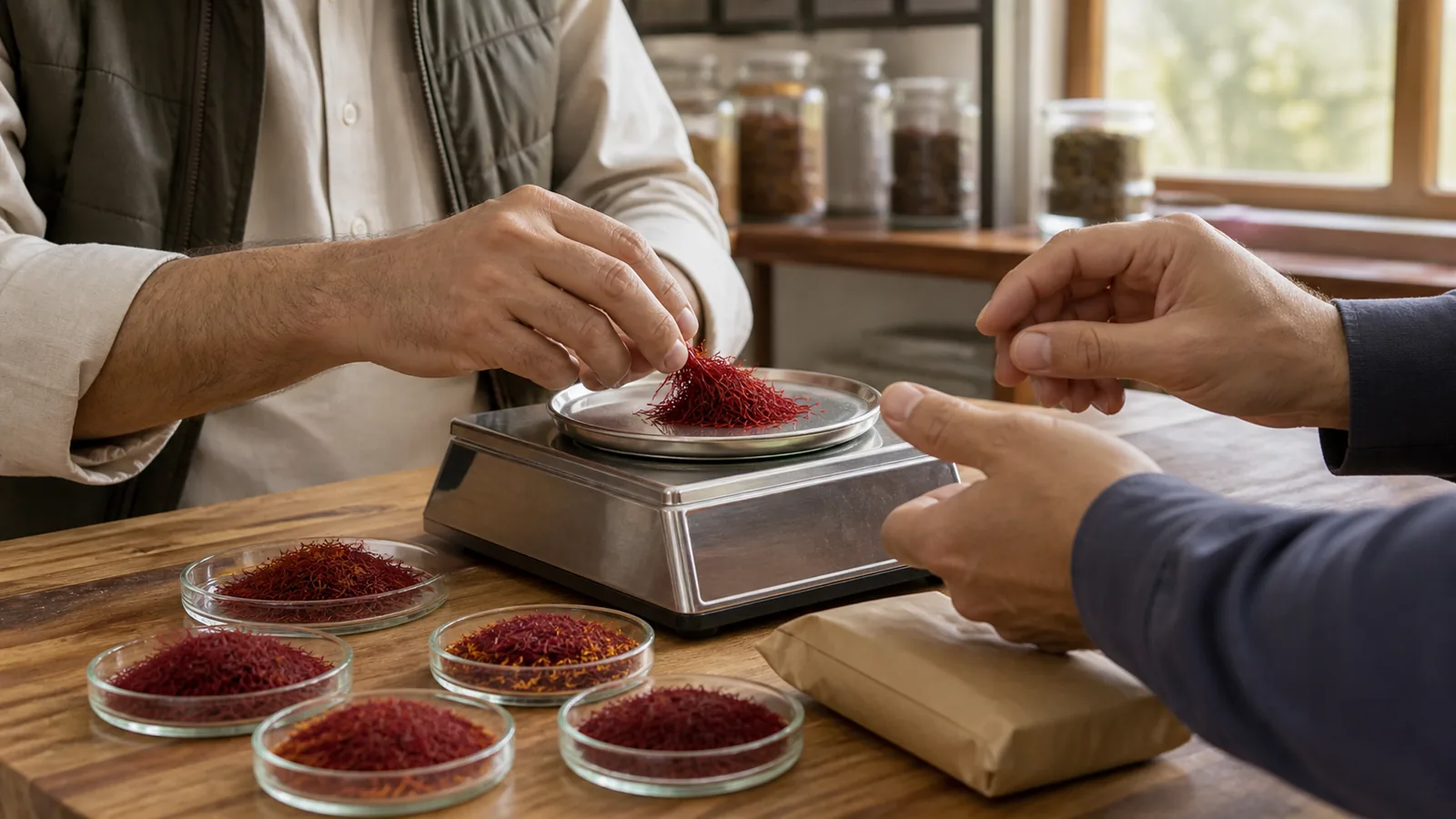
A higher saffron price did not automatically mean a healthier return for growers. In an archived Iranian market report, Gholamreza Miri of the National Saffron Council argued that the price had more than doubled while saffron production costs—including cultivation, harvest, and cleaning—had risen enough to absorb much of the increase.
A second statement from Miri supplied grade-level market prices and explained why unstable prices also troubled exporters. Together, the reports describe the same problem from both ends of the chain: farmers needed a price that reflected real costs, while exporters needed enough stability and reliable data to quote customers and plan shipments.
All monetary values below are historical figures from the reporting period, expressed in Iranian tomans per kilogram. They are not today’s saffron prices and should not be used as a live quotation.
The saffron production costs behind the headline
Miri estimated production costs during the reported season at roughly 6 million to 10 million tomans for one kilogram of finished saffron. He contrasted that with a prior market range of about 4.2 million to 5.4 million tomans per kilogram.
The wide cost range makes sense because “the cost of saffron” is not one universal number. It changes with land and water costs, the age and yield of a field, corm replacement, labor availability, flower volume, drying and cleaning methods, quality losses, finance, packaging, and the grade finally sold. A farm with a strong harvest spreads some fixed costs over more finished product; a weak harvest does the opposite.
Miri’s central claim was therefore not that a nominal price increase had failed to occur. It was that the increase had to be compared with the much faster-moving cost base. Supply and demand still shaped the transaction price, but a market price below sustainable production cost could discourage field maintenance and future planting even if it looked high beside the previous year.
Harvest and cleaning labor changed the calculation
Saffron is unusually dependent on concentrated manual work. Flowers open during a short autumn period and are normally picked quickly. The red stigmas then have to be separated from each flower and dried with care. Labor demand arrives in a narrow window, so a shortage of experienced workers can raise costs at precisely the point when growers have little room to delay.
The archived report attempted to compare cleaning wages with the previous season, but its translated units conflict: it shifts between payment per 100 kilograms, payment per kilogram, and an implausible monthly total. Those figures cannot be reconciled responsibly from the stored text. The useful, supportable point is narrower: Miri identified a sharp rise in cleaning labor as a major reason the apparent doubling in saffron prices did not translate into an equivalent increase in farm margin.
The grade-by-grade prices Miri reported
In a separate market update, Miri said saffron prices had been relatively stable for several weeks. The stored report gives the following wholesale ranges:
- Negin saffron: 9.5 million to 11 million tomans per kilogram.
- Super Negin saffron: 11.5 million to 12 million tomans per kilogram.
- Ordinary or pushal saffron: 6.5 million to 6.7 million tomans per kilogram.
The source incorrectly labels the final range as US dollars even though the figures and context are Iranian domestic price quotations. Treating the values as tomans resolves that obvious translation error and keeps them consistent with the production-cost report.
The spread between ordinary, Negin, and Super Negin reflects differences in appearance and separation, not merely a name. Longer, well-separated red stigmas generally command more than material with more style attached or less uniform presentation. Moisture, aroma, coloring strength, cleanliness, origin documentation, test results, lot size, and contract terms can also change a real wholesale offer.
Why exports made price stability important
Miri estimated that about 85% of Iran’s saffron production was exported during the period he described. The other archived report said exports had risen by 46% since the start of its reporting year. These are period claims attributed to Miri, not current market shares.
An exporter may quote a buyer weeks before product is purchased, prepared, tested, packed, cleared, and delivered. If the domestic acquisition price changes sharply during that interval, a fixed export quote can become unprofitable. Quoting an unrealistically high buffer can lose the customer to another origin or supplier. Volatility therefore creates risk even when the direction of the change appears favorable to sellers.
The report also placed international saffron prices in a broad range of roughly US$600 to US$1,400 per kilogram at that time. Product grade, origin, packaging, destination, volume, quality documentation, and whether a figure describes bulk export value or retail trade all affect such comparisons. A domestic toman price and a global dollar price should never be compared without the exchange rate and the same commercial basis.
Miri’s proposal for a one-year price framework
Miri proposed that authorities use a mechanism to hold saffron at a reasonable rate for one year. His argument was practical: producers and exporters could not plan a regular program or compete internationally if prices were unpredictable from one week to the next.
That proposal should not be confused with a claim that every price can or should remain unchanged regardless of crop size, quality, demand, or currency conditions. It represented one industry official’s response to volatility. Any stabilization mechanism would still have to decide which grade and transaction level it covered, how the reference price was set, who carried inventory risk, and how it avoided weakening incentives for quality.
Speculation versus genuine price discovery
The private sector did not oppose saffron trading through an exchange, according to Miri. His concern was that brokers or speculators might push for an artificial increase detached from real supply and demand. He warned that such a move could damage both the domestic market and export sales.
A transparent exchange can help reveal prices, standardize contracts, and reduce counterparty risk. It cannot make every price movement legitimate simply because it occurs on a formal platform. Market participants still need clear grade specifications, delivery rules, warehouse controls, published volume, and enough trading depth to distinguish a real change in demand from a thin or manipulated market.
Missing customs data weakened export planning
Miri also criticized a gap in official trade statistics. He said customs had stopped issuing new monthly saffron export figures after December, attributing the delay to changes in basic tariffs. Exporters, he argued, needed timely monthly data for accurate planning.
Without current statistics, businesses cannot easily tell whether a price movement reflects stronger foreign demand, delayed shipments, inventory accumulation, a change in declared value, or currency effects. Reliable data also helps growers and processors judge which grades and destinations are actually expanding. A missing series increases the chance that decisions will be driven by rumor.
What the historical export figures show
The production-cost report cited 250 tonnes of saffron exported with a declared value of US$356 million, an average near US$970 per kilogram and a reported maximum near US$1,300 in international markets. Those values appear to refer to a specific Iranian reporting year and administrative dataset. Because the stored translation does not identify the exact Gregorian period consistently, they should be read as historical context rather than a current benchmark.
The report also recalled a severe prior price fall below 3 million tomans per kilogram and a government support purchase of about 67 tonnes. That episode helps explain why participants were sensitive to both low prices and artificial spikes. A market can harm growers when it collapses, then harm exporters when it rises too quickly to support stable contracts.
A sustainable saffron price needs more than a headline increase
The combined reports show why a simple statement such as “saffron prices doubled” reveals little about the health of the sector. The relevant questions are which grade was sold, at what stage in the chain, against which production costs, under what exchange rate, and with what ability to reach a buyer.
For growers, a sustainable price must cover efficient cultivation and harvest while rewarding quality. For exporters, it must remain competitive and predictable enough to honor contracts. Transparent grade definitions, credible trade data, controlled storage, and genuine price discovery connect those needs more effectively than either a depressed farm-gate price or a speculative surge.

![Exporting Saffron to Turkey + Price Guide [Complete 0 to 100]](https://img.rowhanisaffron.com/20260827003933/saffron-export-turkey-quality-inspection.webp)



