


Gonabad saffron is known internationally because the farming system behind it was recognised by the UN Food and Agriculture Organization in 2018. The designation covers far more than a crop. It recognises the way local communities use qanats, terraces and inherited knowledge to grow saffron in a dry landscape while supporting livelihoods, biodiversity and local culture.
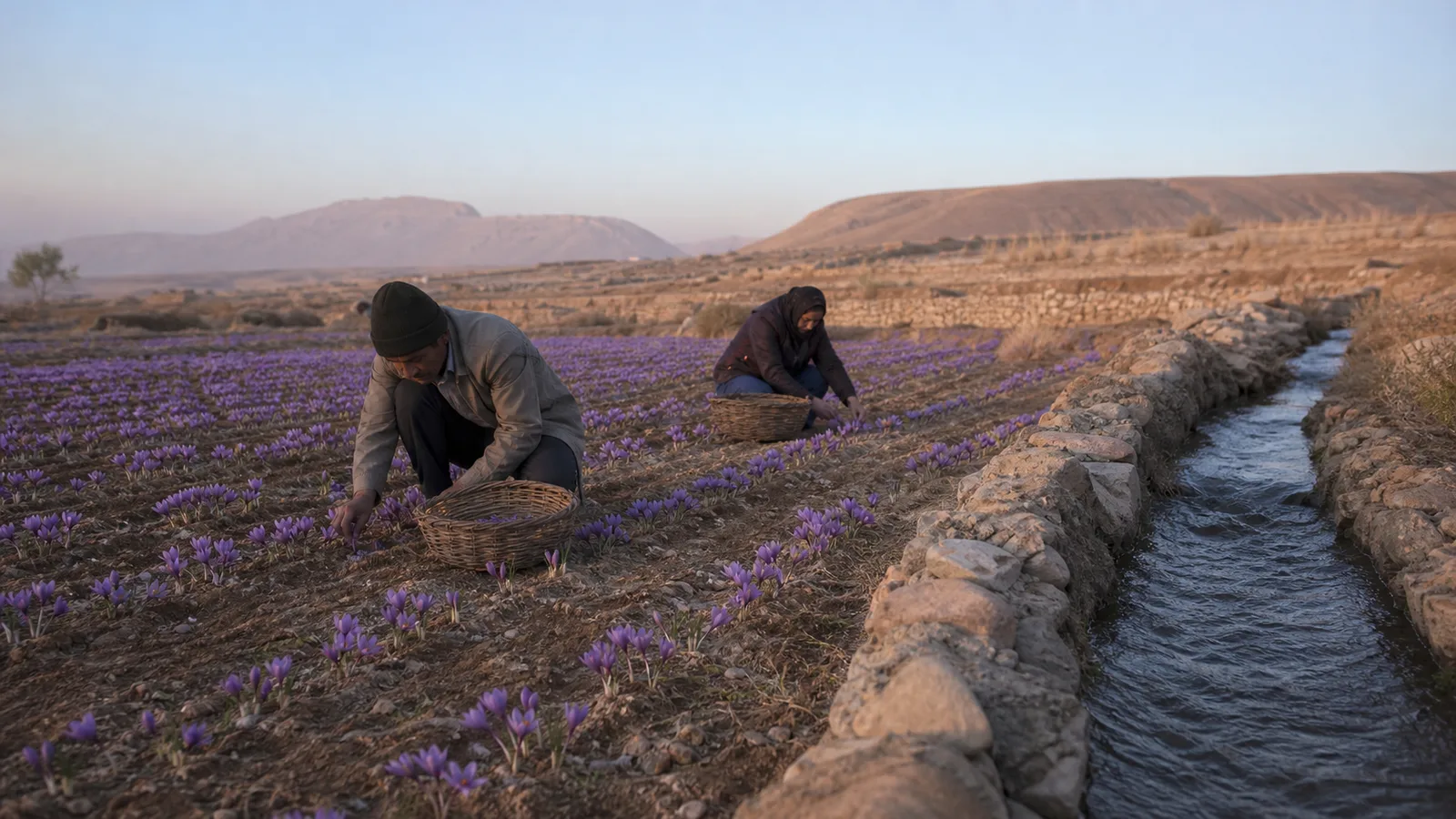
That distinction is sometimes described loosely as “world registration.” Its official name is the Qanat-based Saffron Farming System in Gonabad, Iran, and it is one of FAO’s Globally Important Agricultural Heritage Systems, or GIAHS. It is not a geographical-indication certificate for every packet of saffron, nor is it a blanket guarantee of product quality. It is recognition of a living agricultural system.
Why Gonabad’s saffron system received global recognition
Gonabad lies in a part of Khorasan where water is scarce. FAO’s official GIAHS profile for Gonabad explains that saffron suits these conditions because it needs relatively modest irrigation. The qanat supplies a dependable flow of groundwater without relying on modern pumping alone.
A qanat is a gently sloping underground channel. It carries water from an aquifer or the foothills to fields and settlements by gravity. Vertical shafts along its route provide access for construction, ventilation and maintenance. The system requires specialist knowledge: the gradient must be controlled, tunnels kept clear and the shared water distributed carefully.
FAO reports that saffron farms around Gonabad cover more than 2,000 hectares. Many occupy small terraces on sloping ground, with fruit trees such as almond and mulberry planted around some field edges. The result is a cultivated landscape shaped by water management rather than a single industrial plantation.
How qanat water and saffron fit together
Saffron crocuses remain dormant through the hottest part of the year and flower in autumn. Irrigation is timed to wake the corms and support growth, rather than applied continuously. This seasonal cycle makes saffron more compatible with an arid climate than many thirsty crops, although it does not make the plant drought-proof.
The qanat also changes the economics of farming. Gravity moves water without fuel at the point of delivery, but the tunnels and shafts still need inspection, repair and collective management. If a channel collapses or its source declines, every farm downstream can be affected. Protecting saffron production therefore means protecting the water system and the people who know how to maintain it.
A heritage designation is about people, not just a product
GIAHS sites are selected for connected qualities: food and livelihood security, agricultural biodiversity, local knowledge, culture and a distinctive landscape. In Gonabad, families have adapted field size, irrigation turns, harvesting and post-harvest work to a difficult environment. Those practices remain useful only while communities continue them.
Saffron harvesting is especially labour-intensive. Flowers are picked during a short season, often early in the day, and their red stigmas must be separated and dried with care. The value of the finished spice depends on all of those steps. A famous origin cannot compensate for poor drying, contamination, excessive moisture or misleading grading.
For visitors, the violet fields, qanat structures and villages create an opportunity for agricultural tourism. That opportunity needs restraint. Working channels and farms are not stage sets; visits should respect water infrastructure, harvest work and private land.
The proposed Sano village saffron celebration
The original report behind this article described a planning meeting for a celebration in Sano village. Gonabad governor Hamed Ghorbani said a local festival could introduce the farming system and strengthen recognition of saffron from Gonabad and Sano. The machine-translated version rendered his surname as “the victim” and Sano as “Snow”; those are translation errors, not separate people or places.
Ghorbani’s central point was that farmers and traders should be owners of the event rather than passive guests. He also wanted merchants, processors and investors included so that recognition could lead to durable local activity. A festival can bring buyers and visitors together, but its value depends on what follows: transparent sourcing, consistent handling, useful business relationships and benefits that reach growers.
What “branding Gonabad saffron” should mean
A place name becomes meaningful to a customer when it is supported by evidence. For Gonabad saffron, that can include the identified farm or cooperative, harvest year, product grade, net weight, storage conditions and laboratory results where relevant. The story of qanat agriculture adds context, but it should not replace ordinary food traceability.
Businesses also need to describe the FAO recognition accurately. The farming system is GIAHS-designated; FAO has not endorsed every seller or approved every product carrying the word Gonabad. Clear wording protects the heritage claim from becoming a vague marketing badge.
At the same time, selling only anonymous bulk material can separate the spice from its origin. Local cleaning, testing and appropriate packaging can retain more of that identity. The aim is not elaborate presentation for its own sake. Packaging should protect the threads from moisture, light, odour and physical damage while giving the buyer information that can be checked.
Gonabad within Iran’s historical export picture
The assigned source article placed Gonabad’s opportunity within Iran’s wider saffron trade. National Saffron Council figure Mohsen Ehtesham was quoted as saying that roughly 75–80% of Iranian saffron was exported and 20–25% consumed domestically. These were historical, attributed estimates, not a current customs series, so they should not be used as today’s market split.
The same source gave export figures of 217 and 235 tonnes but lost one of the year labels in translation. That ambiguity matters. The World Bank’s WITS presentation of UN Comtrade data records 203,348 kg of Iranian saffron exports in 2016 and 235,900 kg in 2017. The second figure closely matches the interview; the unexplained 217-ton number should remain part of the source’s account rather than be assigned a year by guesswork.
Historical figures also depend on the reporting system, product code and calendar used. An Iranian year and a Gregorian customs year do not align exactly. For current decisions, buyers and growers need a dated customs dataset rather than an old percentage repeated without context.
Why export volume does not guarantee local value
Ehtesham identified intermediaries, sanctions-related banking weakness and foreign-exchange rules as barriers. These affect different parts of a sale. Intermediaries may provide useful aggregation or market access, but a long chain can reduce origin visibility and the share retained near the farm. Payment restrictions can make an otherwise genuine order difficult to settle. Currency rules can add cost or uncertainty after the spice has already been produced.
World recognition does not remove those constraints. It can, however, give producers a stronger basis for explaining why the origin matters. When that story is paired with verifiable quality, reliable delivery and lawful payment arrangements, it is more likely to create repeat demand than a festival slogan alone.
What buyers should look for
A customer interested in Gonabad saffron should separate three questions:
- Origin: can the seller identify where the saffron was grown and handled?
- Product quality: are the grade, condition, aroma, colour and any laboratory claims supported?
- Heritage claim: does the description accurately connect the product with Gonabad’s qanat-based farming system without implying an endorsement that does not exist?
The strongest account of Iranian saffron in Gonabad is therefore not simply that the city is “global.” It is that a water-wise farming system, maintained across generations, received international recognition and still supports real agricultural work. Keeping that recognition valuable requires healthy qanats, skilled growers, careful processing and honest communication from field to customer.

![Exporting Saffron to Turkey + Price Guide [Complete 0 to 100]](https://img.rowhanisaffron.com/20260827003933/saffron-export-turkey-quality-inspection.webp)



