


Iranian saffron reaches European stores through both consumer packs and larger trade consignments. An old debate blamed bulk exports to Spain for lost Iranian value; Gholamreza Miri replied that “bulk” did not mean unpackaged and that the trade route was more complicated than repacking alone.
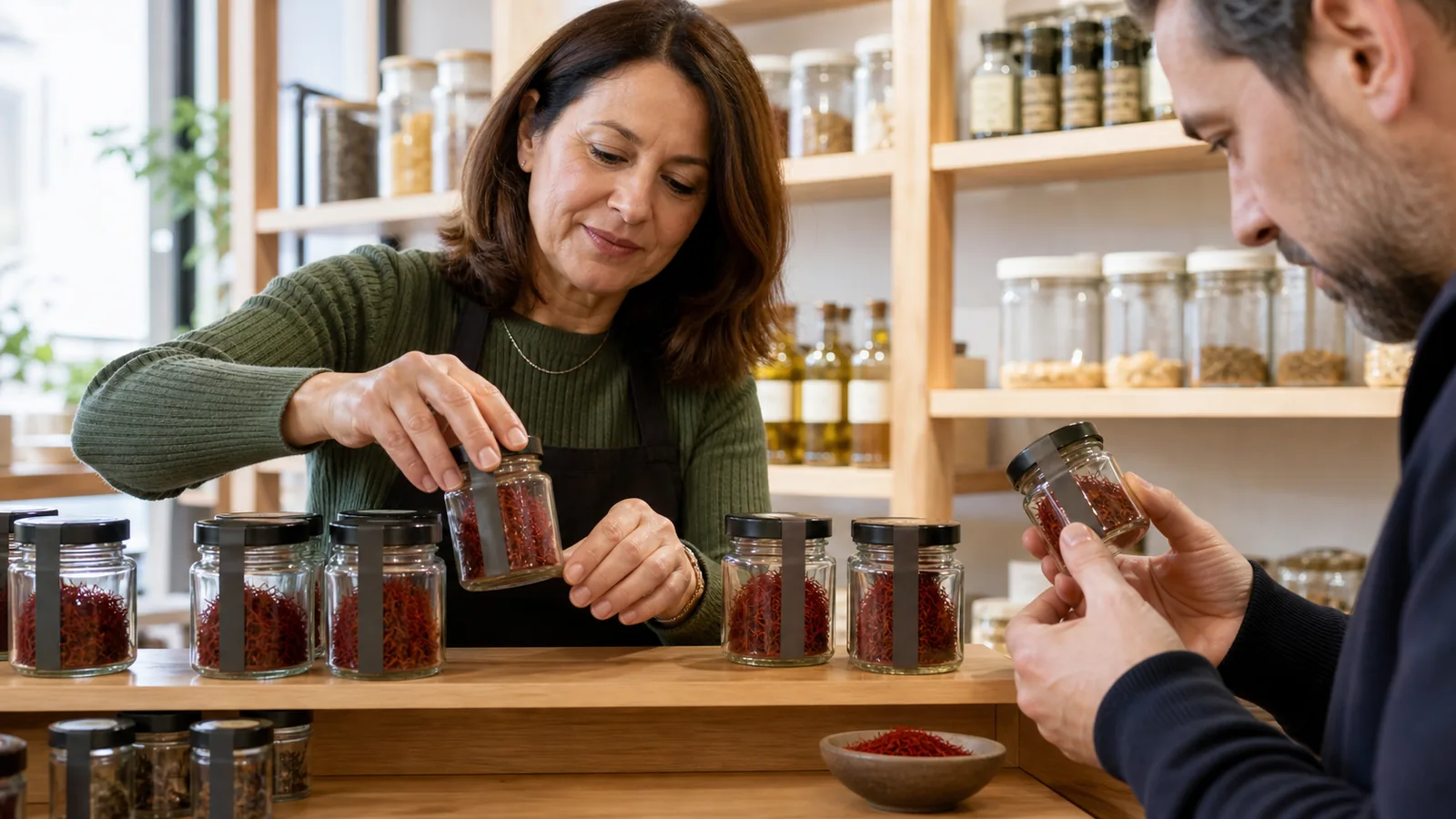
The archived report began with public requests to prevent saffron exports in bulk, especially to Spain. Petitioners said Iran produced 95% of the world’s saffron, alleged that Spanish firms bought it cheaply and resold it at many times the price in attractive packs, and blamed officials, brokers and intermediaries for growers receiving too little.
What Gholamreza Miri disputed
Miri, then vice president of the National Saffron Council, challenged two parts of that account. First, he said Iranian saffron was not shipped loose and unprotected. Second, he rejected the idea that Spain’s role could be explained only by changing an inadequate Iranian package.
His distinction is important. A bulk consignment still needs a food-safe container, batch identity and shipping documents. What it may lack is a finished consumer format designed for a particular European store, language and distributor. “Packaged” and “shelf-ready retail packaged” are not the same thing.
The package sizes in the original report
The stored English text says all saffron was exported in packages from 0.2 to 1 kilogram. Miri described smaller packages as suitable for stores and one-kilogram packs as mainly industrial.
The lower unit is ambiguous. If it is truly 0.2 kilograms, it means 200 grams, much larger than many household saffron packs. The source translation may have lost a gram symbol or decimal convention, but the original-language record is not available here. The number should therefore be preserved as reported, not silently converted to 0.2 grams.
Miri also said export packages carried trademarks, health markings, a brand name, quality information and an address. That was his description of the historic Iranian export system. It should not be used as a complete list of today’s requirements in every destination market.
What 2018 trade data say about Spain
World Bank WITS data based on UN Comtrade show that Spain imported 50,248 kilograms of saffron from Iran in 2018, valued at about $33.75 million. Iran was by far Spain’s largest recorded supplier in that dataset.
In the same year, Spain exported 78,898 kilograms of saffron worth $55.76 million. The figures establish that Spain was both a large importer and exporter. They do not identify which export lots contained Iranian-grown saffron or trace the same batch from import to a European shelf.
Aggregate customs unit values also do not support a simple “many times the price” claim. Spain’s recorded Iranian imports average roughly $672 per kilogram, while its world exports average roughly $707 per kilogram. Those averages mix grades, destinations, transaction dates and reporting practices. They are not retail prices, but they show why a multiple-price assertion needs batch-level evidence.
Iran’s position in the same market snapshot
The petitioners’ 95% production figure was a historical claim, not a current statistic established in the article. Trade data do confirm Iran’s scale as an exporter: the 2018 WITS record lists Iran first by saffron export value and quantity, at about $351.13 million and 279,608 kilograms.
Production share and export share are different measures. A country may grow saffron that is consumed domestically, stored or exported through another market. Another country may import, process, grade or re-export saffron without having grown the same quantity. Neither measure alone reveals how much of the final store price reaches a farmer.
Why saffron appears under a European brand
A European-facing business may provide import clearance, testing, quality sorting, compliant labels, local warehousing, smaller packs, sales relationships and retailer delivery. Those services cost money and can add market value. They do not change where the saffron was grown, and they should not justify misleading origin claims.
The price gap between a farm lot and a tiny retail jar also includes several transformations: moisture and foreign-matter checks, losses during cleaning, packaging materials, labour, laboratory analysis, financing, unsold inventory, distributor and store margins, and tax. A fair value-chain analysis accounts for each step instead of assigning the entire difference to a new label.
What a European store pack must communicate
Current EU rules for prepacked food require clear consumer information. The European Commission’s summary of mandatory food information includes the food name, net quantity, date marking, storage or use conditions where relevant, and the responsible food-business operator’s name and address, with origin information required in specified circumstances or where omission would mislead.
The exact requirements depend on the product and market, and a competent importer should confirm current EU and national rules. Attractive packaging cannot replace accurate identity, traceability and legible information. A retailer also needs confidence that the product in the jar matches the grade and origin offered.
Can brokers simply be removed?
The petition blamed brokers for buying cheaply from farmers. Miri responded that Iran’s production position should give it more control over price and suggested fixed-price future sales as a way to reduce speculative intermediary power. He said countries such as Spain used fixed-price selling.
That proposal needs more detail than the original article provides. A forward or fixed-price contract can give a grower and buyer greater certainty, but it also creates delivery, quality, counterparty and price-opportunity risks. It does not automatically eliminate the work performed by collection, testing, finance, storage and distribution.
The better question is which intermediary adds a verifiable service and what it costs. Transparent grading, published fees, traceable lots, cooperative selling and enforceable contracts can strengthen the grower’s position without pretending the product can move from thousands of farms to foreign stores with no coordination.
How more value can remain connected to Iranian origin
Preventing every large-format export is not the only route. Producers and exporters can pursue several channels at once:
- traceable bulk lots for processors that disclose Iranian origin accurately;
- food-service and industrial packs with consistent specifications;
- finished retail packs designed for the destination’s language and rules;
- cooperative grading and contracts that improve grower bargaining power;
- quality and origin evidence that follows the batch through repacking.
A smaller pack does not create value by itself. The buyer must trust its contents, the retailer must be able to sell it, and the producer must capture enough of the return to justify the additional work.
What the historical debate establishes
The report on Iranian saffron in European stores preserves a real dispute. Petitioners saw bulk trade to Spain as lost national value; Miri said all exports were packaged, described a 0.2-to-1-kilogram range, listed marks and identity details, and promoted fixed-price sales to limit speculation.
Trade data confirm large two-way Spanish saffron flows but not the claim that Spanish businesses simply multiplied the price by changing the package. The strongest lesson is that growing origin, customs origin, package format, brand ownership and final retail value must be traced separately. Only then can the share retained by farmers and Iranian businesses be measured rather than assumed.

![Exporting Saffron to Turkey + Price Guide [Complete 0 to 100]](https://img.rowhanisaffron.com/20260827003933/saffron-export-turkey-quality-inspection.webp)



