


The proposal to raise Khorasan Razavi saffron exports from US$300 million to US$1.2 billion was an industry plan, not a record of sales already achieved. Ali Shariati Moghaddam, then head of the Agriculture and Water Commission at the provincial Chamber of Commerce, presented the five-year target as a way to turn the region’s production strength into more export value.
The proposal matters because it brought several problems into one discussion: falling prices, difficult trade rules, the disruption of the COVID-19 pandemic, storage and finance for growers, weak processing capacity, and competition from new producing countries. This article combines those related reports while keeping their claims in their original historical setting.
What the US$1.2 billion saffron-export plan proposed
At a government–private sector dialogue meeting in Mashhad, Shariati Moghaddam argued that exports should become a central part of Khorasan Razavi’s development strategy. Working with Ferdowsi University, he said, the province could aim to increase the value of its saffron exports fourfold over five years, from about US$300 million to US$1.2 billion.
The report did not provide a start year, milestones, a product-code definition or a later result. Those omissions are important. The US$1.2 billion figure should therefore be read as an ambitious target discussed at that meeting, not as a current forecast or proof that the target was met.
That distinction is visible in independent trade data. The World Bank’s WITS portal, using UN Comtrade data for HS 091020, records Iranian saffron exports of about US$190.2 million in 2020 and about US$201.7 million in 2022. These are national customs figures, not a direct audit of a provincial plan, but they show why the proposed US$1.2 billion should not be presented as an accomplished export value.
Why Khorasan Razavi is central to the plan
The plan starts with genuine production strength. The UN Food and Agriculture Organization says Iran produces more than 90% of the world’s saffron and identifies Khorasan Razavi, South Khorasan and North Khorasan as its main producing provinces. Our detailed guide to Khorasan Razavi’s saffron production explains the province’s acreage, harvest work and export routes.
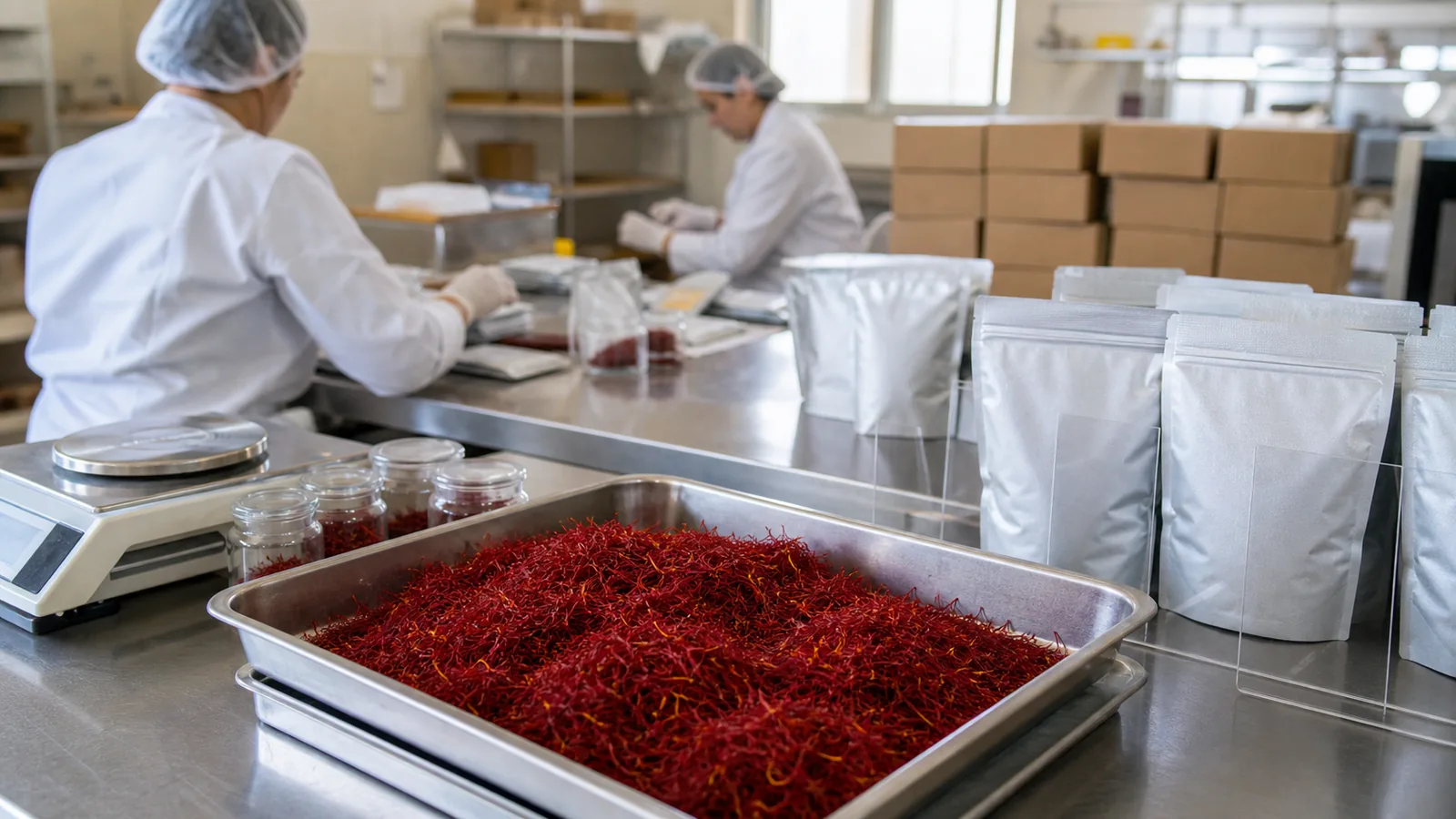
Production volume alone does not create export value. Flowers must be picked quickly, stigmas separated and dried correctly, lots tested, and the finished saffron stored and packed for identifiable markets. Authenticity, traceability and consistent quality are central to that work. FAO’s 2025 collaboration with Mashhad University focuses on those same issues: better authenticity testing, post-harvest practice and training across the Khorasan provinces.
The water claim needs a careful reading
The original report promoted greenhouse saffron and said it could reduce water consumption by 50 to 60 times. It supplied no cultivation method, baseline, yield comparison or study supporting that number, so it would be unsafe to repeat the figure as an established fact.
The sound principle underneath it is water productivity. FAO’s description of the Gonabad qanat-based saffron system notes that saffron is suited to an arid region and does not require large quantities of water. Any greenhouse proposal still needs a like-for-like field trial that measures total energy and water use, flower and stigma yield, quality, disease risk and cost per marketable gram before a saving can be claimed.
COVID-19 exposed the market’s weak points
In a separate pandemic-era interview, Shariati Moghaddam estimated that Iranian saffron exports had fallen by 15% to 20% by weight. He linked the decline to restaurant and airline closures, cancelled gatherings, reduced purchasing power, disrupted transport and fewer international business connections. This was his assessment of the COVID period, not a permanent rate or a prediction for today’s market.
The same interview described approximately 140,000 hectares under saffron across more than 20 Iranian provinces and expected production to rise 15% that year. It also said prices had been declining since Iranian year 1396, roughly 2017–2018, because output had grown faster than demand. These numbers are preserved as dated remarks from the official; they are not substituted for a current agricultural census.
One claim from the interview is deliberately excluded: that saffron could make medicines “smarter” or increase their effects. No medicine, dose, study or clinical evidence was identified, and the statement is not necessary to explain the export market.
Tariffs and informal routes distorted visible trade
Shariati Moghaddam described India’s tariff and associated commercial burden at the time as roughly 60%. He said that this encouraged some Iranian saffron to reach India through Afghanistan rather than through a direct Iranian export declaration. He also alleged unofficial movement to Pakistan and some Arab countries. Those routing and smuggling statements are attributed claims, not measured volumes.
The legal trade pattern in 2020 is consistent with a large Afghan route: WITS records India importing US$22.1 million of saffron from Afghanistan but only US$71,730 directly from Iran. That comparison cannot establish the origin of every Afghan shipment, and it does not prove the amount moved informally. It does show why origin records, tariff treatment and traceability are essential when evaluating Iran’s actual share of end-market value.
Why warehouse receipts can help saffron growers
A related interview asked whether Iran’s commodity exchange offered a promising route. Shariati Moghaddam viewed saffron futures as progress for organized trade, but said a futures market did not by itself provide direct support to growers. His preferred instrument was the commodity deposit certificate, a warehouse receipt backed by a physical lot.
In practical terms, an approved warehouse can receive a lot, test and identify it, and issue a certificate representing the stored saffron. The grower then has a documented asset that may be sold through a more transparent process instead of accepting the first cash offer at harvest. Proper storage can also protect a sensitive product better than an unsuitable village storeroom.
Certificates are not a complete solution. Testing must be prompt and credible, warehouse fees must be proportionate, finance must actually be available, and the lot represented by the certificate must retain its identity and quality. The original speaker also cautioned that exchange trading had not yet created meaningful added value through processing or branding.
Processing and product development were the missing value layer
Gholam-Hossein Shafei, then head of the Iran Chamber of Commerce, supplied a more cautious view. At a South Khorasan dialogue council meeting, he warned that more countries were entering saffron production while Iran was not adopting modern tools quickly enough. He called for a serious study of the crop’s future and said the Chamber would finance it.
Shafei also expected more demand from pharmaceutical and cosmetic industries and argued for investment in conversion and processing industries. That was a strategic expectation, not evidence that non-food uses had already overtaken culinary demand. The useful point is broader: exporting differentiated, tested and well-documented products can retain more value than selling anonymous bulk material. Any medicinal or cosmetic application must still meet the evidence, safety and regulatory rules of its destination market.
The national development-plan order
Another report recorded Industry Minister Reza Rahmani ordering the National Saffron Council to prepare a comprehensive development plan. The intended participants included the Ministry of Industry, Mines and Trade, chambers and trade associations, Parliament’s Industries and Mines Commission, the Central Bank, the national standards organization, commodity exchanges, universities, startups, and officials from Khorasan Razavi and South Khorasan.
An initial package was requested within three weeks. Unresolved proposals could be taken to the Supreme Export Council, and the minister said reforms to export currency-obligation procedures could be considered within a framework accepted by the Central Bank. These were process commitments from the reported meeting. The stored article contains no later document showing which proposals were adopted, so the draft deadline is not presented as a completed policy.
What would make Khorasan Razavi saffron exports grow?
A credible plan needs measurable work across the chain, not one headline number. At minimum it should define:
- a base year, customs product code, export value and net weight;
- target markets and the tariff, payment and documentation obstacles in each;
- lot-level identity, testing and traceability under recognized saffron standards;
- licensed drying, storage and packaging capacity;
- warehouse-receipt and working-capital access for growers;
- separate goals for bulk saffron, consumer packs and compliant industrial ingredients; and
- annual public reporting against the same definitions.
The older report also said an export-related rate had risen from 8% to 18%, while a support share described as 10% had fallen below 1%. Because it did not define either measure, those percentages cannot be compared responsibly with current policy. They remain evidence that exporters considered the facilities and rates inadequate, not usable performance indicators.
Did Khorasan Razavi reach US$1.2 billion in saffron exports?
The material reviewed for this article does not establish that the target was reached. The plan’s value lies in the problems it identified: market disruption, tariff friction, weak traceability, limited grower finance, insufficient processing and the need for coordinated policy. Current claims about progress should be judged against dated customs data and published milestones, not the proposal alone.
Khorasan Razavi remains the heart of Iran’s saffron economy, but sustainable export growth depends on earning more from every verified lot while protecting the growers who produce it. Transparent measurement, reliable quality control and products designed for real customer demand are a safer route than treating a fourfold target as a result.

![Exporting Saffron to Turkey + Price Guide [Complete 0 to 100]](https://img.rowhanisaffron.com/20260827003933/saffron-export-turkey-quality-inspection.webp)



