


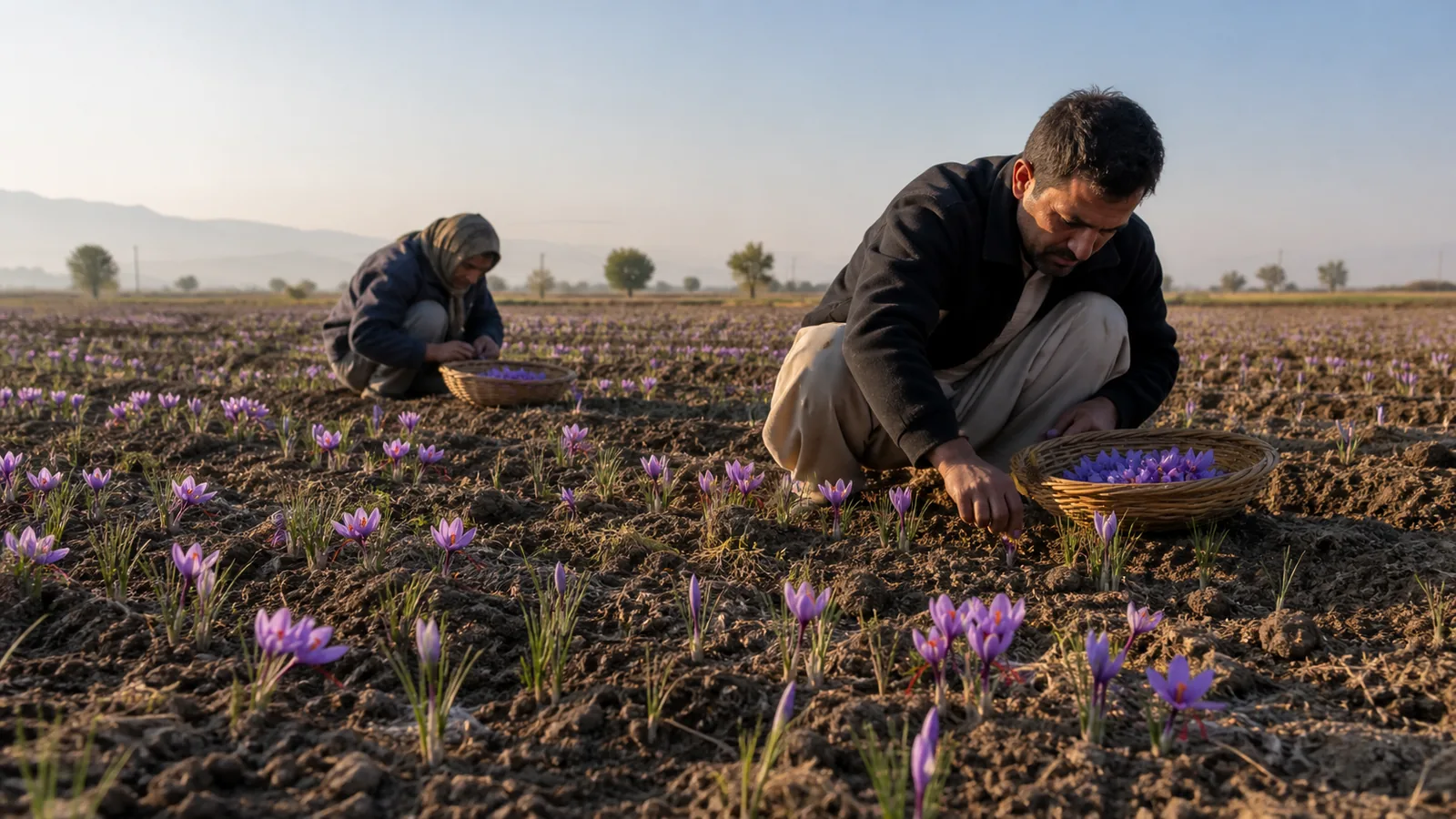
Saffron cultivation growth was taking place on both sides of Iran’s eastern border and within newer Iranian production areas. Two archived agricultural reports illustrate that change at very different scales: Herat was developing an export-oriented saffron industry measured in tonnes, while Khomein reported a sharp percentage increase from a much smaller local crop.
The figures in this article describe the periods covered by those reports; they are not current forecasts or production totals. Read together, they show what expansion required on the ground: suitable farms, grower training, processing capacity, dependable yields, and buyers able to take the finished spice to market.
Herat’s saffron harvest moved beyond a pilot crop
The earlier report focused on Herat Province in western Afghanistan, across the border from Iran’s Razavi Khorasan Province. Afghanistan’s then Minister of Agriculture, Irrigation and Livestock, Nasir Ahmad Durrani, said the province’s saffron harvest had risen from roughly seven tonnes in the previous season to more than 15 tonnes.
Describing that change as a 100% increase conveyed the scale of the expansion, although a rise from seven to more than 15 tonnes is slightly greater than a simple doubling. The important point was that Herat was no longer treating saffron as a small demonstration crop. Production had reached a level at which processing, quality control, and sales channels mattered alongside cultivation.
Independent reporting from the period also placed Afghanistan’s annual saffron output at about 15 tonnes, most of it produced in Herat. A TOLOnews report on the proposed Turkish market quoted Durrani on Turkey’s interest in buying Afghan saffron and the opportunity this could create for farmers and the national economy.
A training and production center connected the chain
Durrani announced the figures at the start of work on a saffron training and production center in Herat. He described the center as covering activities from propagation and cultivation through to marketing. That breadth is significant because growing more flowers does not by itself create a stronger saffron sector.
Saffron flowers must be harvested and processed quickly. The red stigmas need careful separation and drying, then protection from moisture, light, contamination, and adulteration. Growers also need access to healthy corms, practical field guidance, testing, packaging, and buyers. A center that connects those stages can help a region turn additional planted land into a consistent commercial product.
The report also reflected a policy objective in Afghanistan: promoting a legal, high-value crop as an alternative to opium poppy in suitable districts. Saffron offered a possible income stream, but the switch was never automatic. Farmers compare labor, risk, finance, water, crop timing, market access, and the reliability of payment. Training and a buyer are therefore as important as distributing planting material.
Turkey and China were identified as potential markets
The Herat report named Turkey and China as prospective customers. Turkish interest was especially important because officials discussed both direct demand and Turkey’s potential role as a bridge to other markets. At the time, tariffs and the cost of reaching buyers were practical concerns for Afghan producers.
More production can benefit growers only when quality and market access keep pace. If supply expands faster than processing or sales, farm-gate prices may weaken. If products from different origins are mixed or mislabeled, trust in the regional name can suffer. Contemporary reporting recorded Durrani’s concern about foreign saffron being exported under an Afghan label, showing that traceability was already part of the market discussion.
Saffron growth inside Iran: Khomein
A separate local report from Khomein, in Iran’s Markazi Province, showed expansion on a smaller base. Ahmad Reza Jafari, identified as director of the city’s Jihad Agriculture Department, said Khomein had produced and marketed 85 kilograms of saffron during the reported season. He described that as a 64% increase over the comparable period a year earlier.
Jafari put the average yield at five kilograms per hectare. At that yield, an 85-kilogram crop corresponds to roughly 17 hectares of productive area, although the original statement did not provide an exact cultivated-area figure or explain whether every plot had reached the same stage of maturity. The yield should therefore be read as a reported average, not a guarantee for another farm.
He linked saffron cultivation with local employment and said part of the crop was marketed beyond the immediate area. The translated source says it was “exported inside,” an incomplete phrase that most safely indicates distribution outside Khomein rather than documented international exports. The rewritten account does not turn that wording into a stronger trade claim.
Khomein’s honey figure adds agricultural context
In the same statement, Jafari reported that Khomein produced 155 tonnes of honey during the year. Honey is not part of the saffron output total, and the report did not claim that the two products were operationally connected. The figure is useful because it places the small saffron crop within a more diverse local agricultural economy.
For a district testing or expanding a high-value crop, diversification can spread risk and sustain work beyond the short saffron flowering season. It also changes what local support may be useful: beekeeper services, saffron processing, storage, packaging, and market development require different skills even when they serve the same rural communities.
Why the percentages need scale beside them
Herat and Khomein cannot be compared by percentage alone. Herat’s report discussed a rise of several tonnes and an emerging national export industry. Khomein’s 64% increase ended at 85 kilograms. Both indicate growth, but they describe different starting points, infrastructure needs, and market roles.
This is why responsible agricultural reporting should provide the final production quantity as well as the growth rate. A large percentage from a small base may represent an encouraging local trial, while a similar percentage in an established region can reshape processing and trade. Yield per hectare, harvested area, product quality, and sale price complete the picture.
A regional crop with local conditions
These two reports capture saffron spreading beyond its most familiar production centers. Herat was building a coordinated chain around a rapidly expanding harvest and international market ambitions. Khomein was demonstrating that a smaller Iranian district could produce a marketable crop and create seasonal work.
Neither case proves that expansion succeeds everywhere. Saffron remains labor-intensive, yields change as fields mature, and the value of the harvest depends on careful processing and credible sales channels. The lasting lesson is that saffron cultivation growth is strongest when agronomy, post-harvest handling, traceability, and demand advance together.

![Exporting Saffron to Turkey + Price Guide [Complete 0 to 100]](https://img.rowhanisaffron.com/20260827003933/saffron-export-turkey-quality-inspection.webp)



