


Moving saffron corms across a border can transfer the crop’s planting material, but it does not by itself establish a new commercial rival. A competitive saffron industry also needs suitable growing conditions, healthy corms, skilled labour, careful drying, quality control, traceability and dependable routes to market.
The archived report behind this article used the headline “Chinese red gold rival of Iranian saffron.” Its evidence was much narrower. Mohammad Reza Ghodsi, then identified as Director of Horticulture at the Khorasan Razavi Agricultural Jihad Organization, warned about saffron planting material being smuggled out of Iran. The report did not name a Chinese producer, give a destination for the corms, or provide Chinese cultivation, production or market-share figures. The China claim therefore needs to remain a question, not a conclusion.
Why saffron corms matter
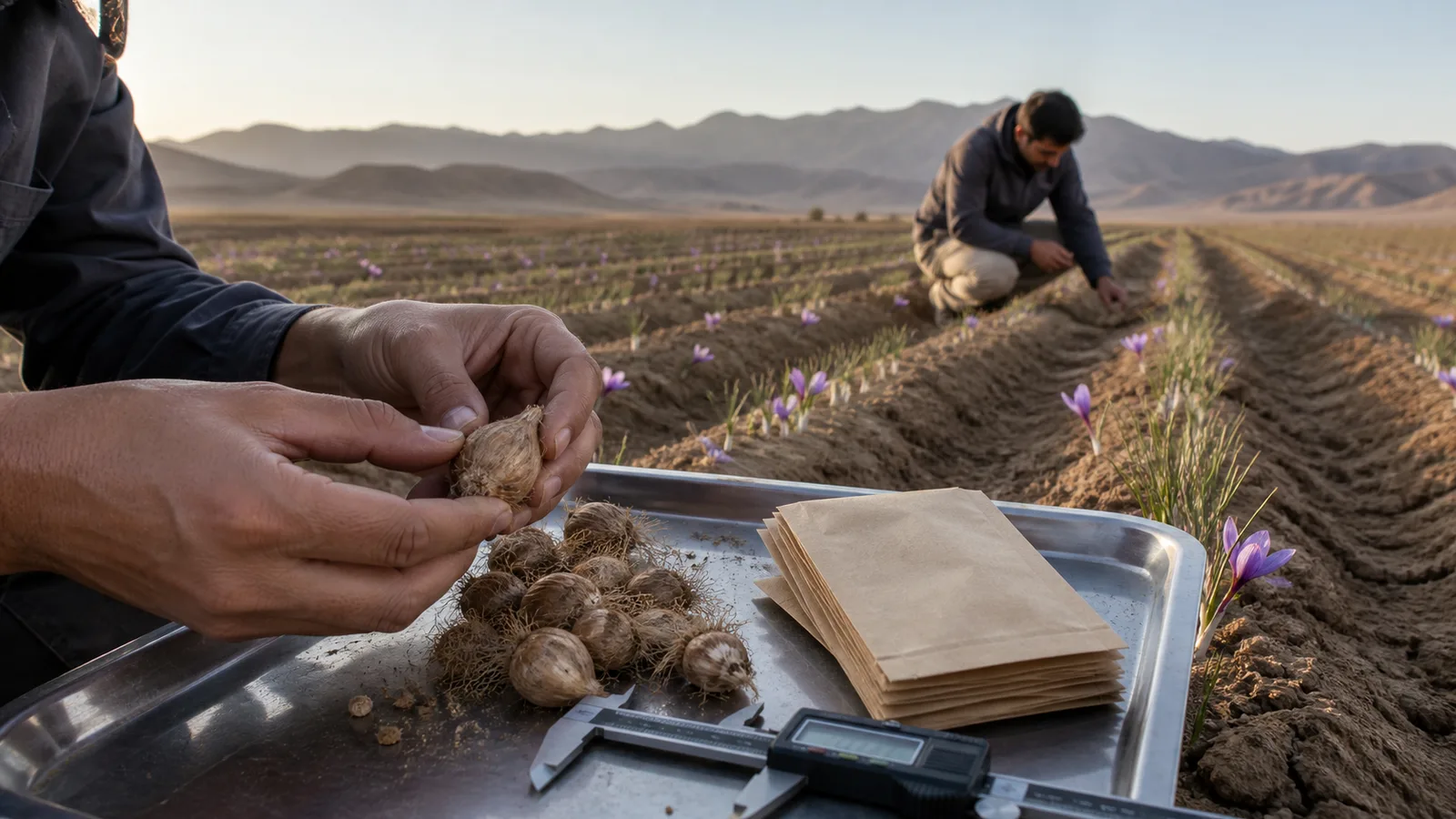
The “saffron onions” mentioned in the original translation are more accurately called saffron corms. They are compact underground stems used to establish and renew a saffron field. Cultivated saffron, Crocus sativus, is a sterile triploid plant; it does not produce a commercial crop from seed and is propagated vegetatively.
A 2024 study of saffron corm development describes reproduction as occurring exclusively through corms and notes that corm size influences yield. That makes planting material economically important. It also explains why unrecorded movement can concern growers and agricultural authorities: the material can establish new fields, and its health, origin and handling may be unknown.
Yet a corm is only the beginning. Moving genetic material does not reproduce the knowledge, labour system, post-harvest discipline, laboratories, buyer relationships or reputation built around an established producing region.
What the Khorasan official actually warned about
Ghodsi said military and law-enforcement bodies were actively confronting saffron corm smuggling, but alleged that bulk quantities were still crossing Iran’s borders. The short report supplied no seizure records, dates, volumes, routes or named destination. That statement should be treated as an attributed contemporary warning, not as independently verified evidence of a particular shipment.
He also argued that approval of a comprehensive saffron plan would ease concern about the crop. The article did not identify the plan, its legal status or its provisions, so it cannot tell readers whether that proposal was later approved. The useful policy question is broader: how can a producing region protect clean planting material, raise farm productivity and retain value without relying on unsupported claims about competitors?
Would exported corms create a Chinese saffron rival?
They could help establish or expand cultivation wherever climate, soil and production systems are suitable. That is a biological possibility, not proof that the smuggled corms described in the report went to China or created a rival industry there.
Commercial competition is measured with evidence: area under cultivation, harvested output, quality, cost, export volume, destination markets and the value retained by growers and sellers. None of those measures appeared in the archived item. Calling China a confirmed rival would therefore overstate the source.
The more defensible conclusion is that uncontrolled corm movement can lower one barrier to cultivation elsewhere. Iran’s durable advantage cannot depend on keeping a crop physically confined. It depends on producing reliably, protecting authenticity and connecting verified quality to customers.
A 30% production decline was a forecast, not a permanent fact
Ghodsi described the saffron price at the time as favourable and relatively stable, while forecasting that minimum provincial production would fall by 30% compared with the previous year. The original article did not provide the year, baseline tonnage, final harvest or calculation. The figure belongs to that historical forecast and should not be read as a current production statistic.
This distinction matters because saffron output can vary with corm condition, rainfall and irrigation, temperature, field age, disease, labour and harvest timing. A prediction can communicate concern, but later harvest data are needed to establish what occurred.
Water scarcity was the underlying concern
The report linked the production outlook to drought and a sharp decline in underground water resources. Ghodsi attributed a striking statistic to meteorological records: only 10 wet years and 90 dry years over the preceding century. No weather station, precipitation threshold or reference period was supplied, so the 10/90 split cannot be checked from the article alone.
The regional water problem itself is well established. The UN Food and Agriculture Organization’s description of the qanat-based saffron farming system in Gonabad places it in an arid and semi-arid area with severe water shortages. FAO notes that saffron requires comparatively little water and that qanat irrigation supports production and rural livelihoods. “Low water” does not mean “no water,” nor does it make every cultivation method suitable for every field.
What “modern agriculture” should mean here
Ghodsi urged farmers to move toward modern agriculture because it could use less water and remain economically viable. He referred specifically to greenhouse crops and pressurised irrigation. Those are tools, not universal prescriptions. Open-field saffron, greenhouse vegetables, pistachio orchards and pomegranate orchards have different water, climate and investment requirements.
For a saffron grower, a modern approach is better defined by measured decisions:
- start with healthy, traceable corms of an appropriate size;
- test soil and irrigation water before setting a nutrition programme;
- schedule irrigation for local soil, weather and crop stage rather than by habit;
- monitor corm health and remove diseased material;
- harvest flowers promptly and separate stigmas hygienically;
- dry and store saffron under controlled conditions; and
- record each lot so quality findings can be traced back to the field.
These practices connect water efficiency with saleable quality. A new irrigation system is valuable only if its design, operation and crop response justify the cost.
The province’s “healthy products” programme
The archived report said the Khorasan Razavi organization wanted gardeners to move toward “healthy products.” It described planned work across 200 hectares of pistachio orchards and 100 hectares of pomegranate orchards, with related work in saffron. It also said funding had been provided for a pistachio-orchard nutrition plan because pistachios were considered a valuable crop.
“Healthy” is not a sufficiently precise product standard on its own. For saffron, meaningful assurance requires defined cultivation and post-harvest practices, residue and contaminant controls where applicable, authentic identity, accurate labelling and records that connect a batch to its source. Readers comparing products can learn more from documented Iranian saffron standards and quality controls than from a broad label.
The stronger response to competition
Corm control may be one part of agricultural governance, but it cannot be the whole strategy. In 2025, an FAO and Iranian Ministry of Agriculture-Jahad workshop framed the current challenge around climate pressure, water scarcity and growing global competition. Its programme covered production, post-harvest handling, safety, traceability, modern marketing and digital branding.
That is the practical answer to the concern behind “Chinese red gold rival of Iranian saffron.” Treat reports of smuggling seriously enough to investigate, but do not turn an undocumented route into a market fact. Protect planting material and water at farm level, then protect quality and identity all the way to the buyer. A competitor can acquire corms; earning long-term confidence is the harder work.

![Exporting Saffron to Turkey + Price Guide [Complete 0 to 100]](https://img.rowhanisaffron.com/20260827003933/saffron-export-turkey-quality-inspection.webp)



