


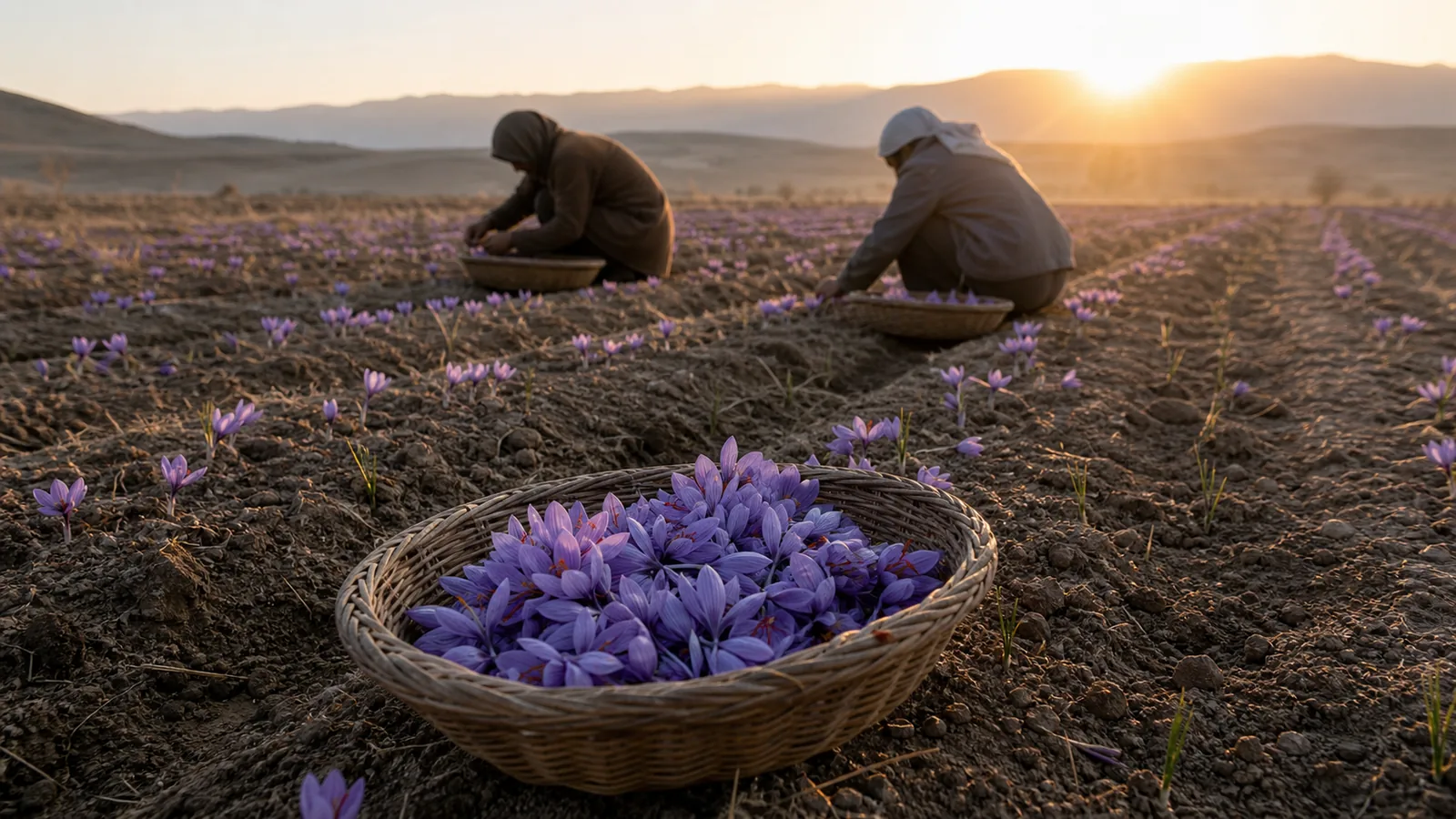
Khorasan Razavi is widely documented as the leading saffron-producing province within Iran, the largest producer of saffron in the world. The province’s scale is not a recent marketing claim: official historical data recorded more than 69,000 hectares of saffron and over 218 tonnes of production there in the 2014–2015 crop year.
Numbers in older news stories can look contradictory because they refer to different crop years, customs gates or definitions of “exports.” This guide separates current institutional context from dated production and trade snapshots, while preserving what those reports tell us about the province’s farms, processing sector and route to market.
Why Khorasan Razavi leads saffron production
Saffron suits the province’s dry climate, cold winters and long-established irrigation knowledge. It is a high-value crop on relatively small plots and requires most of its labour during the short autumn flowering period. Generations of growers around Mashhad, Torbat-e Heydarieh, Zaveh, Mahvelat, Gonabad and neighbouring districts have built specialized skills in corm care, picking, stigma separation and drying.
The importance is larger than acreage alone. The destination’s historical official estimated that saffron supported around 550,000 livelihoods across the Iranian sector. He also said agriculture represented about 24% of provincial employment while contributing about 13% of Khorasan Razavi’s economic activity. Those are dated statements rather than a current labour census, but they show why saffron policy affects many small farms and seasonal workers.
Iran remains the world’s leading saffron country
In September 2025, the UN Food and Agriculture Organization stated that Iran produces more than 90% of the world’s saffron. FAO identified Razavi, South and North Khorasan as the main producing provinces and announced work with Mashhad University of Medical Sciences on authenticity testing, post-harvest practice and training.
That makes Iran the leading country. Calling Khorasan Razavi the leading province is supported by the provincial breakdown below, but country and province should not be mixed. The original article’s phrase “South Africa” was a translation error for South Khorasan.
The official provincial production snapshot
An Iranian government submission to the FAO/WHO Codex Committee provides a clear historical baseline. For 2014–2015 it reported:
- Razavi Khorasan: 218.348 tonnes from 69,407 hectares, with an average yield of 3.1 kg per hectare;
- South Khorasan: 48.019 tonnes from 14,727 hectares;
- North Khorasan: 2.640 tonnes from 635 hectares; and
- other listed Iranian provinces combined: much smaller individual totals.
The figures come from Iran’s Ministry of Agriculture-Jahad and appear in Codex paper CX/SCH 17/3/12. They correct three damaged lines in the old translation: the area was measured in hectares, yield was about 3.1 kilograms per hectare rather than grams, and annual provincial production was measured in tonnes, not “people.”
A separate UNIDO value-chain study describes the concentration of small saffron farms in Khorasan Razavi. That fragmented farm structure helps explain both the crop’s social reach and the challenge of consistent harvesting, drying, aggregation and traceability.
Two historical saffron-export snapshots
The destination and its absorbed source report similar volumes but very different values:
- One provincial official said 123 tonnes of saffron worth US$375 million had been exported in the preceding year, with 43 licensed processing units operating in Khorasan Razavi.
- The absorbed ILNA report said 128,479 kg, or 128.479 tonnes, worth US$180,728,444 moved through the province’s customs offices and border markets in its reporting year. It described growth of 145% by weight and 150% by value compared with Iranian year 1394.
These should not be blended into one total. The stored articles do not supply precise Gregorian reporting dates or matching scope definitions. One may refer to saffron originating in the province, while the other explicitly concerns shipments cleared through provincial customs and border markets. Currency valuation, shipment timing and revisions may also differ.
The responsible conclusion is that both are historical statements, not current export figures. A modern quote about Khorasan Razavi exports needs a year, data owner, product code, customs scope, net weight and declared value.
Where Khorasan Razavi’s saffron exports travelled
The archived ILNA account named Afghanistan, Spain, Kazakhstan, Uzbekistan, Pakistan, the Netherlands, India and Qatar among destinations for the province’s exports. It also described Afghanistan, Turkmenistan, Tajikistan and Central Asian markets as important to the province’s broader export geography.
Those lists are not contradictory. One describes reported destinations for major goods in a particular year; the other summarizes strategic regional markets. They should not be read as a current ranking.
Five customs offices and two border markets
Khorasan Razavi’s location gives it multiple trade corridors. The source identified five customs offices:
- Lotf Abad;
- Sarakhs;
- Bajgiran;
- Dogharoun; and
- Mashhad.
It also named two border markets: Taybad on the Afghanistan border and Bajgiran on the Turkmenistan border. The customs network handles much more than saffron, so a product’s province of origin and the customs point where it leaves Iran are separate data fields.
The wider customs picture behind the saffron figure
The ILNA source placed saffron within a much larger provincial trade report. It said 4,435,335 kg of pistachios worth US$39,198,963 were exported, alongside construction materials, manufactured goods, eggs, industrial tallow and preforms. It also reported imports of 431,000 tonnes worth US$396 million, including cotton, grain, rail wagons and rice.
The stored English translation renders the province’s total export weight ambiguously: it can be read as either 298,000 or 2,098,000 tonnes. Because the original linked story and a clean source field are missing, that total weight should not be guessed. The reported total export value was US$1.704 billion. Against US$396 million of imports, the arithmetic implies a positive trade balance of about US$1.308 billion, not the US$1.308 million produced by the old translation.
The report also counted 2,476,900 passenger movements through border customs and Mashhad airport: 1,239,389 entries and 1,237,511 exits. These figures provide logistics context, but they are not saffron-export measures.
Why production leadership does not guarantee export value
The destination’s official listed persistent barriers: traditional production methods, plots often smaller than one hectare, limited crop insurance, weak transfer of research findings, insufficient packaging, lack of working capital, limited promotion and bulk exports. These problems can leave more value in processing and branding markets than in the producing villages.
Production scale also creates a quality-control challenge. Thousands of small lots must be harvested quickly, dried consistently, protected from moisture and contamination, combined without losing traceability, and tested against a clear specification. FAO’s recent work in Mashhad focuses on exactly those issues: authenticity, standardized testing and field-ready post-harvest guidance.
Our guide to Iranian saffron standards explains what ISO 3632 testing can and cannot establish. The article about Gonabad’s saffron and qanat heritage gives the local farming context behind one part of Khorasan Razavi’s production system.
What buyers should verify
“From the world’s largest producer” is useful context, but it is not a lot-level quality certificate. A serious buyer should request:
- country and region of harvest;
- producer, cooperative or supplier traceability;
- harvest year and storage history;
- thread style and agreed specification;
- representative sampling and laboratory results;
- food-safety and contaminant evidence where required;
- packing location, net weight and lot code; and
- Incoterm, destination and quote-validity date.
Origin can support identity and tell a valuable agricultural story. Clean handling, representative testing and transparent documentation determine whether a particular shipment earns that reputation.
Is Khorasan Razavi still the largest producer of saffron in the world?
The strongest current institutional statement is that Iran remains the world’s leading saffron-producing country, with more than 90% of production according to FAO in 2025. The latest detailed province table cited here is historical, but it clearly places Khorasan Razavi first within Iran at 218.348 tonnes in 2014–2015, well ahead of South Khorasan at 48.019 tonnes.
Newer province-level totals may change with weather, corm age, acreage and reporting methods. The enduring point is the scale of the Khorasan cluster: Razavi, South and North Khorasan combine cultivation knowledge, rural livelihoods, processing capacity, laboratories and trade routes in a way no single headline number captures.

![Exporting Saffron to Turkey + Price Guide [Complete 0 to 100]](https://img.rowhanisaffron.com/20260827003933/saffron-export-turkey-quality-inspection.webp)



