


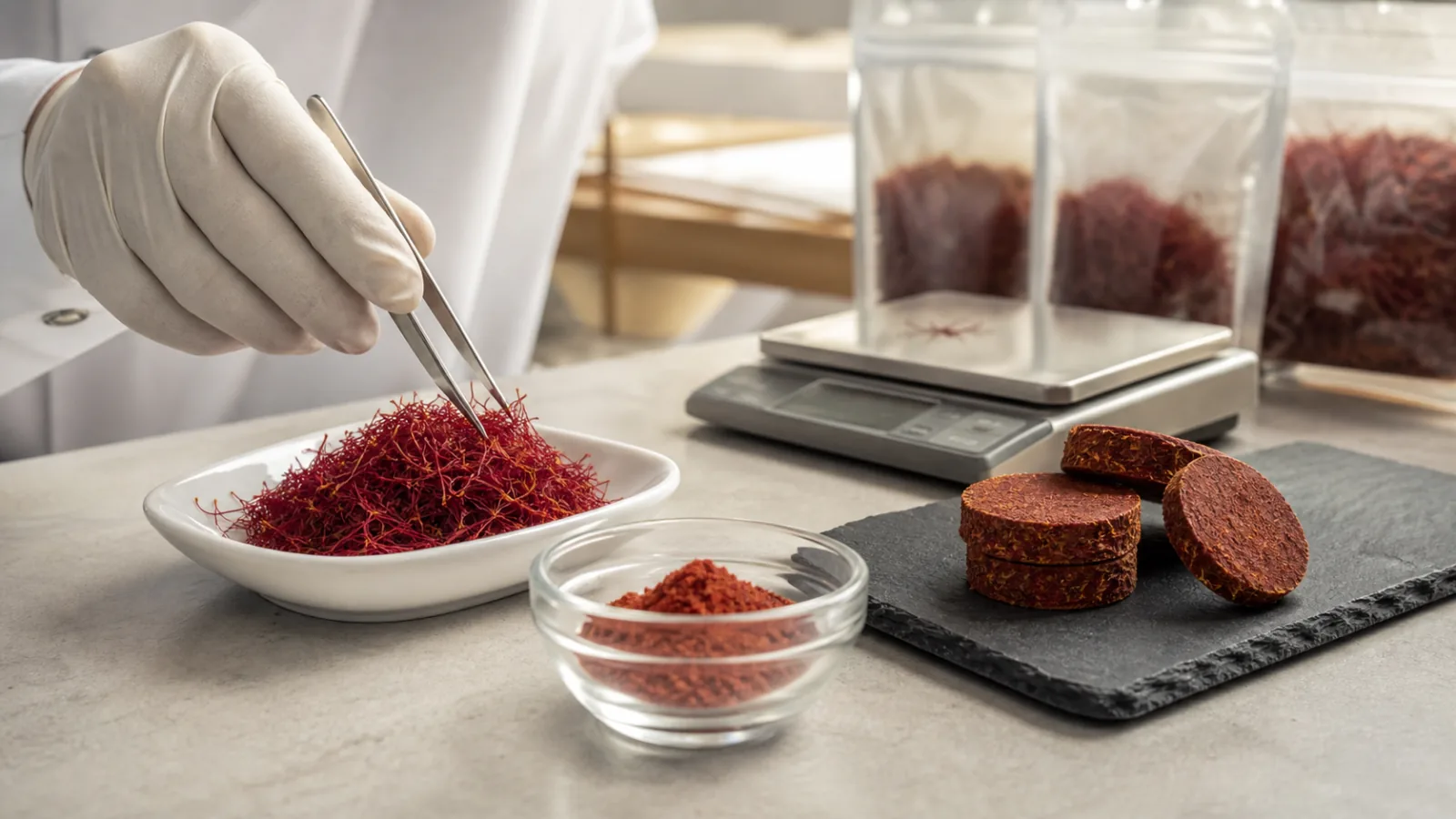
Saffron can be exported as whole threads, powder or a compressed food tablet, but each form needs accurate labelling, traceable raw material and protection from light, moisture and contamination. The old title “Grain export and powdered saffron” came from a poor translation: the historical report discussed saffron tablets and saffron powder, not cereal grain.
The report described a processing factory in Khosf, South Khorasan, and recorded its stated capacity, output, prices and exports at that time. Those numbers are useful as an industrial snapshot. They are not current production figures or a recommendation to buy the named products today.
Whole saffron, powder and tablets are different products
Whole saffron is sold as dried stigmas or pieces of stigma. The buyer can inspect thread colour, shape and the amount of yellow style present, although appearance alone cannot confirm origin or chemical quality. Threads also keep less surface exposed to oxygen than powder.
Saffron powder is the same spice after milling when it contains no other ingredient. It disperses quickly and can be convenient for food production, but grinding makes visual inspection difficult. A saffron powder export therefore needs stronger controls over the incoming lot, milling equipment, sample retention and contamination.
A compressed saffron tablet is a portioned format. It should not automatically be called a medicine or supplement. A food tablet may consist only of compressed saffron, or it may contain a processing aid or other ingredient. The label and specification must say which. “Tablet” describes shape; it does not prove purity, strength or a health effect.
The historical Khosf factory report
The original article described the Khosf saffron tablet factory as the only producer of its kind in Iran at that time. It attributed annual capacity of 25 million saffron tablets, two tonnes of saffron powder and one tonne of packed saffron to the facility.
It also said the factory had exported about $100,000 worth of saffron tablets, powder and packaged saffron in the previous year. No destination list, customs code or shipment record accompanied the translated report, so the value should remain an attributed historical statement rather than be treated as a verified current export total.
The report said the factory had been registered in 2011 to improve saffron processing and develop research-based products. Its translated text referred to ten people on the production line and eight in an entrepreneurship or business unit. The manager’s name and the factory name appear inconsistently in the surviving English translation, so this article does not manufacture a definitive spelling.
Pack sizes and production figures, translated carefully
The archived report referred to tablets in packs of two and four and saffron powder in 0.2-gram packs. It recorded 20,000 packs of two- and four-piece tablets and 60,000 packs of 0.2-gram powder in the preceding production year.
The old machine translation rendered the powder as “2 tbsp,” which is incompatible with the stated product and price. The intended measure was two-tenths of a gram. A tablespoon of saffron powder would be many times larger and would not make sense as the same retail unit.
Likewise, the capacity of 25 million tablets is not the same as actual annual output. Capacity describes what a line is designed to produce under specified operating conditions. Actual output depends on orders, raw material, labour, maintenance, quality release and working days.
Why the historical prices should not be reused
The report listed prices in tomans for two- and four-tablet packs and a 0.2-gram powder pack. Its translated sequence is ambiguous, but appears to refer to roughly 1,650 tomans for the smaller tablet pack, 2,800 tomans for the four-piece pack and 1,000 tomans for powdered saffron.
These are nominal retail prices from an old article. Inflation, exchange rates, saffron grade, pack material and distribution costs make them unsuitable for present-day comparison. Repeating them as a current price would mislead readers and could create a poor buying decision.
Quality controls for powdered saffron
Powder requires a documented chain from the original saffron lot to the final pack. A processor should record supplier, lot number, receipt date, inspection, cleaning, milling, batch yield and release decision. Equipment must be cleaned between lots so an earlier product does not contaminate the next one.
Grinding also makes substitution harder to see. Laboratory testing can assess identity and quality characteristics, while packaging protects the tested product after release. A certificate should identify the exact batch; a generic certificate for a supplier or brand does not prove the contents of every packet.
The Codex standard for dried or dehydrated saffron covers filament, cut filament and powder forms. It sets requirements for identity, quality, contaminants, hygiene, weights and measures, and labelling. Exporters still need to check the legal requirements of the destination market and the buyer’s agreed specification.
Packaging for export
Saffron is sensitive to light, air, moisture and foreign odours. A suitable export pack needs an effective barrier, a sound closure and materials approved for food contact. The outer carton must protect small packs from crushing and should keep lots separate.
At minimum, commercial documentation normally needs a clear product name, net quantity, batch identification, producer or packer information, origin where required, storage conditions and relevant production or best-before dates. The exact wording and language depend on the destination.
Powder and tablets must not be labelled in a way that implies a stronger product than the specification supports. If a tablet contains anything besides saffron, that ingredient belongs on the label. If it is pure compressed saffron, purity still needs batch evidence rather than a slogan.
Does processing always create more value?
Processing can make saffron easier to use and can create a branded retail product. It also introduces costs: grinding losses, specialised equipment, validation, packaging, testing, registration, distribution and returned stock. A format adds value only when a real customer wants it at a price that covers those costs.
Whole threads can be the better export form for buyers who want to inspect and mill the saffron themselves. Powder can suit commercial kitchens or manufacturers that need rapid dispersion. Tablets can provide portion control, but only if they dissolve as intended and the pack explains their use.
South Khorasan’s role
The old report described South Khorasan as Iran’s second-ranking saffron province after Razavi Khorasan and claimed a 1,200-year local cultivation history. South Khorasan is unquestionably a major production region, but the precise historical duration was not supported by a cited archaeological or documentary source in the article.
The strongest conclusion is not the age claim. It is that a producing region was trying to retain more value by processing and packing saffron locally. That objective remains sensible when it is built on verifiable quality, honest labels and products designed for actual buyers.
Technical reference: Codex Standard CXS 351-2022 for dried or dehydrated saffron. For practical buying checks, see our guide to identifying pure saffron, standards and packaging.

![Exporting Saffron to Turkey + Price Guide [Complete 0 to 100]](https://img.rowhanisaffron.com/20260827003933/saffron-export-turkey-quality-inspection.webp)



