


The government’s decision to improve export of saffron was part of a much broader national plan. Iran’s Cabinet approved a programme covering production, processing, distribution and exports, with the Ministry of Agricultural Jihad responsible for coordinating the work and reporting progress annually to the Cabinet Office.
This was a time-bound policy document, not a description of today’s saffron sector. It set targets for the Persian year 1400, which ended in March 2022, and was promulgated by First Vice President Mohammad Reza Rahimi. Its numbers should therefore be read as a baseline and a set of intended outcomes, not as current production, export or processing capacity.
What the national saffron programme intended to change
The plan’s full title was “Improving the Production, Processing, Distribution and Export of Saffron.” It aimed to organise growers, processors, marketers and exporters under the supervision of the National Saffron Council. The Ministry was given up to five years to create the conditions for making the standards in chapter five compulsory and was expected to submit an annual implementation report.
The headline ambitions for 1400 were:
- raise annual saffron production to 500 tonnes;
- improve average yield to seven kilograms per hectare;
- increase average annual exports from about 130 tonnes to 350 tonnes;
- generate more than US$1 billion by identifying and developing sales markets;
- bring domestic and international prices into better balance;
- improve quality and reduce impurities;
- strengthen Iran’s position in international saffron standards, Codex work and intellectual-property protection; and
- establish a recognisable national identity for Iranian saffron.
These goals connected the whole value chain. Growing more saffron was only one part of the decision. The programme also recognised that poor market knowledge, inconsistent processing, weak packaging and limited access to end customers could prevent producers from retaining the value of their crop.
The production baseline and yield target
The decree described Iran as producing more than 96% of the world’s saffron at the time. It recorded total production of 239 tonnes in the Persian year 1389 and an 18-year average yield of 4.32 kilograms per hectare. From that baseline, it sought a yield of seven kilograms per hectare and total production of 500 tonnes by 1400.
Those figures were targets, not guaranteed forecasts. Saffron yield depends on corm quality and density, field age, irrigation timing, soil, weather, disease, harvest labour and post-harvest handling. A national average can also hide wide differences between provinces and farms. Later data submitted by Iran during Codex work recorded 239.244 tonnes in 2010–11, 254.060 in 2011–12, 261.520 in 2012–13, 311.073 in 2013–14 and 280.323 in 2014–15. That series shows progress was not a straight line.
Farm identification, training and mechanisation
The production strategy was to strengthen growers financially, reduce production costs, improve hygiene and build a culture of quality. The proposed tools included separate identity records for saffron growers, farms and operating units, supported by related databases.
The plan also called for training saffron technical experts and using them in farm management, with priority for specialists from agricultural engineering and technical-consulting companies. Skilled machinery operators were to be trained, while growers would be encouraged to participate in farm-renovation and mechanisation projects.
Examples in the original decision included two-row corm planters, flower-harvesting equipment and stigma-separation machines. The old translation rendered this awkwardly as “machinesLego, such as onions, two-row.” In context, it referred to model machinery for planting saffron corms—not onions in the culinary sense—and for handling flowers and stigmas. Mechanisation was presented as a way to improve consistency and labour efficiency, not as proof that delicate harvesting could be fully automated without quality trade-offs.
Processing and packaging targets
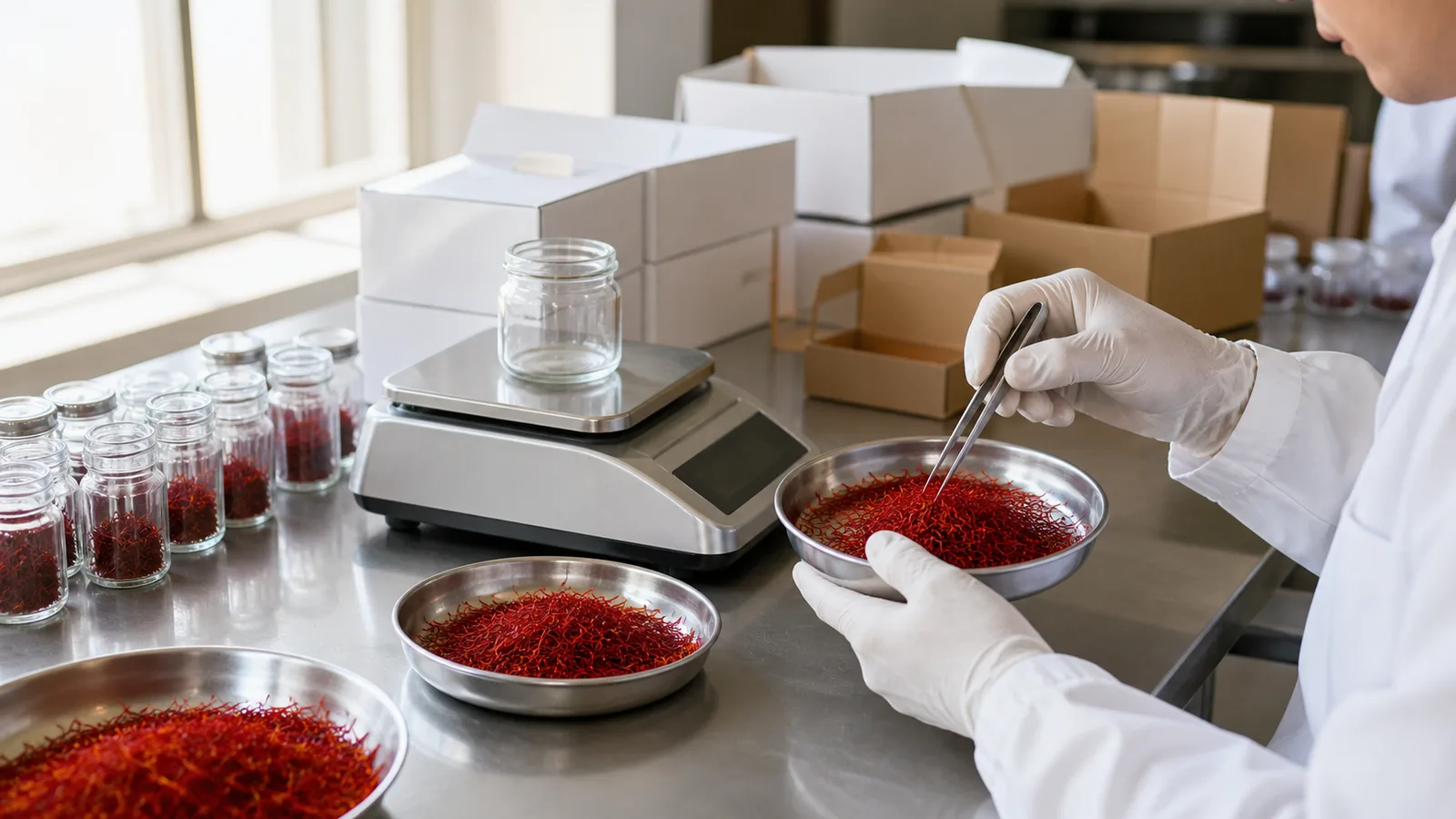
At the programme’s baseline, Iran reportedly had 73 licensed saffron grading and packaging units with a combined annual capacity of 888 tonnes. The 1400 target was 87 licensed units and 963 tonnes of capacity. Capacity is not the same as actual throughput: it describes what licensed facilities could process under stated conditions, not the amount they necessarily handled in a year.
The processing strategy was to reduce impurities, increase the export value of saffron and its by-products, and offer package formats suited to different markets. Planned actions included:
- training packing-unit owners in technical and health requirements for spices and seasonings;
- issuing identity records for processing and packing units;
- equipping grading and packaging lines with modern tools; and
- organising sorting and packaging units through agricultural and saffron cooperatives.
These were practical measures because saffron’s high value makes it vulnerable to excess moisture, foreign matter, substitution and misleading grading. ISO 3632 specifies requirements and test methods for saffron filaments, cut filaments and powder. ISO explains that the standard assesses colour, aroma, flavour, moisture and purity; laboratory conformity is more reliable than judging quality from price or colour alone.
Marketing and foreign trade
The programme identified weak market research, difficulty securing stable customers, volatile prices, limited advertising and poor saffron marketing as barriers. In its analysis, these problems discouraged farmers from accepting the risk of higher investment and could lead Iranian businesses to lose foreign buyers.
Its answer was to retain a larger share of the benefit and value added from international saffron trade. It proposed wider overseas sales networks for saffron and related products, stronger confidence in an Iranian national brand, and more market-specific packaging. Marketing studies, promotional work and feasibility testing for online sales were all included. Companies active in saffron e-commerce were to be encouraged.
The programme also named exhibitions, local supply centres, specialist conferences, consumption-promotion work and saffron-tourism festivals as possible market-development tools. These activities are not interchangeable. A trade fair may find wholesale buyers, an online store can serve retail customers, and a tourism festival may build regional recognition. Each requires its own audience, costs and measures of success.
Why packaging alone could not solve the export problem
A later UNIDO value-chain project reached a related conclusion. Its 2014 report said Iran exported 136 tonnes in 2013 and described how much value could be captured after saffron left the farm through sorting, packaging, marketing, distribution and retail. The report’s estimates were specific to its study, but the strategic point remains useful: a jar and a logo do not create value unless quality is consistent, buyers trust the supply, and the exporter understands the end market.
Trade volumes also fluctuate. Codex background data based on Iran Customs recorded exports of 114.090 tonnes in 2011, 139.223 in 2012, 137.253 in 2013, 158.794 in 2014 and 121.573 in 2015. World Bank WITS data based on UN Comtrade later reported 215,879 kilograms exported in calendar year 2022. These figures use different reporting years and should not be forced into a false like-for-like scorecard, but they do show why the old 350-tonne goal must not be presented as a current fact.
Standards, authenticity and international recognition
Another part of the decision sought updated domestic standards for production, processing, packaging and storage. It referred to standards for saffron produced without toxic inputs, specifications for the domestic and export markets, and packaging requirements. The responsible standards body was named in the translation as the Institute for Standardization and Industrial Research of Iran.
The policy also proposed an independent saffron secretariat in Iran linked to the international committee for spices and condiments, alongside work on a national Iranian saffron identity and protection of intellectual property. The wording in the old article implied that “ISO” was itself a world trade organisation. It is not: ISO develops voluntary international standards through technical committees. Saffron work sits within ISO/TC 34/SC 7 for spices, culinary herbs and condiments.
Codex serves a different role. Its commodity standards support food safety, fair practices and a common basis for trade. The distinction matters because a national brand, an ISO test method and a Codex standard solve different problems. Together they can improve traceability and buyer confidence, but none automatically guarantees a premium price.
How to read the decision today
The plan was ambitious because it tried to align farms, technical advisers, machinery, cooperatives, processors, packers, standards bodies, marketers and exporters. Its most durable idea was that production volume and export value cannot be separated from quality control and market access.
Its statistics are now historical. Anyone evaluating progress should compare the original baseline and 1400 targets with dated official production, area, yield, export-weight, export-value and licensed-capacity data using the same definitions. Our overview of saffron production statistics explains why year, source and measurement basis matter.
The government’s decision to improve export of saffron therefore remains useful as a record of policy priorities: higher farm productivity, cleaner processing, stronger standards, market-specific packaging, direct customer knowledge and a larger share of value for Iranian producers. It should not be used as evidence that every target was achieved or that its decade-old quantities describe the market now.
Sources reviewed: the Iranian Agricultural News Agency record of the national programme; ISO guidance on saffron quality and ISO 3632; Iran’s saffron data submitted to the Codex Committee on Spices and Culinary Herbs; the UNIDO saffron value-chain progress report; and World Bank WITS/UN Comtrade saffron export data for 2022. All accessed 25 August 2026.

![Exporting Saffron to Turkey + Price Guide [Complete 0 to 100]](https://img.rowhanisaffron.com/20260827003933/saffron-export-turkey-quality-inspection.webp)



