


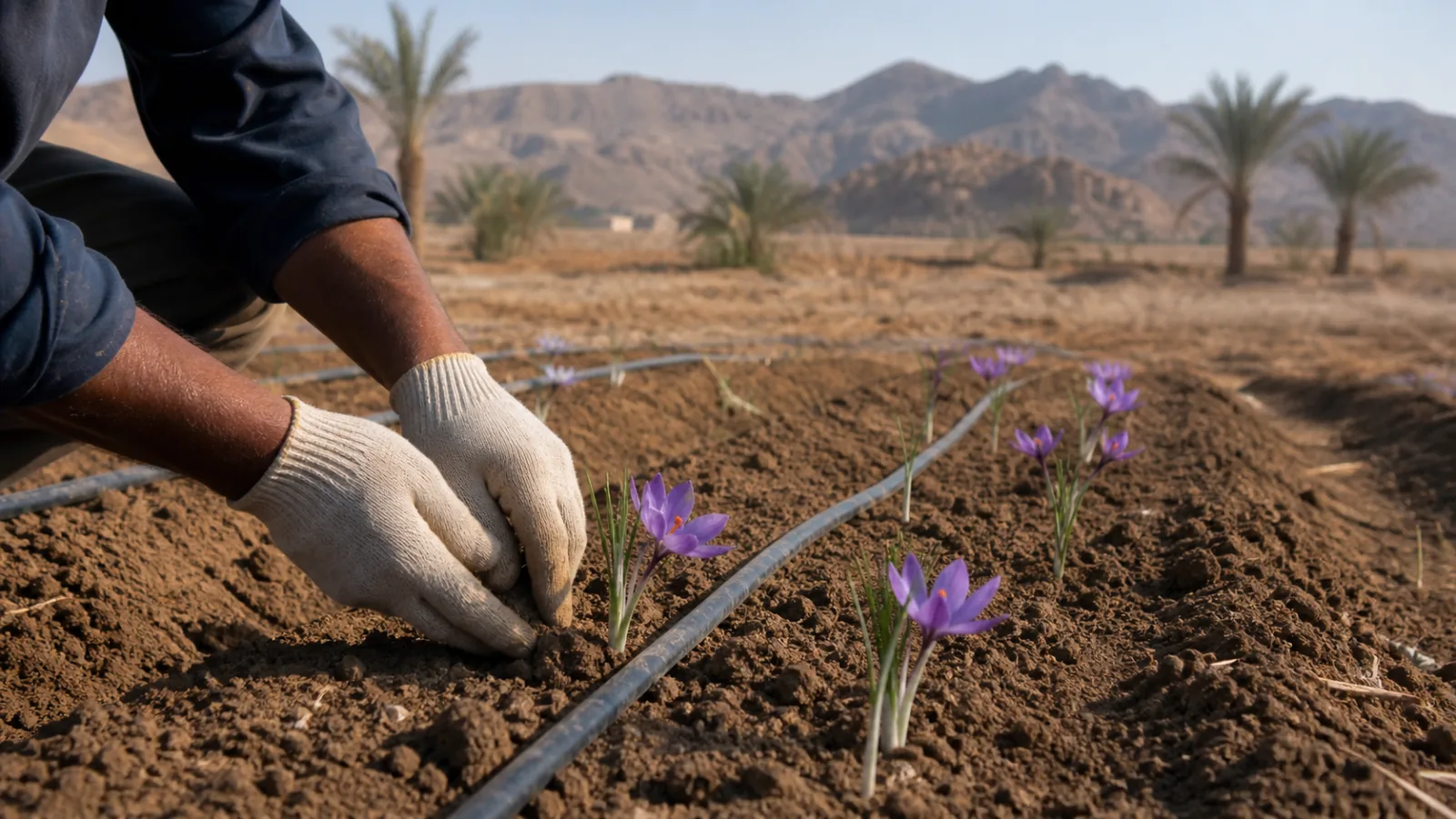
Planting saffron in Hormozgan is possible as a carefully managed trial, but success in one field does not mean that every farm in the province is suitable. Saffron needs a dry summer dormancy, a cool period for autumn growth and flowering, and soil that drains quickly. In a hot southern province, the exact site and its microclimate matter more than the province name.
This article began as a short report from Fin, near Bandar Abbas. A local grower said she planted saffron corms in late September and later saw them flower. The corms had reportedly come from Kashmar in Razavi Khorasan. That first flowering was encouraging, although a sound farm decision requires several seasons of yield, corm survival and cost records.
What the Fin trial actually showed
The original account attributed the planting to Nasim Ghamari Tabasi and described it as an outdoor farm trial. The old English translation called the planting material “pistachio saffron hara” and repeatedly used the word “onion.” Those phrases are translation errors. Saffron is established from corms, not seed, and there is no agricultural basis for treating the material as pistachio.
According to the report, the corms went into the ground in late September and produced flowers during their first season. The grower also planned to investigate protected cultivation later. These details should be read as a dated local observation, not as proof of an established commercial saffron industry in Hormozgan.
Fin lies in Bandar Abbas County, and the report placed it about 90 kilometres from Bandar Abbas. It also listed dates, millet, sesame, tobacco, onions, barley, wheat and oranges among local crops. That crop mix explains why a low-volume, high-value spice could attract interest, but saffron behaves differently from the warm-season crops commonly associated with southern Iran.
Can saffron cope with Hormozgan’s heat?
Saffron is dormant during summer, so dry heat by itself is not automatically fatal. The harder question is whether the corm experiences suitable temperatures before flowering and whether the soil remains free of waterlogging. Research and extension guidance consistently treat local temperature, drainage and planting depth as connected decisions rather than separate checklist items.
University of Vermont saffron guidance notes that planting depth varies with geography and climate. Deeper planting can buffer summer heat, but planting too deeply can restrict emergence and daughter-corm production. That is why a depth copied from another region should not be adopted across Hormozgan without a local trial.
The province also contains very different elevations and local conditions. A cooler inland or elevated site may behave differently from a humid coastal field. Growers should compare soil temperature and moisture at corm depth, not rely only on the nearest city’s air-temperature forecast.
Drainage is the first practical test
Saffron corms can rot in soil that holds water. A prospective field should therefore be checked after irrigation: if water remains around the root zone or the soil stays saturated, the site needs drainage improvement or should be rejected. A raised bed can help only when water also has somewhere to leave beneath and beside it.
Before planting, test the soil rather than adding fertiliser by habit. Texture, salinity, pH and organic matter all affect establishment. Well-decomposed organic matter may improve structure, but fresh manure or excessive nitrogen can create avoidable disease and growth problems. Irrigation-water quality deserves the same attention in an arid region.
How to run a useful farm trial
A small, measured plot is more informative than a large speculative planting. Start with firm, healthy corms of a recorded size and origin. Divide the plot into repeatable sections if comparing depth, shade or irrigation. Keep the planting date, corm count and layout in a notebook or spreadsheet.
During the season, record emergence, flowering date, flower count, dried stigma weight and any signs of rot or pests. Continue after harvest: leaf growth supports replacement corms, and the condition of those corms determines whether the field can perform in later years. A first bloom is only one point in that cycle.
For a commercial decision, calculate labour as well as yield. Flowers must be picked promptly, stigmas separated cleanly and the saffron dried under controlled conditions. Packaging and testing costs still apply even when the crop is grown locally.
What greenhouse cultivation can and cannot solve
A greenhouse or other protected structure can reduce rain exposure and give a grower more control, but it does not make climate irrelevant. An uncooled structure in Hormozgan can become hotter than the outdoor field. Ventilation, temperature at corm level, humidity, irrigation and disease control must all be designed and measured.
Protected flowering systems are sometimes promoted with ambitious yield claims. Those figures should be treated cautiously unless they include the full crop cycle, replacement-corm health, energy use, labour, losses and several seasons of results. Moving flowering indoors does not remove the biological needs of the plant.
A sensible conclusion for Hormozgan growers
The Fin report is valuable because it records that saffron corms flowered in a place outside Iran’s traditional production centre. It does not establish an average yield for Hormozgan or guarantee a profitable farm. The safe conclusion is narrower: selected sites may justify a controlled local trial.
Choose the site by measured soil and temperature conditions, begin on a scale that can be observed closely, and wait for multi-year evidence before expanding. Our guide to weather and site conditions for planting saffron explains the crop cycle in more detail.
Technical references: the University of Vermont saffron cultivation guide and the FAO overview of Iran’s qanat-based saffron farming system. The Fin planting details remain attributed to the historical YJC report cited by the original post.

![Exporting Saffron to Turkey + Price Guide [Complete 0 to 100]](https://img.rowhanisaffron.com/20260827003933/saffron-export-turkey-quality-inspection.webp)



