


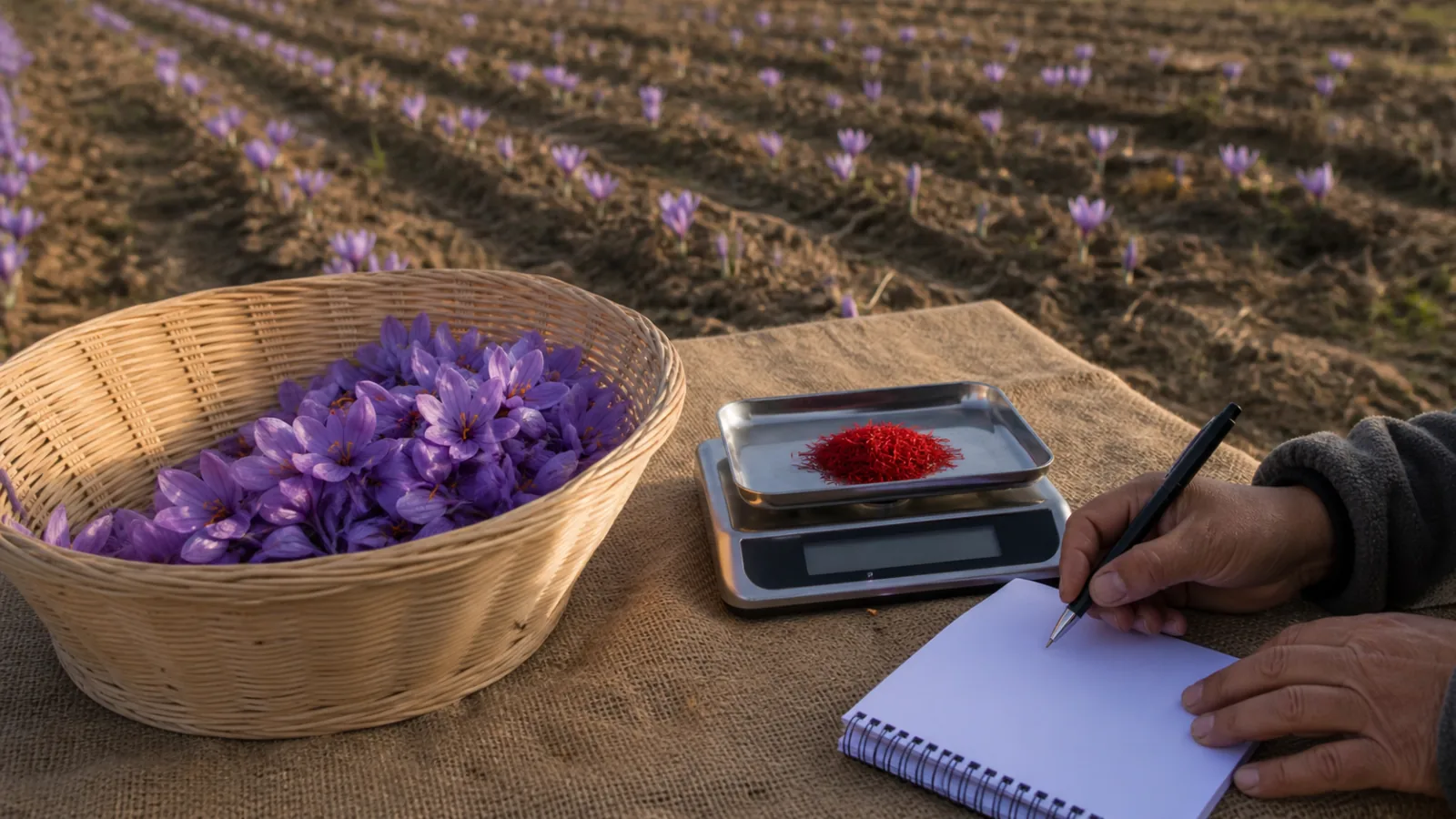
A reported saffron harvest record in Bakharz, Razavi Khorasan, credited one three-hectare farm with an average dried-saffron yield of 38 kilograms per hectare. That is the figure preserved in the original 2018 article. It is an exceptional historical claim, not a yield that another farmer should enter into a business plan without the underlying field records.
The local agriculture director attributed the result to disciplined crop management: fertiliser used at the right time, planned irrigation, a reservoir that captured surplus winter and spring water, and timely watering during saffron’s growing season. These practices are plausible contributors to yield. They do not, by themselves, verify the reported number.
What the original record report said
The archived story described a model saffron grower from a village in Bakharz County. The English machine translation badly damaged both the farmer’s name and the village name, rendering part of the location as “Bunjnjrd Kordian.” Without a reliable Persian source or official farm record, inventing a clean English spelling would be less accurate than acknowledging that limitation.
What remains clear is the agricultural claim. The farm covered three hectares, and the report said the grower harvested an average of 38 kilograms of dried saffron per hectare. It compared that with a usual provincial range of roughly three to four kilograms per hectare and an upper figure of eight kilograms cited by Khorasan Razavi Agricultural Jihad at the time.
The story also offered a flower-to-spice estimate: about 100 kilograms of fresh saffron flowers for one kilogram of dried saffron. That is best treated as a working estimate, not a fixed conversion. Flower size, how much yellow style remains attached, separation losses and final moisture all change the relationship.
Why a record needs more than one number
A yield claim becomes useful when its measurement method is visible. The reported 38 kilograms should mean dry, cleaned saffron from a measured three-hectare production area. The record is harder to interpret if it came from a smaller high-performing section extrapolated to a hectare, included more style than the comparison farms, or used a different final moisture level.
A sound verification file would include the mapped harvest area, corm age and planting density, daily flower weights, dry stigma weights, drying method, moisture result, rejected material and independent witness. It should also say whether 38 kilograms was the whole-farm average or the best plot.
This does not prove the old report wrong. It explains why a striking number needs a chain of evidence before it can be called a regional or national record.
Water management was the central lesson
The most useful part of the Bakharz account is its description of water storage and timing. Saffron uses far less water than many field crops, but “drought tolerant” does not mean that irrigation can be random. The crop’s needs change across root growth, flowering, leaf development and summer dormancy.
Capturing surplus winter and spring water in a reservoir can improve reliability where rainfall and water delivery are uneven. It may also let the grower irrigate at the agronomically useful moment instead of simply when water becomes available. Reservoir water still needs protection from contamination and uncontrolled loss, and each irrigation should be recorded.
Too much water is not a substitute for good timing. Saturated soil increases corm-rot risk, while an irrigation schedule copied from another farm may not suit the same soil depth, texture or weather. A farmer should check moisture in the active root zone before deciding.
Fertiliser timing is not a universal recipe
The original report credited timely fertiliser use but did not give products, rates or soil-test results. That omission matters. A treatment that corrects a nutrient shortage on one farm can be wasteful or harmful on another.
Record the amendment, nutrient analysis, application date and treated area. Compare those records with leaf growth, flower count and daughter-corm development. The relevant question is not whether more fertiliser was applied, but whether the crop received what the soil could not already supply.
Harvest handling affects the measured result
Every saffron flower contains three stigmas, and each flower is picked and separated individually. University of Vermont Extension estimates that roughly 150 to 170 flowers are needed for one gram of dried spice. At field scale, small differences in sorting and drying can therefore move the final weight substantially.
Flowers should be collected promptly and handled in clean, shallow containers that do not crush or heat them. Stigmas need careful separation and controlled drying. A high field yield loses value if delays, contamination or uneven moisture reduce the quality of the finished saffron.
For comparisons, every sample should be weighed after the same drying endpoint and on a calibrated scale. The Codex standard recognises saffron as dried stigmas with part of the style and defines quality and labelling expectations; it does not create a single flower-to-dry-weight conversion for every harvest.
How growers can use this case responsibly
The Bakharz result should be treated as a case worth investigating, not a guaranteed target. Its management themes—stored water, irrigation timing, planned nutrition and attention to the crop cycle—are more transferable than the headline number.
Track yield by individual plot and year, retain representative samples, and calculate marketable dry saffron rather than fresh flower weight alone. Multi-year records reveal whether a strong season is repeatable and whether the replacement corms remain productive.
For background on the crop’s water-efficient heritage, see FAO’s account of the qanat-based saffron farming system in Gonabad. Our article on saffron production statistics explains why dated regional figures and current totals should be kept separate.
Technical references: University of Vermont Extension’s saffron overview and Codex Standard CXS 351-2022. The Bakharz figures remain attributed to the historical Agricultural Jihad/YJC report cited by the original post.

![Exporting Saffron to Turkey + Price Guide [Complete 0 to 100]](https://img.rowhanisaffron.com/20260827003933/saffron-export-turkey-quality-inspection.webp)



