


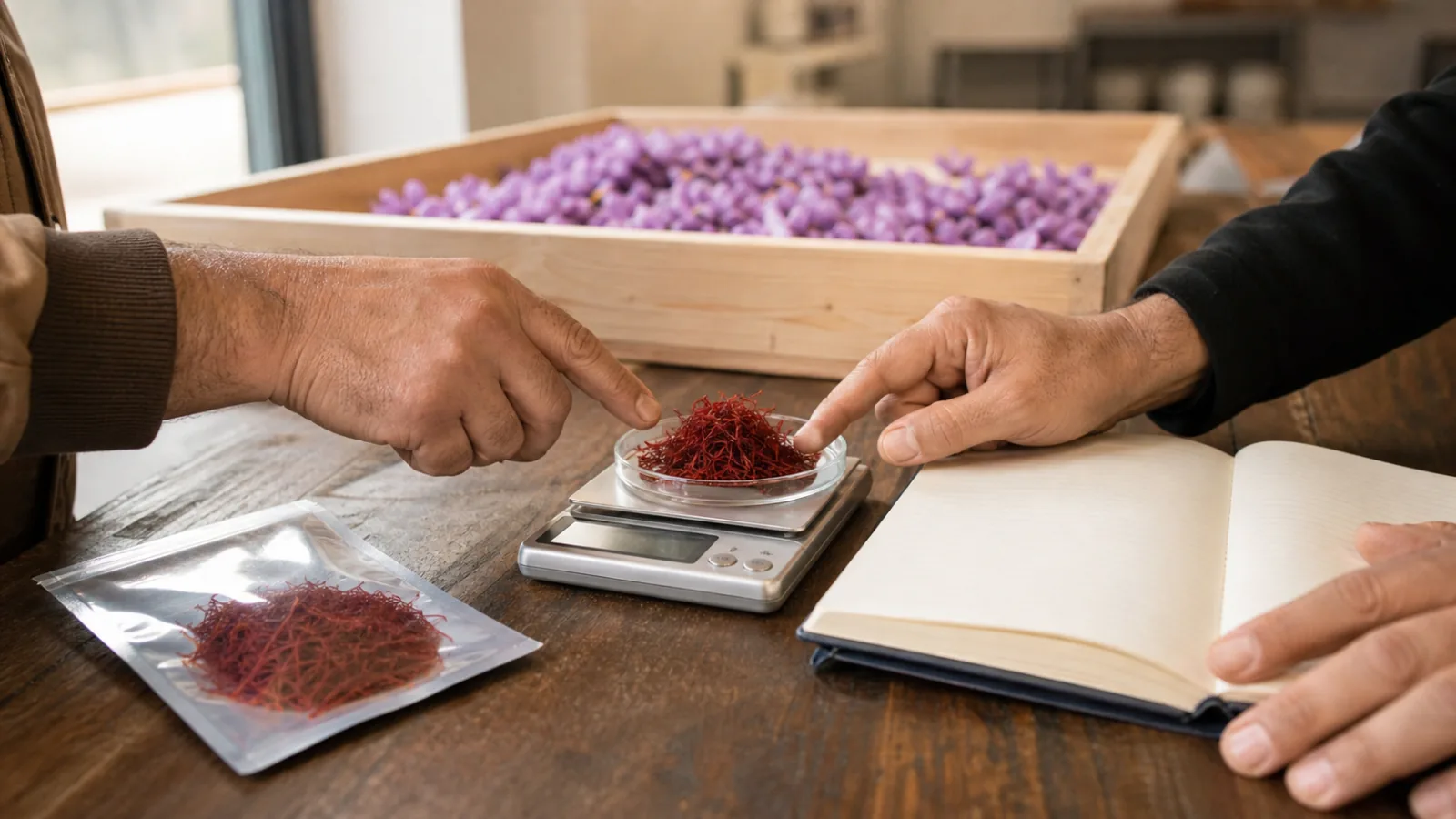
The debate over saffron profit and speculators is really about who keeps the value, but the word speculator can hide several different causes. Farmers may sell flowers under time pressure, processors carry drying and quality risk, exporters pay for testing and market access, and some traders simply exploit poor price information. A fair analysis has to separate those roles.
This 2018 report recorded comments by Mohammad Reza Amiri Kahnouj, then identified as a member of the Iranian parliament’s agriculture committee and a representative of Kerman, Kahnouj and Manujan. He argued that producers needed better planning and support as other countries expanded saffron cultivation.
What the historical report claimed
Amiri Kahnouj said the purchase price paid for saffron had fallen from the previous year while intermediaries captured more of the return. The machine-translated sentence about the margin is damaged; it appears to allege a gain of about 100,000 tomans on each kilogram of saffron flowers, but the unit and calculation cannot be confirmed from the surviving English copy. It should not be presented as a current margin.
He also cited Iran as the source of roughly 90 to 96 percent of world saffron production, while arguing that the country retained too little of the final value. Afghanistan and China were named as emerging competitors. His comments claimed typical Iranian field yield of up to four kilograms per hectare and about seven to ten kilograms in Afghanistan.
Those figures belong to the time and speaker. Production share, yields, prices and exchange rates change, and cross-country yield comparisons are meaningful only when the area, crop age, drying endpoint and data collection method match.
Why farmers often sell flowers quickly
Saffron flowers are highly perishable. Picking is concentrated into a short period, and stigmas need to be separated and dried promptly. A grower without enough labour, clean processing space or drying equipment may prefer to sell fresh flowers even when the later product is worth more.
That urgency gives a buyer with cash, transport and processing capacity more negotiating power. It also means the difference between the flower price and packaged-saffron price is not automatically pure profit. Conversion loss, labour, drying, rejected material, testing, finance, packaging, storage and sales all sit between those points.
The useful question is how much value each service adds and whether the farmer can see the calculation. A hidden deduction or coordinated low bid is very different from a transparent fee for genuine processing and market risk.
Bulk export and packaging are related, not identical
The old report described packaging as a missing link and said Iranian saffron was exported in bulk to countries such as Spain, then sold onward in higher-value packs. Packaging can retain more value, but a decorative box alone does not build a successful export product.
A packer needs traceable lots, consistent grade, food-contact materials, accurate net weight, destination-compliant labels and evidence behind origin and quality claims. Importer relationships, shelf placement and repeat demand matter as much as the container. Without those systems, added packaging can simply add cost.
Bulk trade also has legitimate uses. A food manufacturer or specialist packer may need a larger format. The strategic weakness is not every bulk shipment; it is selling an undifferentiated product without traceability, negotiating strength or access to the buyer who captures the brand premium.
What can reduce an unfair intermediary margin
Timely price information is the first protection. Farmers need comparable quotations that state whether the product is flower, fresh stigma or dry saffron; its grade and moisture; the payment date; and every deduction. Comparing only a headline price can be misleading.
Producer groups can share separation rooms, dryers, testing and storage, allowing members to avoid a forced same-day sale. Standard lot records make pooled saffron more credible to larger buyers. Forward purchase agreements can also help when they define grade, delivery, rejection and payment terms clearly.
Market access matters too. A farmer or cooperative that knows only one local buyer remains vulnerable even with good saffron. Samples, laboratory evidence, realistic pack formats and reliable fulfilment create alternatives. Public support is most useful when it improves those capabilities and transparent trade, not when it promises a price that the market cannot sustain.
Yield improvement needs local evidence
The MP linked better farm yields with stronger competitiveness. That can be true, but expanding acreage or chasing a national yield target is not enough. Corm health, planting density, water timing, soil condition, labour availability and post-harvest losses all affect the amount of marketable saffron.
Each province should be assessed for climate and water compatibility before cultivation expands. A low-water crop is not a no-water crop, and a promising trial does not prove that a whole province is suitable. The original call for “localisation” is best understood as crop zoning based on evidence.
A stronger way to judge who keeps the value
Follow one documented lot from flowers to final sale. Record farm yield and labour, fresh-to-dry conversion, processing loss, test results, pack cost, transport, finance, taxes, buyer price and payment time. That reveals which margins pay for necessary work and which result from poor information or market power.
FAO’s recent work on Iran’s saffron value chain emphasises authenticity, quality assurance and supply-chain governance. Those are practical ways to protect reputation and improve bargaining power. Our review of why saffron packaging can fail looks more closely at the commercial choices behind a useful pack.
Background sources: FAO’s update on innovation and quality integrity in Iran’s saffron value chain and UNIDO’s Saffron Industry Value Chain Development in Iran. Historical political and price statements remain attributed to the YJC report cited by the original article.

![Exporting Saffron to Turkey + Price Guide [Complete 0 to 100]](https://img.rowhanisaffron.com/20260827003933/saffron-export-turkey-quality-inspection.webp)



