


This article revisits comments reported by ISNA in 2017 about weaknesses in Iranian export packaging. The percentages below are attributed to that interview and should not be treated as current market measurements.
“Saffron packaging is not suitable” is a blunt title, but the concern behind it was specific. Rahim Bana Molayi, then identified as head of the Alborz Chamber of Commerce, argued that too much Iranian produce was leaving the country in bulk while much of the branding and final retail value was created elsewhere.
Saffron makes the packaging question especially important. The spice is light, aromatic and sold in small quantities. A pack must protect those delicate threads, help the buyer understand what is inside and travel through storage and delivery without opening, crushing or absorbing moisture.
What the 2017 criticism said
In the ISNA interview cited by the original post, Bana Molayi said packaging represented about 10 percent of the cost of exported goods, yet could contribute much more to the value of the final offer. He also claimed that roughly 85 percent of the country’s relevant exports were sold in large packages and only 15 percent went to other countries in what he considered appropriate packaging.
The translated report gave another figure: packaging could add “up to 90 percent.” It did not provide the underlying dataset, product mix or calculation, so that number is best preserved as the interviewee’s assertion, not repeated as a universal formula for saffron.
His broader point was easier to assess. When a product is exported without a clear consumer identity, another company may handle the final packs, develop the brand and sell at a higher retail price. The producer still sells the raw or bulk product, but has less control over how customers recognise it.
What suitable saffron packaging needs to do
A saffron pack has several jobs, and appearance is only one of them. It should:
- close securely and show obvious evidence if it has been opened;
- limit exposure to moisture, strong light and outside odours;
- protect threads from unnecessary crushing during transport;
- state the net quantity and identify the responsible seller or packer;
- carry the origin, lot and date information required for its market; and
- use a size that makes sense for the small amount of saffron inside.
These details create trust. Decorative boxes can be attractive, but decoration cannot compensate for a loose closure, vague label or untraceable product. Nor should a large gift box create a false impression about the quantity it contains.
Bulk export and retail packaging serve different purposes
Bulk packaging is not automatically poor packaging. A food business buying saffron for repacking or production needs a strong, documented bulk container rather than a row of tiny retail jars. The relevant question is whether the pack suits the next step in the supply chain.
The commercial criticism arises when almost all of the customer-facing value is created after export. A producer that can grade, pack and present saffron for the intended buyer may keep more control over quality communication and brand reputation. That requires more than buying elaborate boxes: it calls for consistent product specifications, traceability, reliable filling and labelling that complies with the destination market.
How packaging supports a saffron brand
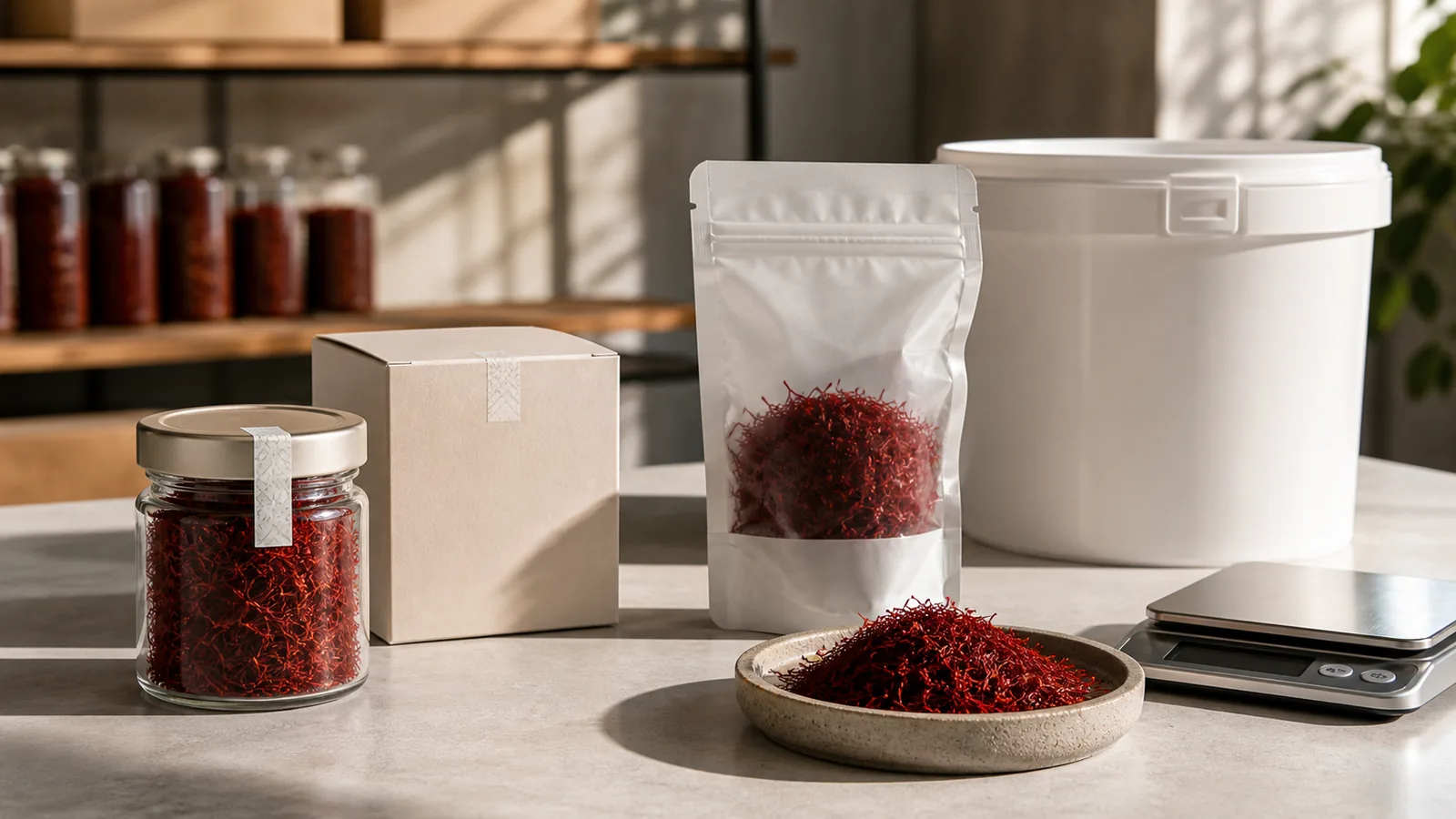
Packaging is often the customer’s first physical contact with saffron. A clear window may show the threads, while an opaque outer box may offer additional light protection. A compact jar or sealed inner container can make storage easier after opening. The best choice depends on quantity, transport conditions and how quickly the customer expects to use the spice.
Good information matters just as much as materials. Buyers should not have to guess whether they are looking at whole threads or powder, how much the pack contains or how to store it. Specific, readable information is more persuasive than a cluster of exaggerated superlatives.
A better meaning of “suitable”
The 2017 interview framed packaging as both protection and marketing. That remains a useful distinction, provided marketing does not outrun the product. Suitable saffron packaging protects the spice, communicates honestly, meets the rules of the receiving market and fits the way the customer will use it.
For exporters, that can help move the conversation beyond bulk volume toward documented quality and a recognisable identity. For customers, it offers something more immediate: a clean, secure pack that makes it easy to see what they bought and keep it in good condition.
Original report: ISNA interview cited by the 2017 post.

![Exporting Saffron to Turkey + Price Guide [Complete 0 to 100]](https://img.rowhanisaffron.com/20260827003933/saffron-export-turkey-quality-inspection.webp)



