


This page preserves a historical report about a saffron conference in Qom. The report announced a May 10 meeting but did not clearly identify the year in the surviving English text. Its acreage, yield and cost figures are attributed to the speaker and are not current farming guidance.
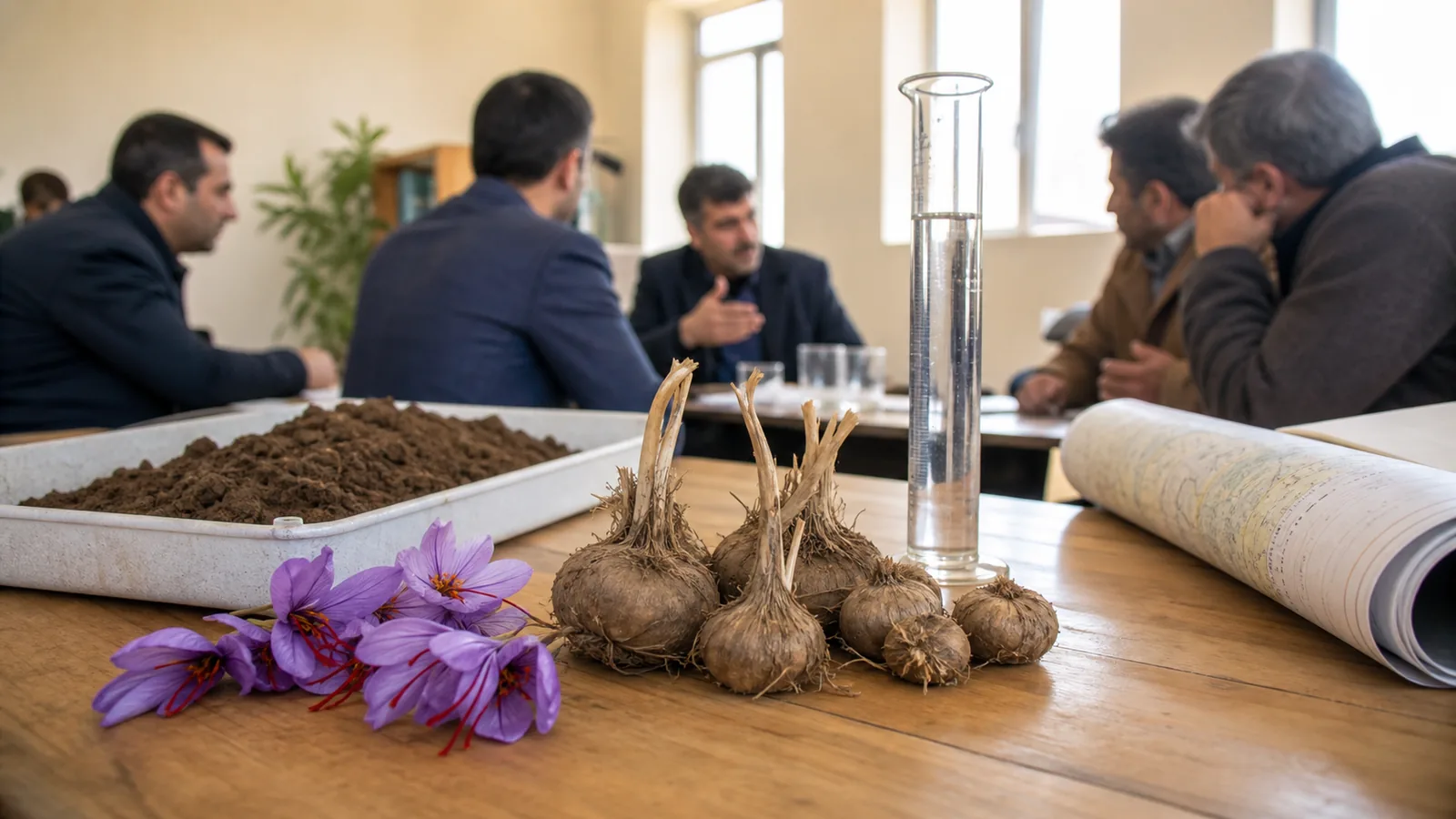
A saffron conference in Qom was announced as part of the province’s effort to explore crops suited to limited water supplies. Hassan Malmir, identified in the report as the provincial organiser for the mobilisation of agricultural engineers, said the meeting would bring agricultural specialists and experienced saffron farmers together at Qom’s Agricultural Research Center.
The purpose was practical: discuss whether saffron could fit parts of the province, explain the crop to interested growers and connect local decisions with scientific agricultural advice. The announcement also placed the conference inside a wider plan to manage Qom’s farming system more carefully during a serious water shortage.
What the Qom saffron conference was meant to cover
According to the Tasnim report cited by the original post, the event was scheduled for May 10 in the research centre’s conference hall. Professors, agricultural specialists and what the translation called “sample farmers” were expected to attend. The latter phrase is best understood as exemplary or experienced saffron growers, not farmers selected for a scientific sample.
The conference was presented as an opportunity to discuss saffron production in Qom rather than simply promote a product. That distinction matters. A crop may use less irrigation than some alternatives and still require suitable soil, healthy corms, careful planting, labour at harvest and a market for the finished spice.
Why saffron attracted attention in a dry province
Malmir connected the conference directly with the provincial water crisis. He described saffron as a crop that could be considered alongside other lower-water options. The original translation called it “water-free,” which is misleading: saffron is not grown without water. The defensible meaning is that it was being discussed as a comparatively lower-water crop within the local agricultural plan.
He said about 10 hectares of Qom agricultural land were under saffron at the time of the report. That figure belongs to the historical announcement. It should not be used as a current estimate of the province’s planting area.
Areas mentioned in the original report
The report named several parts of Qom province in connection with saffron cultivation: Kahak, Dastjerd, Jafariyeh and Salafchegan. Some names were badly transliterated in the earlier English version, including “Galaxy” and “Danjard.” Preserving the intended geography makes the account useful without pretending that every field in those districts is suitable.
Site-level conditions still decide whether planting is sensible. Drainage, soil properties, access to irrigation at the necessary stages, corm health and labour availability all need assessment. A provincial conference can introduce the option; it cannot replace a field inspection or a realistic crop budget.
Historical yield and cost claims need context
Malmir referred to a saffron corm cycle of about five years and cited a harvest figure of up to 2.5 kilograms per hectare. The article did not provide a trial method, field age, grade or range of results, so the yield should remain an attributed example rather than a promise to growers.
The translated report also mentioned a planting cost of “10 million per hectare,” but omitted the currency and accounting details. It claimed the eventual return could exceed the initial cost. Without a stated year, currency, labour calculation or sale price, that number cannot support a present-day investment decision.
What a useful farming conference should help answer
For growers considering saffron, the most valuable questions go beyond headline water use:
- Which fields have the drainage and soil conditions needed for healthy corms?
- When and how much irrigation is locally available?
- What labour is needed during the short flower-picking period?
- How will flowers be separated, dried, graded and stored?
- Which buyer, cooperative or sales route will handle the crop?
The Qom saffron conference was valuable as an early forum for those discussions. Its historical figures show what local organisers hoped to achieve, while its larger message remains sound: decisions about a new crop should combine water planning, field evidence, practical training and a credible route to market.
Original report: Tasnim News account cited by the archived post.

![Exporting Saffron to Turkey + Price Guide [Complete 0 to 100]](https://img.rowhanisaffron.com/20260827003933/saffron-export-turkey-quality-inspection.webp)



