


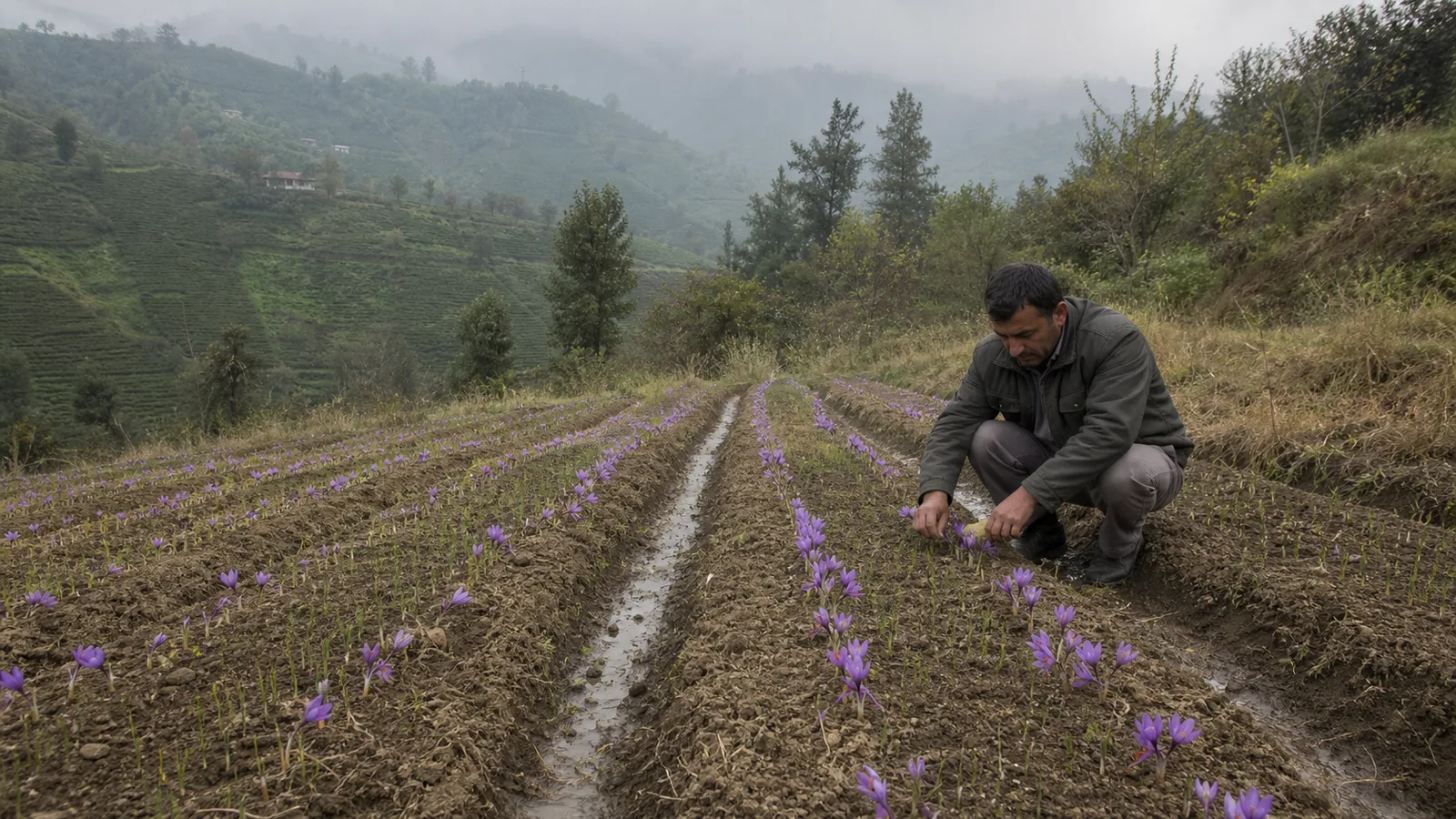
Increasing planting of saffron in Gilan province was the aim of a small agricultural initiative reported from Amlash. According to an archived Rasht Journalists’ Club report, local officials distributed saffron planting material and identified modest plots for growers. The announcement is useful as a historical record, but its brief figures do not prove that saffron is suitable for every part of Gilan.
Gilan is better known for a humid Caspian climate than for the dry conditions associated with Iran’s main saffron regions. That does not make cultivation impossible. It makes drainage, local temperature, rainfall timing, soil and trial results especially important.
What the Amlash report actually said
Masoud Amir Baneh, identified in the translation as director of Amlash Agricultural Jihad, said that 1.5 tonnes of saffron planting material had been distributed in the city. The old English version called it “saffron seeds,” but Crocus sativus is propagated commercially by corms. “Corms” is therefore the accurate agricultural term.
The same report referred to land parcels of between 200 and 300 square metres being distributed among people described as saffron merchants or growers. It then said that one and a half hectares of land were “susceptible to spraying saffron.” That phrase is a translation error. In context, it appears to mean land considered suitable for planting saffron, not land intended for pesticide spraying.
Finally, the report gave an average harvest of two kilograms of dried saffron per hectare from gardens in the area. It did not identify the harvest year, number or age of fields, corm density, sampling method or range of yields. The figure should be retained as the official’s reported local average, not treated as a guaranteed result for a new field.
Why Gilan requires a local suitability check
Saffron can adapt to more than one climate, but it performs best when the field’s seasonal pattern matches the plant’s annual cycle. The corm is dormant through the warm season, flowers in autumn and grows leaves through the cooler months. Water at the wrong time, poor drainage or prolonged wet soil can undermine a planting even when total annual rainfall appears favourable.
FAO cultivation guidance describes saffron as adaptable from temperate to subtropical climates and from sandy soils to well-drained clay loams. It also notes that most commercial areas are dry and that saffron is propagated through selected, disease-free corms. “Adaptable” does not mean every field is equally suitable.
Research on rain-fed saffron in Iran found that annual rainfall alone did not predict yield accurately. The distribution of rain in autumn and winter, winter temperature and field age were more informative when considered together. A separate field study found that soil texture and irrigation interval affected flowers, dry-stigma yield and replacement corm production. Neither experiment was conducted in Amlash, so its numbers should not be copied directly into a Gilan recommendation. They explain which variables local trials should measure.
Drainage is the first practical question
A prospective plot should drain freely after heavy rain. Standing water around the corm zone is a warning sign. Raised beds or furrows may help on some sites, but their dimensions need to follow the slope, soil texture and actual rainfall rather than a generic recipe. A soil assessment should also check structure, salinity, organic matter and whether compaction prevents infiltration.
On a hillside, fast surface runoff and erosion can be as damaging as saturation. The layout has to move excess water safely without washing soil or exposing corms. This is one reason a 200–300-square-metre pilot can be more informative than committing a large area immediately.
What should be measured in a Gilan saffron trial
The original initiative would be easier to evaluate if every participating plot kept the same basic records:
- field location, elevation, slope, soil texture and drainage observations;
- source, health, average weight and number of planted corms;
- planting date, depth, spacing and total planted area;
- rainfall and any irrigation before flowering and during leaf growth;
- flower count, harvest dates and labour time;
- fresh flowers and dried stigma weight, with the drying method recorded;
- corm disease, rodent damage, weeds and plant survival; and
- costs, saleable grade and actual price received.
Yield should be calculated from a measured area and reported separately for each field age. Saffron often changes as the corm population establishes and multiplies, so a first harvest cannot stand in for the life of a multi-year plot. Quality testing also matters: two fields with the same dry weight may differ in moisture, aroma, colour strength and foreign matter.
How to interpret the two-kilogram yield
Two kilograms per hectare is a plausible reported outcome, but it is not enough by itself to decide whether planting was successful. A grower needs the input and labour costs behind that yield, the grade obtained, losses during drying and storage, and the number of productive years expected from the field.
The old article also moved between “gardens,” distributed plots and one and a half hectares without explaining whether these referred to the same land. They may have been different parts of the local programme. Until a primary project report or farm-level dataset is available, the numbers should not be combined to estimate the number of growers or total harvest.
What the initiative did—and did not—establish
The Amlash announcement established that local agricultural officials were testing or expanding saffron beyond Iran’s traditional production core. It named a quantity of corms, small plot sizes, a total candidate area and a reported local yield. That is meaningful evidence of an initiative.
It did not publish a controlled trial, a current production census or a province-wide land-suitability map. Nor did the short report provide follow-up results showing how the distributed corms performed. The safest conclusion is therefore local: some Amlash growers and officials considered saffron worth testing, but expansion elsewhere in Gilan should follow measured trials and qualified local agronomic advice.
For readers planning a field rather than reviewing this historical news item, our guide to the requirements for planting saffron covers the plant’s broader cycle and site checks. Those general principles still need to be adjusted to the exact Gilan field.
Sources reviewed: the archived Amlash statement attributed to the Rasht Journalists’ Club/YJC; FAO’s cultivation overview in Natural colourants and dyestuffs; the AGRIS-indexed study of rainfall distribution and rain-fed saffron yield; and the AGRIS-indexed study of irrigation, soil texture, flower yield and corm yield. All accessed 25 August 2026.

![Exporting Saffron to Turkey + Price Guide [Complete 0 to 100]](https://img.rowhanisaffron.com/20260827003933/saffron-export-turkey-quality-inspection.webp)



