


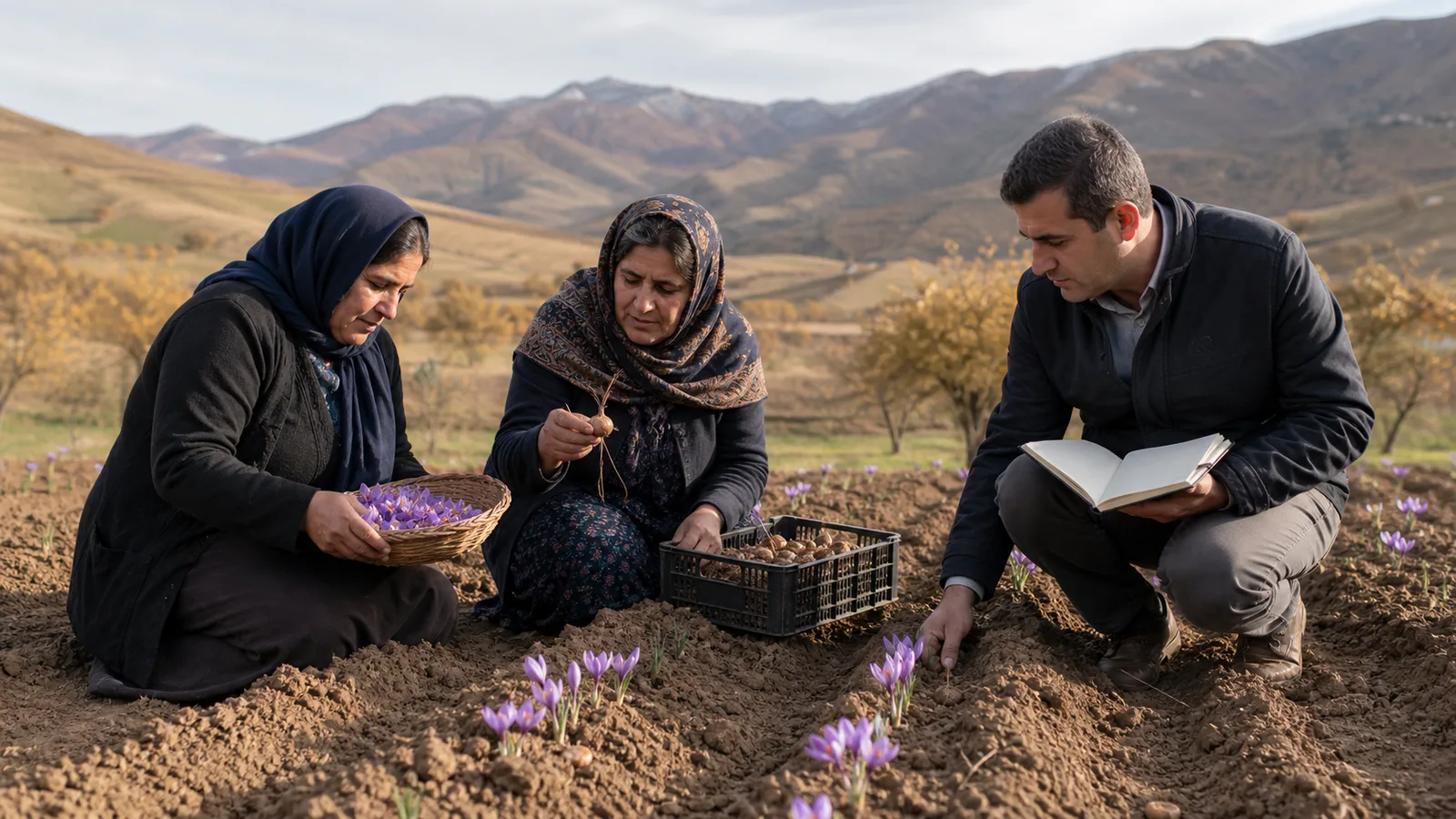
Planting saffron in Ardabil began as a small diversification program built around cold-climate farming, limited irrigation water and the possibility of keeping more agricultural value in rural communities. Historical provincial reports describe a crop moving from research plots into commercial fields, with targets of 30 and later 50 hectares. They also show why acreage alone is a poor measure of success: corm supply, field maturity, harvest labour, testing and a stable market all matter.
Ardabil is the main subject of this article. Historical experiences from Malayer, Shahroud and Lorestan are included because they test the same assumptions under other western and northern Iranian conditions. Together, the reports offer a more useful picture than any one expansion announcement.
How saffron cultivation developed in Ardabil
One archived update from Ardabil’s Jihad Agriculture Organization recorded 12 hectares under saffron and annual production of about 12 kilograms. Organization head Adeel Sarvi said the immediate plan was to reach 30 hectares and reported distribution of 56.32 tonnes of subsidized saffron corms to support new fields.
A separate program account set a later target of 50 hectares and said work had begun in Ardabil, Khalkhal, Meshgin Shahr and other parts of the province. It expected about 1.5 kilograms of dried saffron per hectare during that stage. The different area and yield figures are best read as historical snapshots from a developing program, not as current provincial statistics.
Officials cited lower seasonal water demand, employment and adaptation to regional conditions as reasons to try the crop. Those advantages are possible, but none is automatic. Saffron still needs well-drained soil, healthy planting material, well-timed moisture and intense labour during its short flowering period.
Corm distribution solved only the first problem
Distributing 56.32 tonnes of subsidized corms reduced one barrier to expansion: the high initial cost of planting material. It did not establish how many hectares would reach productive maturity or what their eventual yield would be. Corm size, health, density and handling can all affect establishment and flowering.
Research indexed by FAO’s AGRIS database reports significant effects from corm weight and planting density. That supports the Ardabil program’s interest in selected planting material, but it does not supply a single rate that every field should copy. A local plan should document the source lot, discard damaged or diseased corms, match density and depth to the field, and track planted area separately from bearing area.
The older Ardabil account also called for patterned and research fields and identified the purchase and movement of corms from established production areas as a practical difficulty. That is a more durable lesson than a target acreage: new regions need clean planting stock and local trial data before expanding quickly.
Women farmers, local research and quality control
Ardabil’s early program involved agricultural researchers and women farmers. Hassan Beynehah of Ardabil Azad University described positive results in university trials and proposed rural women’s cooperatives as one route to production and local income. Ashraf Aghabareti, an adviser on women’s affairs, said cultivation studies had begun about a decade earlier and that women farmers were already participating in commercial production.
Those reports framed saffron as a rural employment opportunity, but the final value depends on post-harvest work. Flowers must be collected quickly, the red stigmas separated cleanly, and each batch dried and stored consistently. The provincial standards office said it was ready to help producers seeking the appropriate standard mark for export.
Claims that Ardabil saffron ranked first or second, or was categorically equal to saffron from another province, are not repeated as established facts because the archive provides no test method or report. The current ISO 3632-1 specification sets requirements for dried saffron; credible comparisons need representative samples and named laboratory measurements, not a general quality label.
What Malayer teaches about ambitious targets
The Malayer report described 25 hectares cultivated after roughly seven years of limited farmer uptake, with an estimated yield near four kilograms per hectare. Malayer officials considered the area’s clay-rich soils and climate promising and proposed putting at least three percent of the county’s farmland into saffron. At provincial level, the archive recorded roughly 55 hectares in Hamedan and a target above 500 hectares by Iranian year 1400.
That target was a policy ambition, not a measured outcome. The same report admitted that most growers worked plots smaller than one hectare and that precise area data were weak. It also said locally available corms cost more than twice those in eastern Iran, increasing establishment costs.
Malayer University researchers had studied regional feasibility since 2009 and organized training with agricultural officials. Their practical concerns remain relevant to Ardabil: contaminated or undersized corms, unsuitable density or depth, and poorly timed irrigation can reduce flowering. Delayed autumn rain was also associated with late flowering in some reported fields.
The archive suggested moving corms during dormancy and minimizing the interval between lifting and replanting, while avoiding the hottest part of summer when desiccation risk is high. Exact dates and a quoted 15–20 centimetre planting depth should be treated as local guidance from that program, not a universal formula.
Shahroud shows the labour and market limits
Shahroud’s cultivated area was reported to have risen about 40 percent, from roughly 50 to 85 hectares. The historical estimate for dried-saffron yield was 4.5–5.5 kilograms per hectare, with harvest running through October. Some fields were managed alongside orchards, and officials described two or three irrigations in the annual cycle used locally.
Expansion exposed three constraints:
- experienced harvest workers were scarce, and much of the skilled workforce was already over 40;
- flowers had to be picked in demanding early-morning shifts;
- growers lacked a stable market and often sold through intermediaries without local packaging.
The report put Shahroud’s total output below 300 kilograms and said some production was consumed locally or in nearby provinces. It also discussed branding and packaging as future needs. Historical price and export-share claims are not used here because they are dated and cannot guide a current farm budget.
Lorestan illustrates the difference between planting and production
In Lorestan, horticulture director Behrouz Baharvand announced 75 hectares of additional autumn planting after about six hectares had been planted in spring. The province already had roughly 97 hectares associated with saffron, and the program expected the combined area to approach 178 hectares.
The same report forecast 380–400 kilograms for the year, compared with 321 kilograms in the preceding season, and referred to an average yield around 3.5 kilograms per hectare. As with the Ardabil figures, the planted-area total and productive-area output should not be treated as if every newly planted hectare bore a mature crop immediately.
A practical framework for planting saffron in Ardabil
The four regional records point to a sequence that is safer than expanding by acreage target alone:
- Validate the site. Check drainage, soil condition, winter exposure and the actual irrigation source.
- Secure healthy corms. Record source, size and plant-health condition before planting.
- Start with a measured area. Track establishment, flowering and dry-stigma yield by field age.
- Plan the harvest workforce. Flower picking and stigma separation are concentrated into a short period.
- Standardize drying and storage. Quality cannot be recovered after poor handling.
- Confirm the buyer and specification. Packaging, testing and market access belong in the budget from the start.
Saffron can fit parts of Ardabil, but “low water” does not mean rain alone will always be sufficient, and high retail value does not guarantee high farm profit. The province’s corm support, research involvement, women’s participation and standards assistance were useful foundations. Long-term success depends on measured field results and a reliable route from fresh flower to tested dried saffron.
References: FAO: Qanat-based Saffron Farming System in Iran; FAO AGRIS: corm weight, density and saffron yield; ISO 3632-1:2025 saffron specification. All Ardabil, Malayer, Shahroud and Lorestan program figures are identified as historical values retained from the archived reports consolidated into this article.

![Exporting Saffron to Turkey + Price Guide [Complete 0 to 100]](https://img.rowhanisaffron.com/20260827003933/saffron-export-turkey-quality-inspection.webp)



