


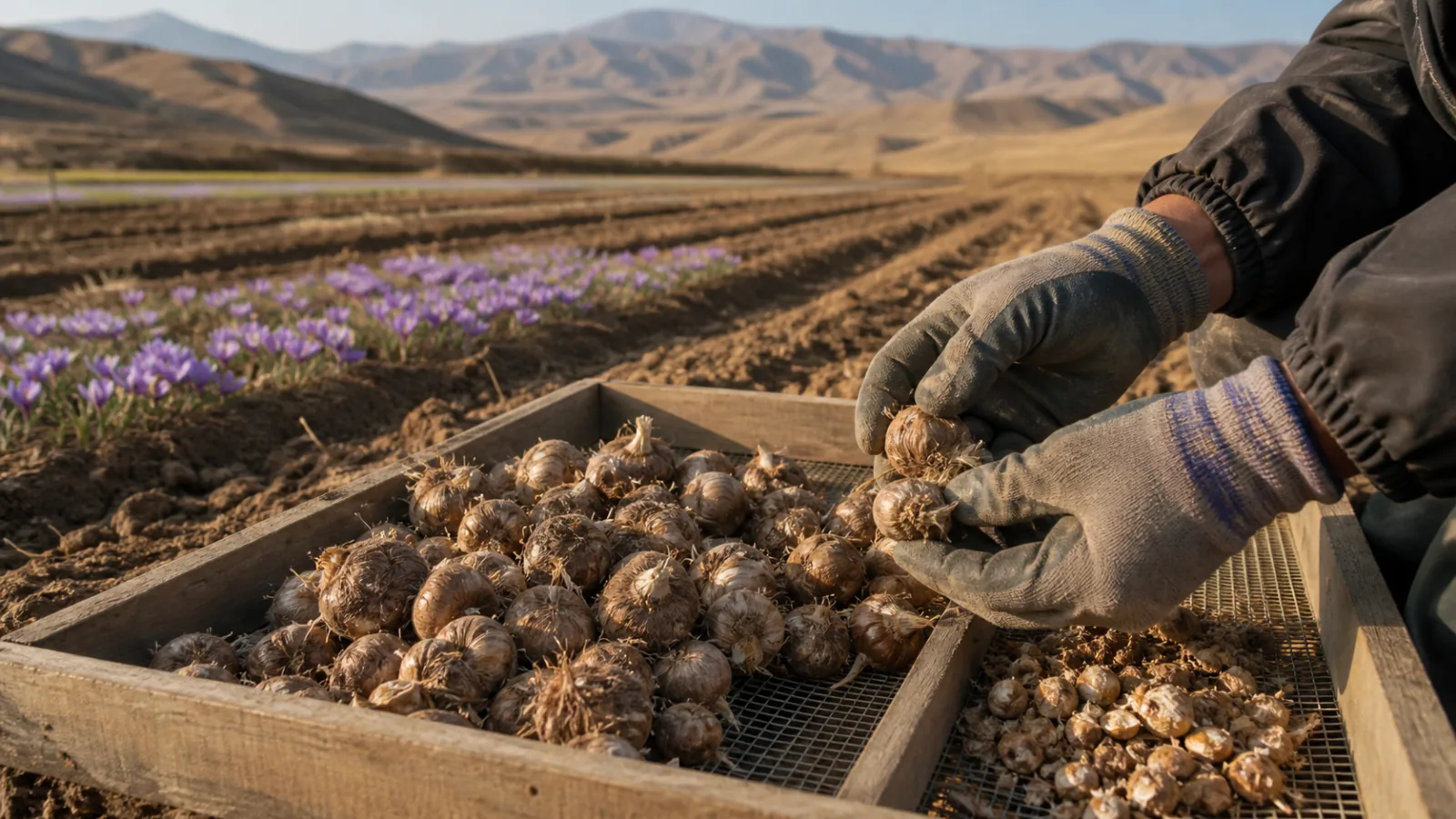
The “Armani plan” for saffron in Razavi Khorasan was not connected with the fashion company. The phrase is a literal mistranslation of the Persian term for an “ideal” or model-farm plan. Its purpose was to revive ageing saffron fields and raise yield per hectare through healthier corms, better field management and demonstration farms.
A historical provincial report attributed the ideal saffron farming plan to Mohammad Reza Ghodsi, an agricultural engineer and horticulture official in Razavi Khorasan. It said the province aimed to bring 2,500 hectares of saffron into the model-farm programme during Iranian year 1392, corresponding broadly to March 2013–March 2014. That was a programme target for a named year, not the current area of model farms.
What “ideal saffron farms” meant
The Persian phrase mazāre-e ārmāni describes farms managed toward an intended standard. In the saffron programme, “ideal” referred to the production method rather than a special variety or brand. Earlier statements from the same provincial horticulture director linked the approach with large, standardised corms and dedicated multiplication plots.
The plan addressed a practical problem. A saffron field remains in place for several seasons. Daughter corms multiply underground, crowding increases, and flowering can decline if the field is not managed or renewed. Simply expanding the planted area does not fix low output from ageing stands.
The 2,500-hectare target in context
Ghodsi said the 2,500-hectare plan was designed to increase yield per unit area and rejuvenate saffron farms. The figure should be read as the scale announced for year 1392. The archived report did not provide a completion audit, a list of participating farms or a measured before-and-after yield.
For that reason, it would be inaccurate to say 2,500 hectares were proven to have been fully renovated. A target records policy intent. Verification would require the area actually enrolled, the work completed, field ages, comparable yield data and the number of farms that remained productive in later seasons.
Why field rejuvenation matters
Saffron is propagated by corms rather than true seed. Over time, multiplication can create dense clusters competing for space and nutrients. Weeds, rodents, fungal problems, poor drainage and declining corm size may also reduce flower numbers. A renovation decision therefore starts with diagnosis: some fields need better management, while others need lifting, sorting and replanting.
Rejuvenation can involve:
- assessing field age, plant density and the pattern of declining yield;
- lifting corms during the correct dormant period where renewal is justified;
- discarding damaged or diseased planting material and grading healthy corms;
- preparing well-drained soil and correcting problems shown by soil and water tests;
- replanting at an appropriate depth and density for local conditions; and
- recording yield by field and year so the result can be measured.
These steps require local agronomic advice. Moving corms between areas without plant-health controls can spread pests or disease. Bigger corms may improve the chance of early flowering, but size alone does not prove that a corm is healthy.
Increasing yield without making promises
The model-farm plan focused on yield per hectare, a more meaningful goal than acreage alone. Even so, saffron yield is shaped by weather, field age, corm quality, planting density, irrigation timing, soil fertility, weed pressure and harvest labour. Results from a demonstration plot cannot be promised to every grower.
A sound programme compares like with like: the same field or matched fields, the same definition of dry saffron, and a clear measurement period. It should also track quality. More dried material is not a complete success if poor separation or drying weakens colour, aroma, cleanliness or storage life.
Our saffron cultivation and growing-conditions guide explains the field variables that need to be considered together.
How the plan related to healthy corm production
An earlier account of the Razavi Khorasan programme said corms above eight grams were part of the model-farm approach and that ten hectares had been reserved in selected counties for multiplying this planting material. Those were historic programme specifications, not a universal modern rule.
A multiplication plot can improve traceability when its starting material is inspected, lots remain separate and plant-health records follow each consignment. It can also make uniform grading easier. The risk is that a multiplication label becomes a substitute for inspection. Every batch still needs to be checked before planting.
The wider horticulture programme
The original report placed saffron within a larger Razavi Khorasan horticulture plan. Its translated text referred to mushroom-production development with a capacity of 10,000 tonnes, 9,000 hectares of modern orchards, two million standard seedlings and energy-efficiency work covering 10 million square metres of greenhouses.
The surviving English version incorrectly rendered the last measure as 10 million hectares, an implausible area. The intended unit was square metres of greenhouse space. These figures are retained because they show that model saffron farms were one part of a province-wide attempt to improve productivity, planting material and controlled-environment agriculture.
They should not be combined into one outcome. Mushroom capacity, orchard area, seedling production and greenhouse energy use have different units and require separate completion evidence.
What a model-farm programme should measure
A credible saffron improvement programme needs more than a headline area. Useful measures include the number of participating farms, verified corm origin, field age, dry yield per hectare, labour hours, irrigation volume, rejected lots, laboratory quality results and the cost of each intervention.
Longer-term measures matter too. A yield increase in the first flowering season may not last. Tracking corm multiplication, disease, quality and farm income over several seasons shows whether the model is genuinely repeatable.
Why the historical plan remains relevant
Razavi Khorasan remains at the centre of Iran’s saffron value chain. In 2025, FAO and Iran’s Ministry of Agriculture-Jahad held a national workshop in Mashhad focused on authenticity, quality assurance and value-chain governance. That newer emphasis complements the older field plan: productivity has value only when the harvested saffron is clean, traceable and accepted by buyers.
The clearest reading of the “Armani” plan is therefore practical. It was a historical model-farm initiative intended to restore fields and improve yield, with 2,500 hectares announced for year 1392. Its useful legacy is the move from counting hectares to managing corms, fields, quality and evidence as one production system.
Context reviewed from archived statements attributed to Razavi Khorasan horticulture director Mohammad Reza Ghodsi and FAO’s 2025 report on saffron authenticity, quality and value-chain governance in Iran.

![Exporting Saffron to Turkey + Price Guide [Complete 0 to 100]](https://img.rowhanisaffron.com/20260827003933/saffron-export-turkey-quality-inspection.webp)



