


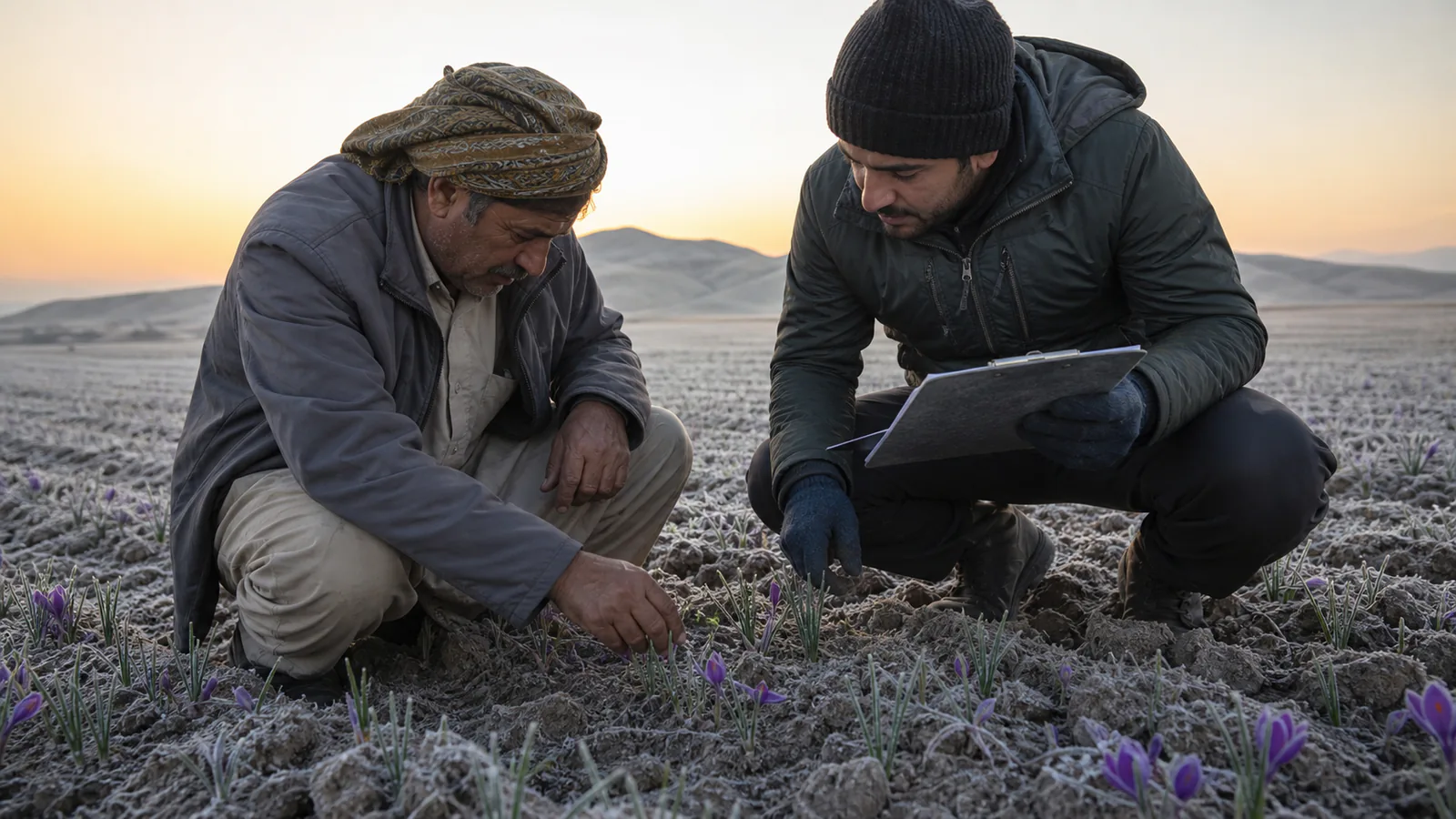
Saffron production in South Khorasan is part of the province’s identity and rural economy, but the crop’s value depends on much more than the kilograms harvested. Weather risk, field yield, prompt processing, packaging, market access and insurance all determine how much of a season reaches buyers and how much income returns to growers.
South Khorasan remains one of Iran’s principal saffron regions. A 2024 study using provincial agricultural and meteorological data describes it as Iran’s second-largest saffron-producing province and analyses eleven counties from 2011 to 2023. FAO’s current sector work also places South Khorasan alongside Khorasan Razavi at the heart of Iranian cultivation.
Why South Khorasan is important for saffron
The province combines dry conditions, established knowledge and communities accustomed to the short, labour-intensive flowering season. Qaen is particularly well known. In an archived interview, a provincial agriculture official said 35% of Qaen’s saffron was exported and called for stronger international recognition. That percentage belongs to the interview’s own period; it is not a current export share.
The point behind it still matters. Selling unprocessed or poorly identified saffron transfers part of the value to whoever cleans, tests, packs and markets it later. A producing province benefits more when it can connect a reliable batch to its origin, protect quality after picking and offer formats that fit the buyer.
Production is a chain, not a harvest number
A useful production record follows saffron through each stage:
- planted and productive hectares;
- field age, corm condition and irrigation history;
- fresh flowers picked and labour available;
- dry stigma weight and grade after separation;
- testing, storage and batch identity; and
- farm-gate, wholesale and export outcomes.
This prevents a common mistake: treating planted area as finished output. A weak flowering period, delayed picking or poor drying can reduce saleable saffron even when the number of hectares has not changed. The saffron processing guide explains the post-harvest steps that protect the spice.
Climate affects both yield and quality
South Khorasan’s dry climate suits saffron, but suitability does not remove weather risk. The 2024 provincial study found that temperature variables affected yield across counties, with direct and neighbouring-area effects. Earlier research using drought indices in Birjand, Qaen, Ferdows and Nehbandan also linked the timing of dry conditions to yield.
These studies do not mean one temperature produces the same loss everywhere. Soil, planting depth, field age, corm origin, snow cover, the growth stage and the duration of an event all change the result. That is why a province-wide alert must be followed by field inspection.
Frost damage and crop insurance
One earlier South Khorasan cold event shows how quickly conditions can change. The provincial Agricultural Insurance Fund director reported a sudden temperature fall in the first half of the Iranian month Azar, which spans late November and early December. Damage to saffron and pomegranate was estimated at 20–60% depending on location, with both product quantity and quality affected.
Sarayan and Ferdows reportedly reached −9°C, and pomegranate orchards there suffered the greatest losses. The account said 1,300 hectares of saffron were insured in the province and that payments would follow loss assessment. These are historical event figures, not a forecast and not today’s insured area.
The pomegranate wording needs care. The source said the crop was insured but the trunks were not, so some damage fell outside the relevant cover. It does not support the simpler claim that every insured loss was paid. The lesson for saffron growers is to check what a policy covers: harvested product, perennial corms, named hazards, the insured yield, notification deadlines and how an assessor measures loss.
What cold can do to saffron
Saffron is adapted to cold winters, yet severe freezing can injure leaves, roots and corm tissue. In a controlled experiment, freezing stress increased cellular injury while planting depth and corm origin changed the response. Deeper planting reduced some measured damage in that experiment, but depth also affects emergence and must be selected for local soil and climate.
After a freeze, growers should record minimum temperature and duration, inspect representative parts of each field, photograph symptoms, notify the insurer promptly and avoid estimating the final loss from appearance alone. Regrowth and the next flowering cycle may reveal damage that is not obvious on the first day.
Insurance is one part of risk management
Insurance transfers defined financial risk; it does not protect the plants from cold. A practical plan combines policy review with field measures: healthy planting material, locally appropriate depth, water and soil management, weather monitoring, accurate acreage records and a documented harvest history.
The old provincial production interview listed agricultural insurance among farmers’ main demands, alongside organised purchasing and processing facilities. Those needs are connected. An insurer needs credible field and yield records. A processor needs predictable raw material. A buyer needs traceable grade and volume.
Processing and packaging keep value in the province
The archived interview argued that insufficient conversion and packaging industries were limiting jobs and added value in South Khorasan. For saffron, “conversion” should not mean unnecessary transformation. The highest priorities are clean separation, controlled drying, sorting, testing, safe storage, batch traceability and suitable packing.
FAO’s 2025 cooperation with Iran combines laboratory verification with post-harvest guidance. It notes that routine grading alone may not detect sophisticated adulteration or explain how to preserve quality after harvest. Local capacity is therefore valuable when it produces consistent evidence rather than only a more decorative box.
For buyers, a South Khorasan offer should state the harvest year, growing origin, thread form, grade or test method, available batch weight, packing location and delivery terms. The current saffron price guide explains why those details must be fixed before comparing quotations.
Saffron within South Khorasan agriculture
The province is not a single-crop landscape. The earlier official named almonds, pistachios, pomegranates, cumin, olives, cotton and other horticultural products, as well as poultry and dairy activity. The surviving English version repeats some crop names and contains unclear machine-translated livestock terms; those ambiguous items are not treated as verified facts here.
Diversity can spread weather and market risk, but every enterprise still needs water, labour, processing and a buyer. Saffron’s flowering period creates an intense seasonal labour demand. Nearby processing and well-planned finance can support employment if they solve a real bottleneck rather than add unused capacity.
The interview also referred to low-interest agricultural development facilities that had been restarted at the time. That is historical programme information. Anyone seeking finance now should verify the current provider, eligibility, rate, security and permitted use instead of relying on an old announcement.
A resilient South Khorasan saffron sector
The province’s advantage begins in its fields, but it is protected by the systems around them. Good records show whether yield is changing. Weather monitoring gives growers time to prepare. Clearly written insurance defines which losses can be recovered. Local processing preserves more of the crop’s quality, while credible testing and origin information help buyers recognise its value.
Frost can still damage a season, and globalisation cannot be achieved by branding alone. South Khorasan saffron is strongest when the field, the batch and the claim on the package all tell the same verifiable story.

![Exporting Saffron to Turkey + Price Guide [Complete 0 to 100]](https://img.rowhanisaffron.com/20260827003933/saffron-export-turkey-quality-inspection.webp)



