


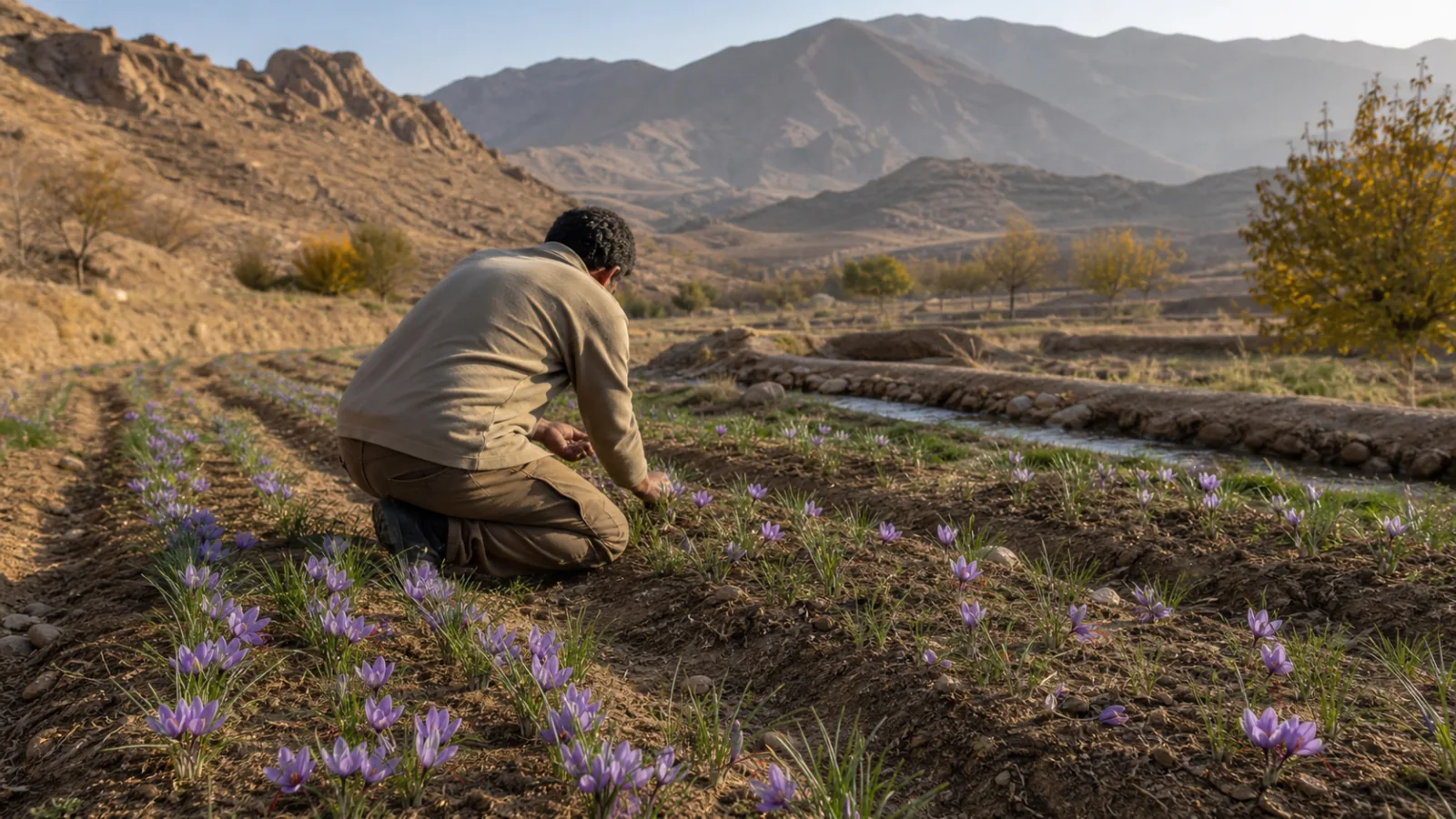
Yes, parts of Rafsanjan County are suitable for saffron planting, especially cooler mountainous areas with suitable soil and fresh water. The strongest local evidence is a 2017 statement from the Rafsanjan Agricultural Jihad director, published from the Kerman Province Agricultural Jihad public-relations office. It identified Raviz, Khenaman and Sarcheshmeh as places where saffron was already grown, and Davaran and nearby villages as potentially suitable.
That does not mean every field in Rafsanjan is suitable, nor that the old acreage and yield figures describe the county today. Local official reports from 2017 and 2020 give different snapshots. Read together, they show genuine Rafsanjan saffron production but also show why a planting decision needs current field-level advice.
Official source for Rafsanjan saffron production
The original source was published on 22 May 2017 by the Iranian Agricultural News Agency (IANA). It attributed the information to Hossein Rezaei, then director of Agricultural Jihad for Rafsanjan County, and said it came through the public-relations office of the Kerman Province Agricultural Jihad Organization.
Rezaei said 40 hectares in Rafsanjan County were under saffron. According to that report, Raviz held 60 percent of the county’s saffron area and was its leading saffron-growing district. The article also named Khenaman and Sarcheshmeh as active growing locations. Davaran and surrounding villages were described as suitable for cultivation.
This primary local report is the official source behind the statements in the earlier version of this page. Several place names were damaged by machine translation: “Qanaman” should be Khenaman, “the source” should be Sarcheshmeh, and “judges” should be Davaran.
Was Rafsanjan known for saffron?
Rafsanjan is much more widely known for pistachios. Saffron is a smaller crop associated with particular parts of the county rather than the whole district. It is accurate to say that Rafsanjan produces saffron and that its mountainous areas have supported the crop. Calling the city itself a national saffron centre would overstate the evidence.
The distinction matters for anyone searching for a reliable source. “Rafsanjan saffron” is not a claim that saffron replaces the county’s dominant crop or that all local saffron has one uniform quality. It refers to production reported in Raviz, Khenaman, Sarcheshmeh and other suitable local sites.
The 12-kilogram yield claim, explained
Rezaei said Raviz harvested an average of 12 kilograms of dried saffron per hectare, compared with a six-kilogram national average cited in the same 2017 statement. The figure belongs to that place, source and reporting year. It should not be treated as a guaranteed yield for a new field.
Saffron yield varies with field age, corm size and health, planting density, temperature, soil, irrigation timing, nutrition, weeds, pests and harvest management. A mature well-managed plot can perform very differently from a newly established or declining field. The phrase “12 kilograms per hectare” is therefore preserved as an attributed Raviz result, not converted into a forecast.
A later Rafsanjan production update
A second IANA report, published in October 2020, gives a useful comparison. Abbas Haj-Abdollahi, then director of Rafsanjan Agricultural Jihad, reported 25 hectares under saffron and forecast a county harvest of about 75 kilograms. He stated an average yield of three kilograms per hectare for that season.
The later report did not disprove the earlier Raviz figure. One described a high-yielding locality; the other described a later county-wide average and forecast. It did, however, show that 40 hectares and 12 kilograms per hectare were not permanent county statistics. Weather, field age, the number of bearing hectares and the method used to compile a seasonal estimate can all change the result.
Why mountainous Rafsanjan can suit saffron
Saffron grows from a corm and follows a seasonal pattern that can fit semi-arid uplands. It flowers in autumn, develops leaves through cooler months and becomes dormant during the hot summer. Mountainous districts can provide cooler autumn conditions than the lower plain, while dry summers suit dormancy and harvesting the corms when necessary.
Climate alone is not enough. The 2020 Rafsanjan report specifically referred to mountainous fields with fresh water and suitable land, as well as some peripheral pump-irrigated farms where water and soil remained appropriate. Soil drainage, salinity and water quality can decide whether an apparently suitable location works in practice.
Our detailed saffron cultivation and growing-conditions guide explains the crop’s broader requirements. A Rafsanjan grower should still base the final decision on a soil test, water test and advice from the current county extension service.
Field checks before planting in Rafsanjan
A prospective field should be checked for more than low annual rainfall. Saffron corms can suffer in poorly drained soil, and saline water or soil may reduce growth. Autumn temperature affects flower emergence, while planting depth, corm size and field age influence the number of flowering shoots.
- Test the soil and irrigation water: texture, drainage, salinity and nutrient status need local measurements.
- Confirm the water schedule: saffron uses less irrigation than many crops, but correct timing—particularly before flowering—still matters.
- Plan for labour: flowering is brief, and flowers need prompt collection and stigma separation.
- Check the market: the decision should include realistic yield, drying, testing, packaging and sale costs, not gross price alone.
The original article told interested growers to act immediately “this year.” That was time-sensitive advice from 2017 and is no longer valid. Planting dates and field preparation should be confirmed for the current season rather than copied from an archived announcement.
Corm quality is a specific local warning
The 2020 official report emphasised corm quality. Haj-Abdollahi advised farmers to obtain good, larger corms and warned that some corms brought from saffron-growing regions had been infested, causing planting problems. That warning is more useful than assuming any corm sold under a familiar regional name is healthy.
Planting material should be inspected for damage, rot and pests and sourced with a clear origin. Moving infested corms can introduce a problem that remains in the soil and spreads through a multi-year field. Local plant-health requirements should be checked before material is transported between provinces or districts.
What the evidence supports
The evidence supports a careful conclusion: Rafsanjan has documented saffron production, and official local agricultural sources have identified its mountainous districts as suitable. Raviz was the leading location in the 2017 report, while Khenaman and Sarcheshmeh also cultivated the crop and Davaran was considered suitable.
The evidence does not support treating the entire county as equally suitable or promising a 12-kilogram yield. For a new planting, the best use of the Rafsanjan record is to identify where the crop has worked, then verify the specific field, water, corms, labour and market before committing land.
Official local sources: Kerman Agricultural Jihad statement on Rafsanjan’s mountainous saffron areas (2017) and Rafsanjan harvest, acreage and corm-health update (2020).

![Exporting Saffron to Turkey + Price Guide [Complete 0 to 100]](https://img.rowhanisaffron.com/20260827003933/saffron-export-turkey-quality-inspection.webp)



