


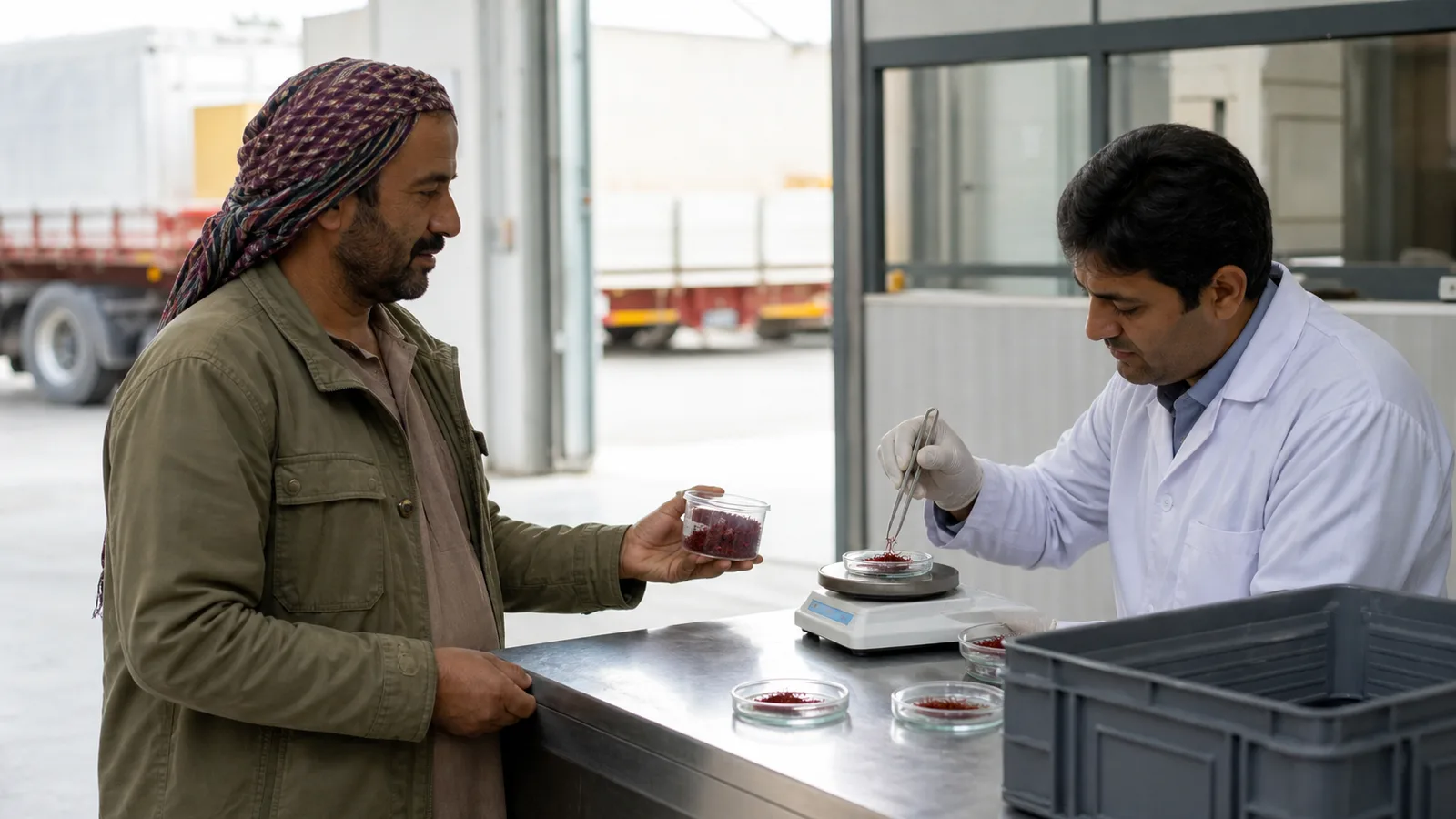
The 2018 headline “Lack of Saffron Shares to Retailers” mistranslated the real issue. Ali Hosseini of Iran’s National Saffron Council was arguing that the saffron commodity exchange had not helped small agricultural landholders as intended. Individual farmers sold modest quantities, while brokers could collect those lots and offer them in bulk.
His criticism was not that an exchange had no purpose. It was that a market designed to reduce intermediaries could still favour intermediaries if small growers could not meet its practical conditions. The price and currency concerns in the report are historical and should not be used as current quotations.
What Ali Hosseini said
In an interview with ILNA, Hosseini discussed saffron offered through the Iran Mercantile Exchange and whether the system had removed middlemen. He said the original objective was to help farmers, but smallholders could not readily offer their low-volume production in the exchange market.
According to his account, dealers bought saffron cheaply from growers, aggregated it and then supplied a wholesale-sized lot through the exchange. The mechanism therefore failed to eliminate the intermediary in practice.
The old title used “shares” and “retailers,” but the subject was physical saffron and small farm owners. A commodity exchange can trade contracts or warehouse-backed certificates connected to standardised product; that is different from giving ordinary retail shops shares in saffron.
Why small lots create a market-access problem
A grower may harvest only a few hundred grams or several kilograms. Formal trading can require an approved grade, warehouse delivery, sampling, fees, registration, a trading account and minimum units. Even when each requirement has a sound reason, their combined time and cost can make direct participation unattractive for a small lot.
An aggregator can solve transport, sorting and volume problems, but gains bargaining power in return. The intermediary is harmful when pricing is opaque or grading is one-sided; it can be useful when it provides a genuine service at a visible cost.
The policy question is therefore not simply “middleman or no middleman.” It is whether the grower can see the reference price, understand the grade deduction, choose among buyers and keep a fair share after necessary services.
What a warehouse receipt can offer
With a commodity deposit system, approved product is delivered to a recognised warehouse, assessed against a specification and represented by a tradable certificate. The physical lot remains stored while ownership of the certificate can change.
A 2017 agricultural-market report on saffron deposit-certificate trading described this structure in Iran. In principle it can add transparent bids, standard grading, secure storage and a delayed sale. In practice, access depends on the approved warehouses, unit rules, costs and assistance available in the producing area.
Why the exchange did not automatically remove brokers
Hosseini said the market suited traders and brokers who could buy from farmers at low prices and offer larger quantities. He described some activity as “stock-exchange playing” and warned that speculative behaviour could shock Iran’s red-gold market.
A transparent trading screen can show prices for what is actually traded. It cannot by itself show the price a farmer received before aggregation, the private grade applied at the farm gate or the cost of reaching an approved warehouse. Those off-exchange steps determine whether price discovery reaches the producer.
Nor does market volatility prove manipulation. Harvest timing, inventory, quality mix, exchange rates, export demand and thin trading can all affect price. A claim about speculation needs order, position or enforcement evidence, none of which the old article supplied.
The export and exchange-rate concern
Hosseini also said saffron exports faced difficulty because of exchange-rate fluctuations. Currency movement can change the local-currency value of an export sale and the costs or risks borne between contracting and payment. The report did not identify a currency, rate, policy or loss, so the point remains a general historical concern.
A grower selling locally, an exporter pricing abroad and a trader holding warehouse stock face different exposures. Combining them into a single “saffron price” hides who carries each risk.
The historical price range
Hosseini quoted saffron at 4.5 million to 5.7 million tomans per kilogram. That range belongs to the period of the interview and may also have varied by grade. It is not today’s farm-gate, exchange or retail price.
Any useful price statement should specify date, saffron grade, unit, location, tax or fees, and whether it is a bid, completed trade, wholesale offer or retail pack equivalent. Without those fields, apparent comparisons can be misleading.
What would make access fairer for small growers?
- collection points or cooperatives that pool lots under transparent rules;
- published grading methods and the right to review a test result;
- clear warehouse, sampling, brokerage and withdrawal costs;
- low practical minimums and help opening the required account;
- fast, predictable payment and a visible reference price;
- traceability that preserves the grower’s identity when buyers value origin.
Pooling is not the same as surrendering control. A well-run cooperative can aggregate volume while documenting each member’s weight, grade, deductions and proceeds.
The conclusion
The old “Lack of Saffron Shares to Retailers” title concealed a straightforward complaint: small saffron farmers were not reaching the commodity exchange directly, so brokers remained between field and market. Hosseini believed that contradicted the exchange’s farmer-support objective.
The lesson is still useful. A formal market should be judged not only by trading volume, but by whether small producers can understand it, access it at proportionate cost and see the price they receive relative to the final transaction.
Historical sources: ILNA interview and Donya-e-Eqtesad, as cited in the original post.

![Exporting Saffron to Turkey + Price Guide [Complete 0 to 100]](https://img.rowhanisaffron.com/20260827003933/saffron-export-turkey-quality-inspection.webp)



