


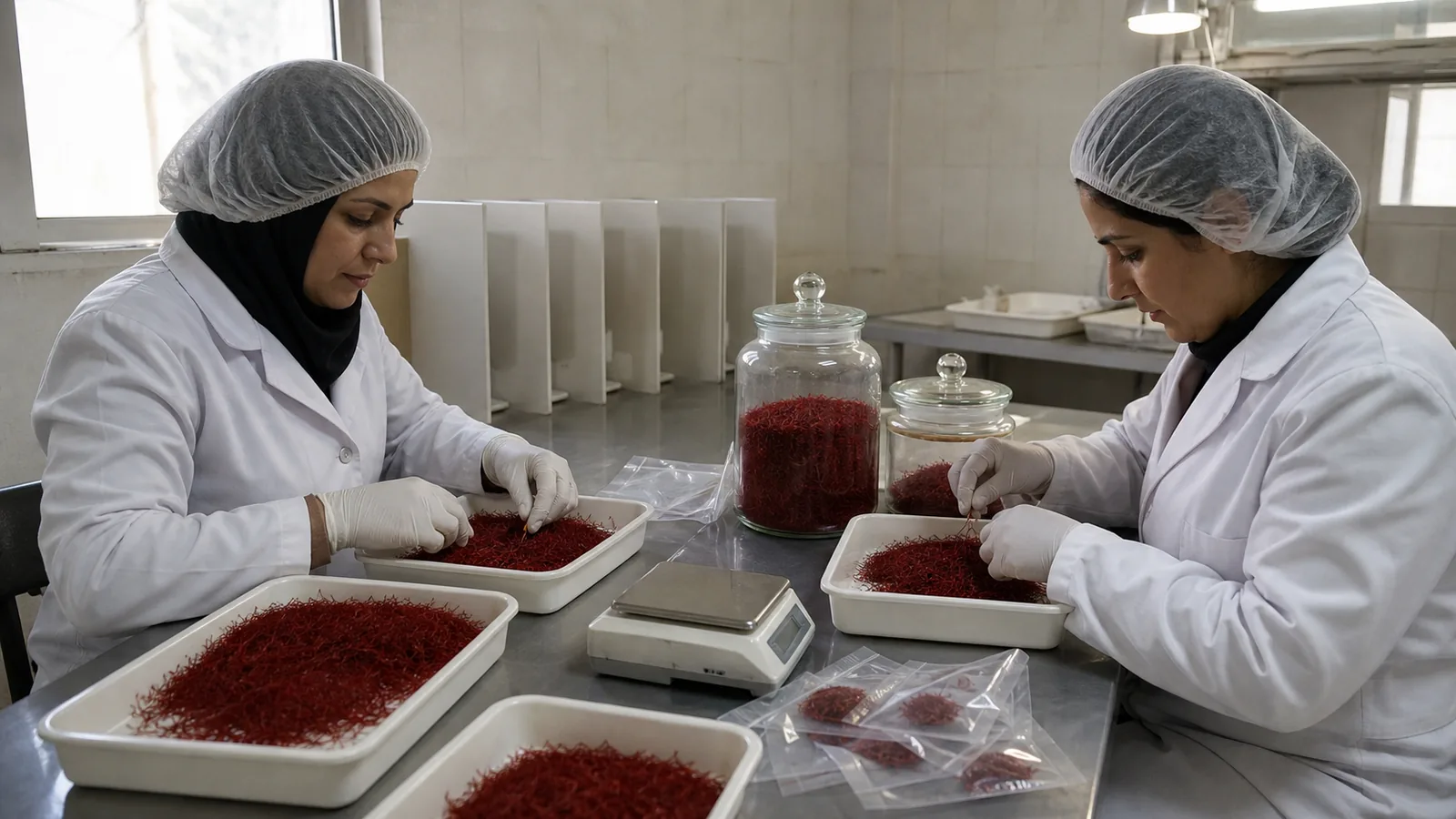
Saffron processing in South Khorasan connects farms around Birjand, Qaen, Khusf, Ferdows and other counties with grading, packing and export markets. An archived provincial report counted nine dedicated saffron grading and packaging units, alongside a wider group of facilities handling the province’s two best-known crops: saffron and barberry.
The figures below belong to the report’s period and should not be read as current capacity or production totals. Their value is in showing the scale of investment, the places involved and the continuing gap between growing a valuable crop and retaining its value after harvest.
Processing capacity reported in South Khorasan
Hashem Valipur Motlagh, then head of the provincial Agricultural Jihad Organization, said 20 barberry and saffron processing units had been launched. Of these, nine units specifically graded and packed saffron in Birjand, Qaen, Tabas, Khusf and Ferdows.
The report gave total operating capacity across the units as 3,124 tonnes. That number cannot mean dried saffron alone: the same report forecast only 56 tonnes of saffron for the province, while the facilities also handled much heavier volumes of barberry. It is therefore best understood as the combined reported throughput or capacity of the processing group, not as saffron output.
Investment in the saffron-related units was reported at 115.922 billion rials, with 112 direct jobs. The provincial saffron area was placed at approximately 15,114 hectares, and South Khorasan was described as Iran’s second-largest producing province at the time.
What happens between harvest and a finished saffron pack?
A processing unit adds value only when each step protects identity and quality. The practical chain includes:
- Lot reception and traceability: keeping grower, field, harvest date and delivered weight linked to the material.
- Stigma separation and cleaning: removing petals, stamens, excess yellow style and foreign matter without damaging the red threads.
- Controlled drying: reducing moisture consistently while protecting aroma, colour and bitterness characteristics.
- Grading and sampling: separating commercial cuts and drawing a representative sample rather than testing a hand-picked portion.
- Quality and authenticity checks: confirming the agreed specification and investigating results that do not match the lot.
- Food-safe packing: choosing a barrier pack suited to the quantity, destination and expected storage period.
- Dry, dark storage: protecting the packed saffron from humidity, heat, light and repeated air exposure.
The current ISO 3632-1:2025 specification covers dried saffron as filaments, cut filaments and powder and includes storage and transport recommendations. A processor still needs a sampling plan and batch records; a grade name on a label cannot make up for weak lot control.
Barberry processing belongs in the same provincial story
The original report also counted 25 barberry processing sites, including 11 units concerned with packaging or producing barberry juice and syrup. It reported investment of 182.587 billion rials and 168 jobs. The corresponding harvest forecast was 14,260 tonnes from 14,780 hectares, with projected grower revenue of 150.7 billion tomans.
These barberry figures explain why the reported multi-crop processing capacity is so much larger than the saffron crop. They also explain the wording error in the companion source article.
Correction: the 98% claim refers to barberry, not saffron
The source post was machine-translated as “98% of red saffron in South Khorasan.” That statement is not credible as a saffron statistic, and the surrounding interview repeatedly discusses South Khorasan’s three strategic products: saffron, barberry and jujube.
Independent reporting confirms the intended crop. A later Mehr report from Qaen said South Khorasan accounted for 95% of Iran’s barberry, while reporting 22 tonnes of dried saffron in Qaen County. Other provincial descriptions place the barberry share around 98%. The absorbed source’s “red saffron” wording is therefore corrected here to red barberry; it is not repeated as a false claim about saffron.
The Chamber of Commerce view
Mohsen Ehtesham, then president of the Birjand Chamber of Commerce, argued that saffron, barberry and jujube could drive South Khorasan’s economic development. Years of low rainfall and limited water made these adapted, higher-value crops particularly important to the province.
His concern was that production alone was not creating enough export value. He identified three linked obstacles:
- border-market opportunities with neighbouring Afghanistan were underused;
- high lending and interest costs weakened exporters against overseas competitors;
- processing and export-oriented businesses lacked consistent support.
Ehtesham’s argument was not simply for more cultivation. It was for an export chain that could finance inventory, process to a defined standard, package for the destination and reach buyers without surrendering most of the margin to intermediaries.
Why local processing matters to growers
Saffron is compact and valuable, but its quality can be damaged between flower separation and packing. When growers have access to competent local drying, grading and storage, the gap between harvest and controlled processing becomes shorter. Traceable lots also make it easier to investigate a quality problem without rejecting unrelated material.
Local packing can retain more labour and commercial activity in the province, but only if the pack meets the buyer’s needs. A decorative container without reliable content, documentation or market access adds cost rather than durable value.
The same principle applies to barberry. Cleaning, drying, cold storage and product development can extend its selling season and create forms suited to different markets. The two crops share some commercial infrastructure, yet their processing lines and food-safety controls should remain appropriate to each product.
A practical processing and export checklist
For a South Khorasan saffron lot intended for trade, the final file should answer clear questions:
- Which grower and harvest does the lot represent?
- Where and when were the stigmas separated and dried?
- Was the submitted sample representative of the packed lot?
- What saffron form and grade is declared, and which evidence supports it?
- Are net weight, pack materials, labelling and transport conditions suitable for the destination?
- Can the processor trace every finished pack back to the source lot?
After packing, storage still matters. Keep saffron airtight, dry and away from heat and light; our saffron storage guide explains practical handling for bulk and opened packs.
South Khorasan’s processing challenge
The archived figures show meaningful infrastructure: processing and packing units, investment, direct jobs and a large cultivation base. They also show why capacity on paper is not the finish line. Export finance, border access, accurate specifications, traceability and buyer development determine whether processing actually returns more value to the province.
South Khorasan’s saffron story is therefore both agricultural and industrial. The flowers begin the chain. Careful drying, grading, testing, packing and market access decide how much of the product’s value remains where it was grown.

![Exporting Saffron to Turkey + Price Guide [Complete 0 to 100]](https://img.rowhanisaffron.com/20260827003933/saffron-export-turkey-quality-inspection.webp)



