


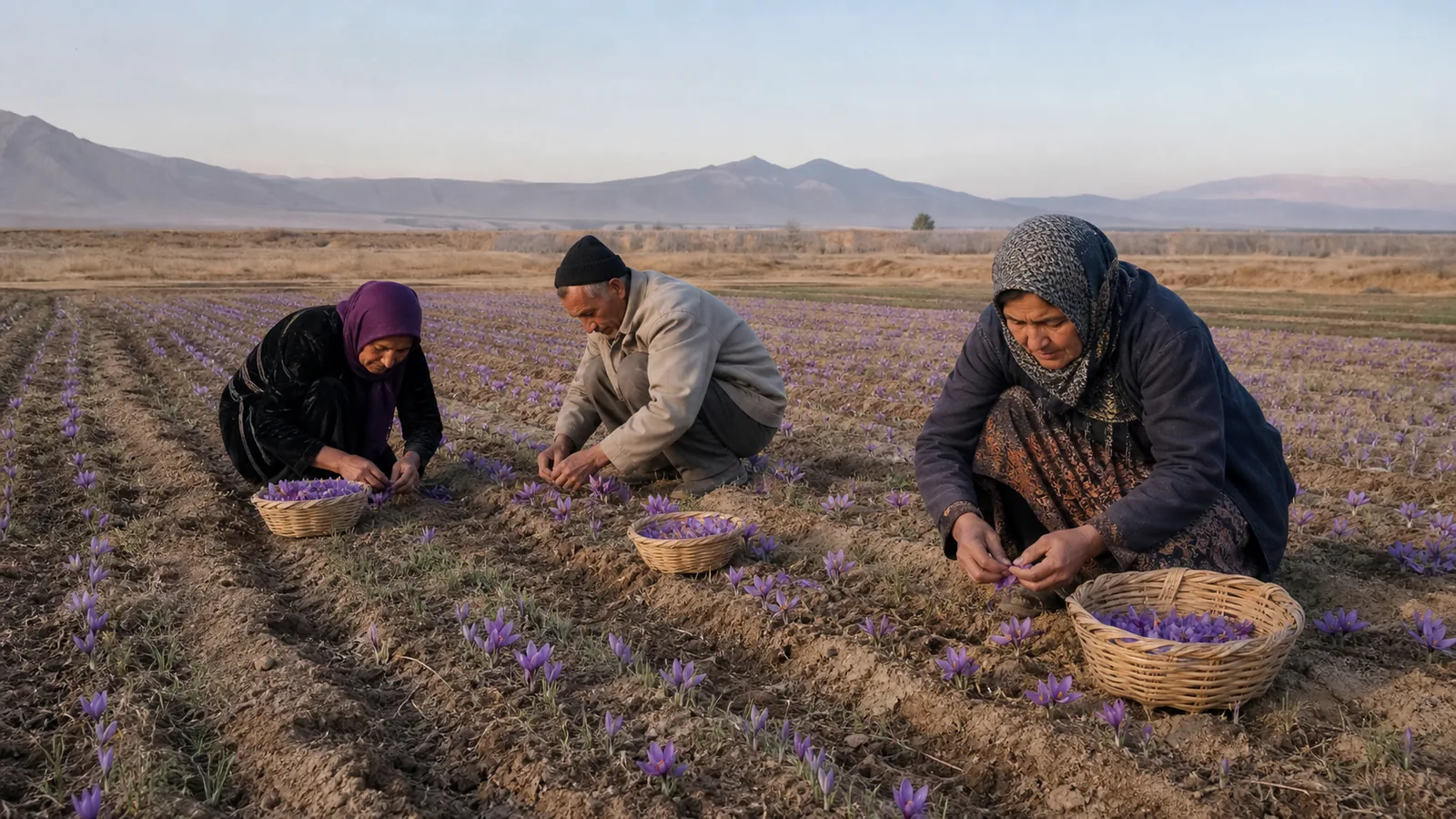
A historical report from Buin Zahra recorded more than 10 kilograms of dry saffron from about six hectares, while a separate pilot in Kowsar expected roughly two kilograms from two new farms. Read together, the reports show why a first harvest cannot be used as a permanent yield forecast: location matters, but so do field age, corm quality, planting density, irrigation, soil, weather, and harvest handling.
The figures below belong to the seasons described in the original local reports. They are not current production totals or prices. Their value is in showing how saffron cultivation was developing beyond Iran’s best-known growing regions and what farmers need to measure before judging a new field.
What the Buin Zahra saffron harvest report said
Morteza Shabannejad, identified as the head of the local agricultural authority, said Buin Zahra had around six hectares under saffron and produced more than 10 kilograms of dry spice in the reported season. That works out to more than 1.67 kilograms per hectare when the two figures are compared.
It is a useful calculation, but not a complete farm-performance measure. The report does not say whether all six hectares were the same age, planted at the same density, managed in the same way, or fully productive. It also gives no field-by-field weights. The result should therefore remain an approximate district snapshot, not a guaranteed yield for an individual grower.
The official attributed local potential to Buin Zahra’s climate and suitable soil. Those qualities can support a crop, but suitability must be confirmed on each site. Drainage, salinity, soil-borne disease, corm health, irrigation timing, and damaging temperature events can change the result even within one county.
How the reported Qazvin totals compare
The same article placed about 15 hectares under saffron across Qazvin province and reported approximately 24 kilograms harvested. On those rounded numbers, the provincial average was about 1.6 kilograms per hectare. Buin Zahra represented about 40% of the stated area and a little over 42% of the stated production.
Those percentages are internally consistent with the article’s figures, but the totals lack a named reporting year and formal statistical table. A current decision would need current agricultural records rather than an old news snapshot. A broader Qazvin report on saffron area and harvest in Qazvin province also needs to be read in its own dated context because planted area and field maturity change from season to season.
Planting and harvest timing in Buin Zahra
The Buin Zahra report said planting took place in late August. It described two irrigations before harvest, with flowering and picking beginning in early November and continuing until the middle of December.
That sequence is a local account, not a universal calendar. Peer-reviewed crop-cycle research describes saffron’s broad pattern as sprouting in September and October, flowering in October and November, leaf growth through winter and spring, corm development into spring, and summer dormancy. Actual dates shift with climate, elevation, soil temperature, rainfall, and irrigation.
Irrigation also cannot be reduced to one fixed number for every field. A two-year Iranian experiment found that irrigation rounds and mother-corm size affected flower yield, quality measurements, daughter-corm development, and nutrient uptake. The practical point is simple: copy neither Buin Zahra’s calendar nor its irrigation count without local soil, weather, and extension advice.
What the Kowsar pilot adds
The assigned source covers Kowsar County in Ardabil Province. A local official said two farms had been planted as a pilot in the previous year and that their first harvest was expected to produce about two kilograms of dry saffron. Picking was expected to start in mid-November and last around three weeks.
No planted area is supplied, so a per-hectare yield cannot be calculated. Nor does the article report a final weighed harvest. The two-kilogram figure is an expectation for the two pilot farms together, not proof that every Kowsar planting will perform the same way.
The Kowsar account belongs in this article because it answers a question the Buin Zahra report leaves open: what can happen when saffron is newly introduced to another cool-climate area? A pilot can test flowering, disease pressure, labor availability, drying, and sale conditions. It should be treated as learning evidence before larger planting, not as a promise of profit.
Why saffron yield changes as a field matures
The Kowsar source said yields could range from two to 10 kilograms per hectare and described saffron as a crop that commonly remains in the ground for about seven years, sometimes producing for up to 10. Its machine-translated sentence joined field age and yield together imprecisely. The safe interpretation is that output varies during the life of a multi-year planting—not that every field automatically rises from two to 10 kilograms.
Peer-reviewed evidence supports the importance of field age while also showing why the old range cannot be used as a benchmark on its own. A study of 110 farms in Gonabad found that technical efficiency depended partly on corm planting density and cultivation age; very dense planting shortened productive field life. The crop-cycle research cited above notes that Iranian saffron cycles commonly last six to eight years, although practice and conditions vary.
As daughter corms multiply, flower numbers may initially rise. Later, crowding can increase competition for water and nutrients and make disease management harder. Farmers therefore need annual records for harvested area, flower weight, dry stigma weight, labor hours, irrigation, rejects, and quality—not just a single district total.
The historical price was not a current quotation
The Kowsar report quoted dry saffron at up to 150,000 rials per gram. That equals 150 million rials per kilogram arithmetically, but the article does not give a grade, transaction date, buyer, package size, or whether the amount was wholesale or retail.
It should not be presented as today’s farm-gate price. Saffron value varies with the year, currency conditions, grade, moisture, purity, lot size, packaging, testing, payment terms, and route to market. Anyone evaluating a planting now should use a current written buyer specification and realistic net price after picking, separation, drying, testing, packing, transport, and rejected material.
Rural women were part of the Buin Zahra project
Shabannejad said 10 rural women had placed their land under saffron through self-employment projects. He hoped the work would support household income, confidence, creativity, and seasonal employment for other women during harvest.
Those are goals reported by the official, not measured outcomes in the article. Saffron does create a concentrated need for careful flower picking and stigma separation, but the report gives no income records, work hours, contract terms, or follow-up. A responsible assessment would ask how revenue and risk were shared, whether participants controlled their crop and sales, and whether the short harvest window produced worthwhile net income.
Labor planning matters because flowers need prompt attention. A farm may have agronomically suitable land yet still lose value if it cannot pick, separate, and dry the stigmas consistently during the flowering peak.
Harvest weight is only the first quality checkpoint
The reported 10 kilograms describes dry saffron weight, but weight alone does not establish quality. The commercial result also depends on how quickly flowers are handled, how stigmas are separated, drying temperature and duration, moisture after drying, foreign matter, storage, and batch traceability.
Pre- and post-harvest practices affect saffron’s color, aroma, and bittering characteristics. A higher yield can still produce a weaker return if drying is uneven or the lot fails a buyer’s specification. Farmers comparing seasons should record both kilograms and quality results from representative samples.
For another provincial example of how reported area, output, and arithmetic need to be read together, see our review of Isfahan saffron farming.
What these two local reports actually establish
The Buin Zahra account records a completed district harvest of more than 10 kilograms from roughly six hectares, a provincial comparison, a local calendar, and the participation of 10 rural women. The Kowsar account contributes a smaller first-year pilot, an expected two-kilogram harvest, a three-week picking window, a historical price quote, and the reminder that yield changes over a field’s life.
Neither report proves that one province is inherently superior or that a new farm will reproduce the same figures. Their combined lesson is more useful: start with evidence at field scale, separate forecasts from weighed results, keep multi-year records, protect post-harvest quality, and expand only when the agronomy, labor, and market all work.

![Exporting Saffron to Turkey + Price Guide [Complete 0 to 100]](https://img.rowhanisaffron.com/20260827003933/saffron-export-turkey-quality-inspection.webp)



