


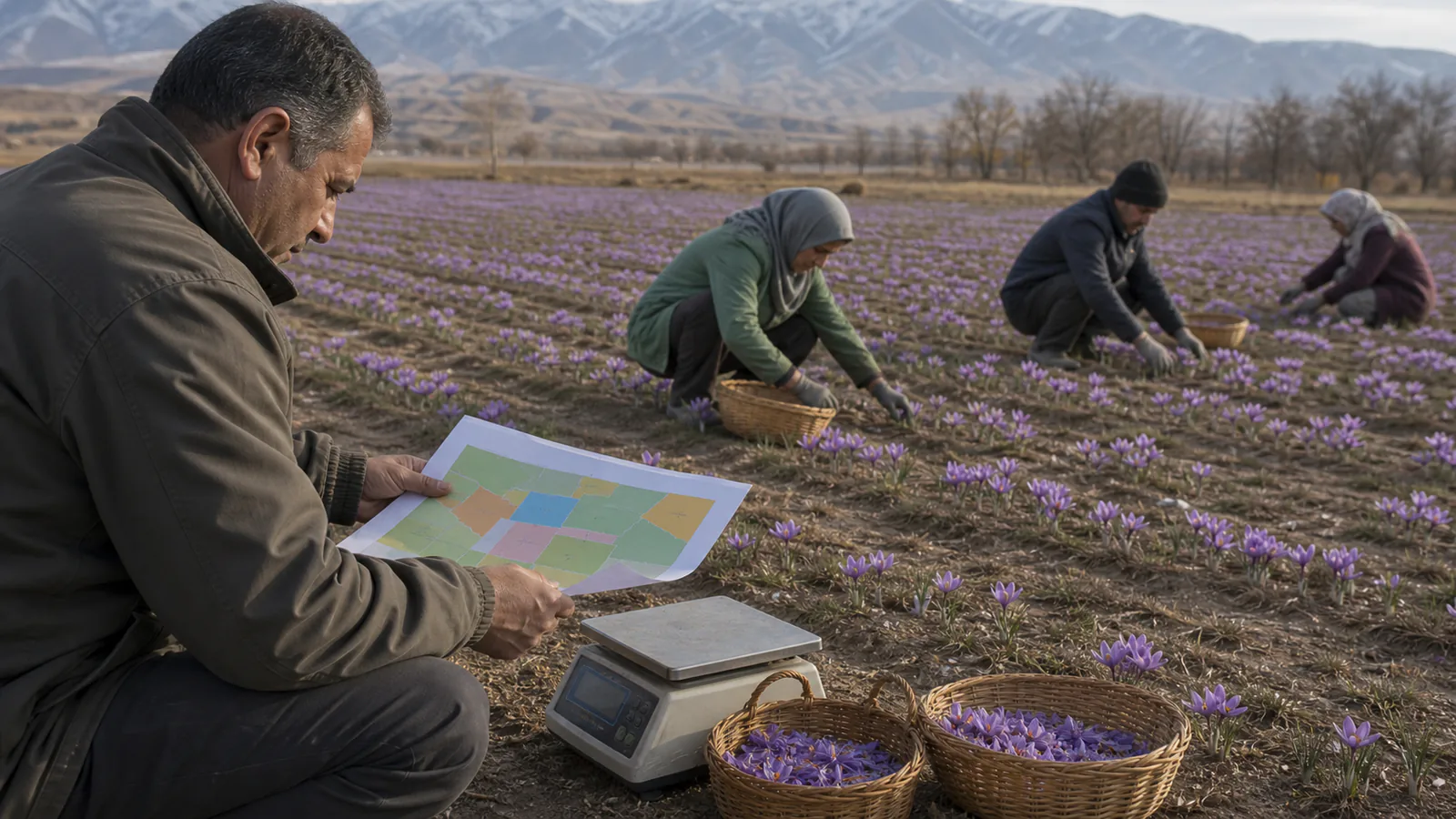
A historical saffron harvest in Qazvin province began across 87 planted hectares, with more than 220 kilograms forecast from 73.5 productive hectares. The remaining 13.5 hectares were described as establishing or not yet productive. Within Qazvin city, a separate report forecast 16 kilograms from nine hectares and identified the districts with the largest local area.
The province and city figures overlap geographically, so they must not be added together. The city’s nine hectares sit within the wider provincial picture, and both reports were written as harvest-season forecasts rather than final audited results.
How Qazvin’s 87 hectares were divided
Ali Akbari, identified as horticulture director of Qazvin’s Agricultural Jihad organization, said saffron picking had begun on 87 hectares across the province. Of that total, 73.5 hectares were productive and 13.5 hectares were not yet bearing.
Those two components add exactly to 87 hectares. Separating them is important because new saffron fields can contribute planted area before they contribute a normal harvest.
Akbari stated an average of three kilograms per hectare and a provincial output above 220 kilograms. Multiplying 73.5 productive hectares by three kg/ha gives 220.5 kilograms, so the area, average, and “more than 220” figure are internally consistent.
The 220 kg figure was announced at harvest start
The article says harvesting had started and that more than 220 kilograms would be produced. It does not provide the final dried weight after the season, moisture basis, farm-level range, or grade distribution.
For that reason, 220.5 kilograms is best understood as the arithmetic behind the forecast—not a verified final total. A subsequent report would need to give the actual dry weight and confirm whether all 73.5 hectares were harvested.
This distinction also matters in other regional reports. The finalized article on the Estahban saffron harvest likewise keeps an opening-season forecast separate from a completed result.
Qazvin city forecast 16 kg from nine hectares
Abbas Alikhani, identified as director of Qazvin city’s Agricultural Jihad office, announced harvesting on nine hectares and forecast 16 kilograms of saffron stigmas. The implied city average is about 1.78 kg/ha if all nine hectares were productive.
That is lower than the province’s stated three kg/ha average, but the reports do not give city field ages, productive area, the same harvest year, or final weights. It would be unsafe to conclude that Qazvin city farms underperformed the province.
The city figure should remain nested within the province rather than treated as additional output. A visitor looking for the nine-hectare report can find its full promise here without creating a double-counted 96-hectare total.
Where Qazvin city’s saffron was concentrated
Alikhani named Iqbal Lahori, Cohen, and Tarom Sofla as the districts with the largest local saffron area. The English spelling “Cohen” may be a transliteration issue; the source provides no Persian spelling or coordinates, so it is preserved without silently substituting another place.
The official described Qazvin city’s cold, mountainous conditions as suitable for saffron. The provincial article, meanwhile, gave a broad description of saffron as suited to mild winters and hot, dry summers. Those general statements do not replace field-specific assessment of winter minimums, drainage, soil, irrigation water, and corm health.
Qazvin province spans plains and Alborz mountain landscapes, so a single climate label cannot describe every farm.
The harvest calendar ran from autumn into December
The provincial source said saffron activity began in October and flowering extended from November to mid-December. It does not define whether “activity” means irrigation, field preparation, emergence, or picking.
The calendar is historical and weather-dependent. A farm still needs enough pickers for the daily flowering peak and a clean post-harvest workflow for prompt stigma separation, drying, and protected storage.
A current operational report should state the first and last picking dates, daily flower peak, labor hours, time to separation, drying conditions, and final dry yield. Those details are more useful than repeating a broad month range.
Support facilities were announced, but terms were missing
The city source said support for saffron and Mohammadi rose cultivation was being provided through a rural and nomadic employment working group. Its English wording is incomplete, and it gives no amount, recipient count, lender, interest or fee, security, term, disbursement date, or repayment outcome.
The statement shows that the crops were included in a local support program. It does not prove that every applicant received funding, that money arrived before planting, or that financed farms became profitable.
A useful update would distinguish application, referral, approval, disbursement, planted area, harvest, sales, and repayment. Those stages are not interchangeable.
The predicted doubling was a goal, not a result
Alikhani predicted that Qazvin city’s saffron area would double in coming years because of grower interest. Starting from nine hectares, that implies a future area near 18 hectares if the baseline and wording are exact.
The article gives no target date, funded projects, corm supply, water plan, or later area measurement. It therefore cannot establish that doubling occurred.
Expansion should also be judged by productive area and saleable output, not hectares alone. New fields can raise area immediately while contributing little to early harvests.
Quality and uses need separate evidence
The provincial article described saffron as useful in food, confectionery, ice cream, distillates, essential oils, perfumery, cosmetics, and colouring. Those product categories do not demonstrate the quality or regulatory suitability of a specific Qazvin lot.
ISO 3632-1:2025 specifies requirements for dried saffron in filament, cut-filament, and powder forms. A credible quality statement should identify the batch, sample, moisture basis, laboratory, test date, analytical values, product form, storage history, and applicable standard edition.
The old pages also contained unsupported disease-treatment language. It is not needed to explain the harvest and is not retained as health advice.
What a current Qazvin harvest report should show
A current provincial update should publish final dry weight, productive and establishing area by county, field age, moisture basis, grade, farm count, and actual yield range. The Qazvin city subset should be identified clearly so readers do not add it to the provincial total.
Program reporting should add funding terms and outcomes. Expansion reporting should show how many planned hectares were planted, how many became productive, and whether output, water use, labor income, and sales improved.
On the available historical evidence, Qazvin province had 87 planted hectares, with arithmetic supporting a forecast just above 220 kilograms from 73.5 productive hectares. Qazvin city accounted for nine hectares and a separate 16-kilogram forecast within that wider total. Neither figure should be presented as a current result.

![Exporting Saffron to Turkey + Price Guide [Complete 0 to 100]](https://img.rowhanisaffron.com/20260827003933/saffron-export-turkey-quality-inspection.webp)



