


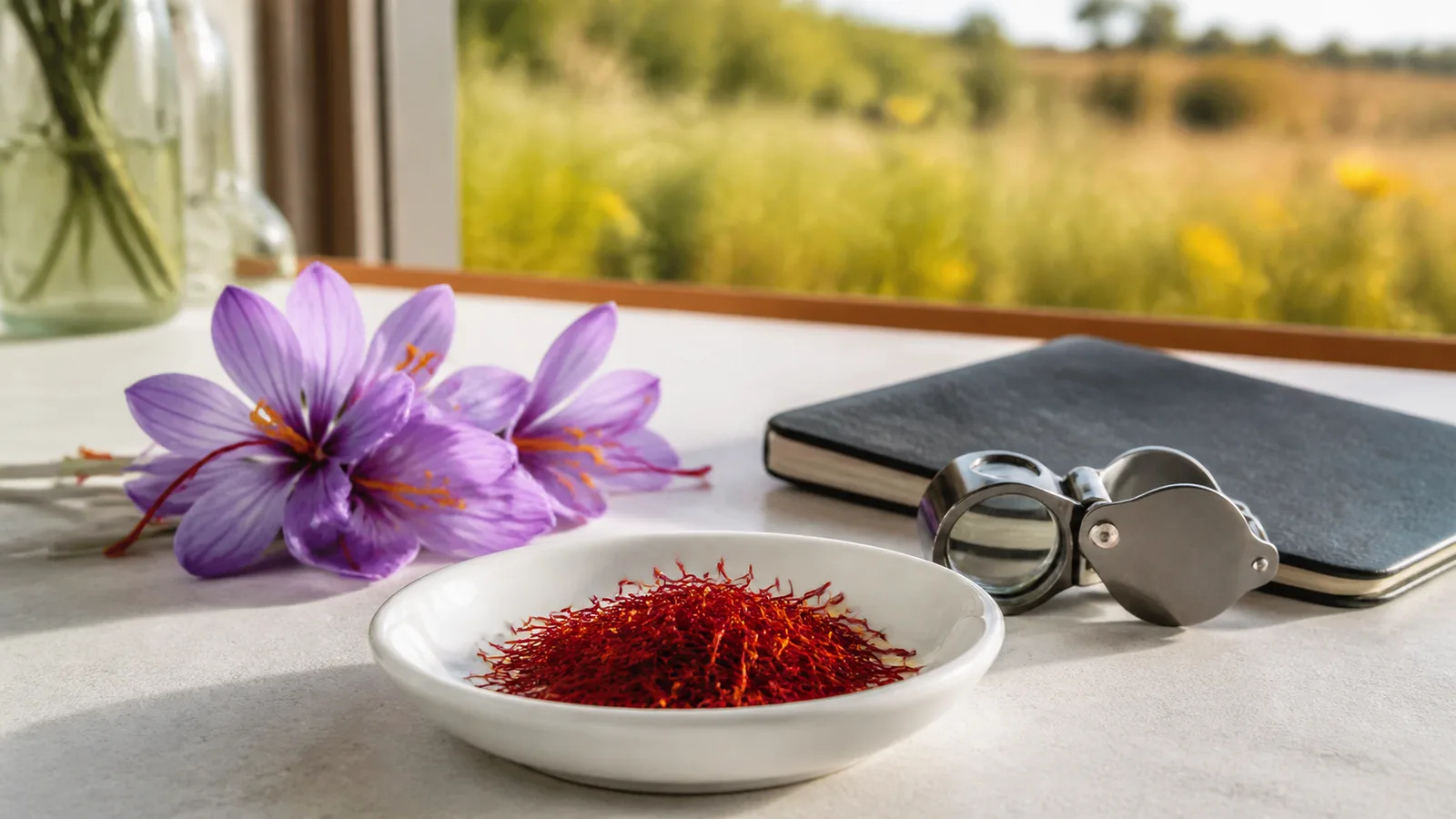
Wild saffron is a common name, not the name of one reliably identifiable plant. It may refer to a wild Crocus species related to cultivated saffron, the poisonous plant Colchicum autumnale (also called meadow saffron), a naturalized patch of cultivated Crocus sativus, or simply a farm or product name. Those possibilities do not share the same edible parts, chemistry, or safety profile.
That distinction changes how “Wild Saffron Benefits” should be read. No single list of health benefits can apply to every plant sold or described under this name. Before discussing food or traditional use, the species has to be established by a qualified botanist or another reliable identification source.
Exploring the Benefits of Wild Saffron
The most useful benefit of understanding wild saffron is practical: it prevents a common name from being mistaken for a food identification. Culinary saffron comes from the dried red stigmas of Crocus sativus. The Royal Horticultural Society describes that plant as unknown in the wild and warns that it must not be confused with poisonous Colchicum.
Several genuinely wild Crocus species exist. Iran has a rich diversity of them, including species recorded from the Zagros region, the southern Caspian area, and other habitats. They differ in flowering season, flower form, distribution, and traditional use. “Mountain saffron” is therefore not precise enough to establish a species either.
The earlier article grouped Central Iran, Lorestan, Ilam, Hamedan, and the Zagros Mountains into the range of one unnamed plant. Those regions may contain different taxa, so that list cannot serve as a distribution map without a scientific identification and a botanical record.
Key Differences Between Wild and Common Saffron
These are the distinctions that matter most:
- Common culinary saffron: Crocus sativus, in the iris family (Iridaceae), is cultivated for three red stigmas in each flower. Those dried stigmas are the spice.
- Wild crocuses: these are multiple Crocus species, not one alternative crop. Some are close relatives of saffron; others are ornamental plants with no established culinary use.
- Meadow saffron or autumn crocus: Colchicum autumnale belongs to a different family, Colchicaceae. Despite its saffron-like common name and crocus-like flower, it is toxic if eaten.
- Trade names: a farm, restaurant, product, or social account can include “wild saffron” in its name even when the crop is ordinary cultivated Crocus sativus.
Flower color is not a safe test. A wild saffron flower may be violet, lilac, blue-toned, white, or patterned, and both Crocus and Colchicum include flowers that can look similar at a glance. Flowering in spring or autumn is useful botanical context, but it does not make a plant edible.
What is the wild saffron plant?
There is no one answer without a scientific name. In discussions of saffron ancestry, “wild saffron” often means Crocus cartwrightianus, a close wild relative associated with the eastern Mediterranean. In Iranian botanical writing, it may refer more broadly to native Crocus species such as Crocus haussknechtii and Crocus cancellatus.
The older botanical account in Encyclopaedia Iranica records wild Crocus species across several Iranian regions and reports traditional collection of the corms of C. cancellatus and C. haussknechtii in some places. That is useful ethnobotanical history, but it is not a general instruction to collect a purple flower or eat an unidentified bulb.
The underground storage organ of a crocus is technically a corm, although it is often called a bulb in everyday speech. Culinary saffron is different: the edible spice sold for cooking is the dried stigma, not the corm, leaf, or petal.
Health Benefits of Wild Saffron
A health claim needs the exact species, plant part, preparation, dose, and evidence. Without those details, phrases such as “wild saffron supports memory” or “wild saffron helps arthritis, sleep, skin, anxiety, or postpartum bleeding” cannot be evaluated responsibly.
The previous version of this article attributed all of those effects to an unnamed wild-saffron bulb. It did not provide a botanical identification or clinical source, so those statements are not carried forward as established benefits. Traditional use can be recorded as cultural information, but it is not proof that a preparation is safe or that it treats a medical condition.
Research on cultivated saffron or a standardized Crocus sativus extract cannot automatically support claims for a different wild species. The compounds present in the red stigmas also should not be assumed to occur at the same levels in a corm, petal, or whole plant.
Is Wild Saffron Safe to Consume?
Do not eat a wild plant because someone called it saffron. The RHS states that all parts of Colchicum are toxic if eaten. The US Centers for Disease Control and Prevention describes colchicine, derived from meadow saffron, as highly toxic and potentially fatal at small doses.
If someone may have swallowed an unidentified crocus-like plant, contact the local poison center or emergency service promptly; do not wait for symptoms and do not induce vomiting unless a medical professional tells you to do so. A photograph, plant-identification app, or common name is not enough to clear a wild corm for eating.
Ways to Prepare Wild Saffron Bulbs: why identification comes first
The former article advised boiling, eating raw, or grilling wild-saffron bulbs. That advice is unsafe as a general recipe because “wild saffron” can identify unrelated plants and potentially toxic lookalikes. Cooking is not a substitute for correct species identification, and it should not be assumed to remove plant toxins.
Historical sources do describe boiled or roasted corms from particular Iranian Crocus species. Anyone documenting that tradition needs the local name, scientific identification, location, plant part, and preparation method. It should be learned from people with verified regional and botanical expertise, not reconstructed from a generic web page.
For ordinary cooking, use food-grade Crocus sativus threads from a traceable supplier. Our guide to identifying pure saffron explains what to examine in the purchased spice.
Can you eat saffron raw?
A few food-grade saffron threads can be used without cooking, but chewing them gives uneven flavor and wastes much of their aroma. Crushing and infusing the threads in warm water or milk distributes the spice more effectively. That answer applies to authenticated culinary Crocus sativus stigmas, not to a wild flower, corm, or leaf.
If you want to use the spice in a drink, follow a measured recipe such as this guide to making saffron tea. It is not a guide to foraging.
Do all crocuses produce saffron?
No. Many Crocus species produce stigmas, but the culinary spice sold as saffron is obtained from Crocus sativus. A flower resembling a saffron crocus does not make its stigmas a verified substitute. Even within genuine saffron production, identity, drying, storage, and adulteration controls affect the finished spice.
It is also worth separating “wild” from “naturalized.” Cultivated saffron reproduces through daughter corms rather than viable seed. A neglected or long-established patch can persist away from a formal field, but that does not prove the plant is a distinct wild species.
What does “wild Tasmanian saffron” mean?
Searches for wild Tasmanian saffron may be looking for a producer or place name rather than a botanical category. Tasmania has commercial saffron cultivation. Tas-Saff, for example, identifies its crop as acclimatized Crocus sativus, which means cultivated culinary saffron rather than an unnamed wild species.
The same caution applies to phrases such as “Wild About Saffron,” “Wild Saffron Clare,” or “Saffron Gone Wild.” They may be business, event, account, or product names. Check the named entity and its own description before drawing a botanical conclusion from the words.
How to identify what a seller or article means
- Ask for the scientific name. A responsible edible-plant claim should go beyond “wild saffron” or “mountain saffron.”
- Confirm the plant part. Genuine culinary saffron is the dried red stigma. A bulb, corm, petal, leaf, or whole-plant product is something different.
- Check the source of the identification. Prefer a herbarium, botanist, botanical garden, flora, agricultural authority, or regulator over an image match.
- Separate traditional use from proof of safety. A documented local practice belongs in the record, but context and species still matter.
- Treat health claims separately. Look for human evidence on the exact preparation rather than transferring research from cultivated saffron.
Which Should You Choose: Wild or Common Saffron?
For cooking, choose authenticated, food-grade Crocus sativus threads. They provide the familiar saffron aroma, golden color, and flavor, and the edible plant part is clear. A wild crocus belongs in botanical study or responsible conservation unless a qualified local authority has established its identity and use.
The name “wild saffron” is still worth understanding. It opens a useful story about saffron’s relatives, regional plant knowledge, and the danger of relying on common names. It should never be used as a shortcut from a purple flower to an edible bulb or a list of medical benefits.
Botanical and safety references: Royal Horticultural Society guidance on growing and identifying saffron; RHS guide to toxic Colchicum; CDC/NIOSH colchicine safety information; Encyclopaedia Iranica account of wild Crocus species in Iran; Kew Plants of the World Online record for Crocus sativus; and Tas-Saff’s description of its cultivated Tasmanian saffron.

![Exporting Saffron to Turkey + Price Guide [Complete 0 to 100]](https://img.rowhanisaffron.com/20260827003933/saffron-export-turkey-quality-inspection.webp)



