


Saffron farming in Isfahan sits at the meeting point of water scarcity, skilled hand work, regional identity, and international trade. The province can grow a high-value crop suited to a dry climate, but turning those threads into a recognised global product takes more than expanding the planted area.
Why saffron is grown in Isfahan
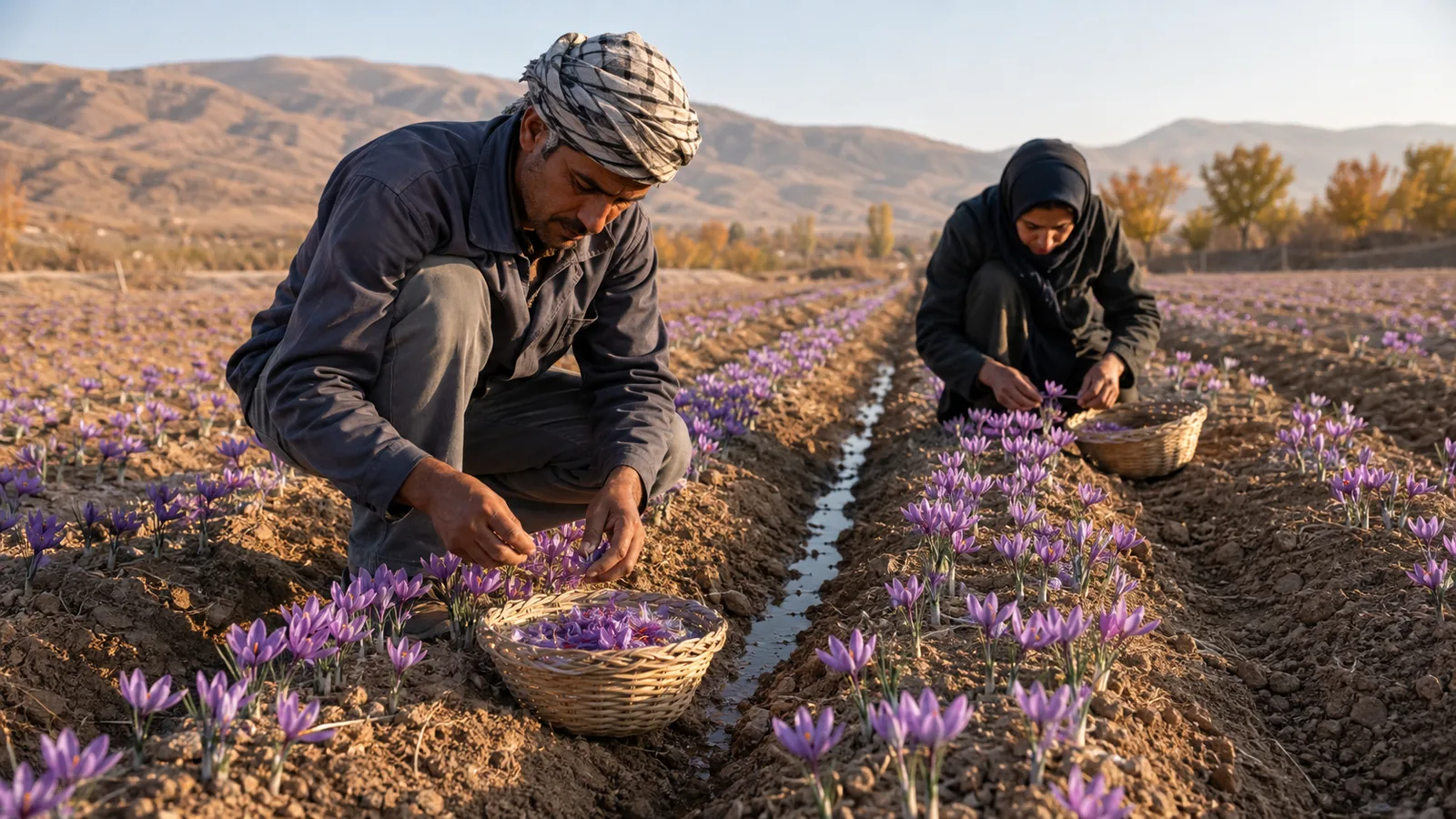
Isfahan has long experience with agriculture under dry conditions. The province includes cold winters, warm dry summers, and farming communities accustomed to planning around limited water. Saffron’s active growth occurs through the cooler part of the year, while its corms are dormant during much of summer. That seasonal pattern helps explain its appeal in areas where summer water is under pressure.
It would still be misleading to call saffron a crop that needs no water. Corm establishment, pre-flowering irrigation, rainfall, soil moisture, drainage, field age, and local weather all influence the result. A farmer must compare the crop’s full water demand and likely return with the alternatives on that particular land. Our detailed guide to saffron irrigation explains why fixed calendars should not replace field observation.
Traditional water management is also part of Isfahan’s agricultural history. The UN Food and Agriculture Organization describes Kashan’s qanat-irrigated agricultural system, where saffron is among the crops supported by groundwater carried through long-established underground channels. Qanats are not a universal answer to today’s water shortage, but they show how farming in the province has been shaped by careful delivery rather than an assumption of abundant water.
Where Isfahan saffron farming is discussed
Earlier local accounts highlighted Tiran and Karvan as important saffron-growing areas in the province. They also described expansion around Najafabad, including Mehrdasht, Aliabad, and Kheirabad. These place names matter because “Isfahan saffron” is not produced in one uniform landscape; elevation, soil, water quality, frost exposure, and farm practice can differ from district to district.
The archived report on which this page was based said that more than 70 hectares in Najafabad had been devoted to saffron. It also described Isfahan as Iran’s third-largest saffron-producing province and reported a 10% increase in cultivation. No year or named statistical release accompanied those figures, so they should be read as historical claims from that report, not as a current acreage, ranking, or growth rate.
That distinction is important for farm decisions. A province-wide number cannot tell a grower whether an individual field drains well, whether its irrigation water is suitable, or whether labour will be available during the short flowering period. Before planting at commercial scale, soil and water testing, a small local trial, realistic labour planning, and a route to market provide more useful evidence than a general statement that the crop is profitable.
The original local account described some Najafabad farmers considering saffron in place of almonds and presented it more broadly as an alternative to water-intensive crops such as rice. Neither comparison is a universal instruction. Removing a productive orchard is difficult to reverse, while rice water use and returns depend on the local production system. A sound decision compares several years of water, labour, establishment cost, yield risk, and likely sales for the actual field rather than assuming one crop is always more sustainable.
What research says about saffron and water in Isfahan
A peer-reviewed study of Iran’s saffron water footprint used provincial data from 2008 to 2014. It reported the highest average yield in that dataset for Isfahan and placed the province among those with the lowest economic water footprint. That is encouraging historical evidence, but it is not a promise of the same yield or financial return on every Isfahan farm today.
The result depends on its period, methods, prices, yields, and regional averages. Groundwater conditions, energy costs, labour rates, corm quality, and weather can change. The study is most useful as evidence that Isfahan merits field-specific evaluation, not as permission to replace any existing crop without comparing local water use and farm economics. Readers can review the published saffron water-footprint study and its assumptions directly.
From a good harvest to a dependable product
Growing flowers is only the first stage. Each flower must be picked at the right time, handled gently, and separated promptly so the stigmas do not sit in a warm, compressed mass. Drying must reduce moisture while protecting colour, aroma, and flavour. The finished threads then need clean storage away from humidity, light, heat, and strong odours.
Consistency across lots matters to a buyer. A sample may look excellent, but an importer or food producer also wants confidence that the next shipment will meet the same specification. Lot identification, harvest and processing records, hygienic handling, suitable testing, and protective packaging turn a seasonal crop into something a business can purchase repeatedly.
Local advocates quoted in the original account regarded saffron from Tiran and Karvan as better than saffron from Mashhad. Regional pride is understandable, but “better” requires a defined test. Colouring strength, aroma, flavour, moisture, foreign matter, thread condition, traceability, and intended use can all affect a buying decision. Origin alone does not prove that one individual lot is superior to another.
Why Isfahan saffron can lose its identity
If saffron from several origins is combined before it reaches the customer, the final pack cannot honestly communicate the character of a particular Isfahan lot. Mixing is not automatically adulteration when it is lawful and labelled accurately, but an undisclosed origin claim is a different matter. Once traceability is broken, neither the farmer nor the buyer can easily demonstrate what a named region contributed.
Keeping identity intact requires separation and records from receipt onward. A practical chain might include a producer or cooperative lot number, the harvest location and date, drying and storage records, test results, sealed transport packs, and a link between the trade pack and the smaller retail units made from it. This is less glamorous than branding, but it gives a regional name evidence behind it.
When Iranian saffron becomes a global brand under Spain
The title of this article reflects a common concern: Iran grows most of the world’s saffron, while Spanish businesses have strong recognition in many export and retail markets. The relationship should be described with care. World Bank WITS data sourced from UN Comtrade show that in 2023 Spain declared about US$45.2 million in saffron imports, including about US$39.5 million from Iran. Spain also declared about US$55.3 million in saffron exports that year.
Those customs figures demonstrate that Iranian saffron is important to Spanish trade. They do not show that every Iranian shipment was repackaged, nor do they reveal the profit earned by a particular farmer, exporter, packer, or retailer. Gross import and export flows can include different lots, grades, stock periods, re-exports, and reporting differences.
The commercial lesson is not that a Spanish name automatically transforms the spice. Value is created when a business makes quality predictable, presents the product for a particular customer, complies with the destination market’s rules, delivers reliably, and earns repeat trust. Isfahan producers and exporters can build more recognition by doing those jobs well and keeping the regional origin verifiable. Our article on Iranian saffron’s production share and global market value explains the trade data and its limits in more detail.
Practical priorities for Isfahan growers and sellers
Test the field before expanding
A small trial can reveal emergence, flowering, drainage, salinity, frost exposure, pest pressure, and labour needs under local conditions. Several seasons are more informative than one favourable harvest because a saffron field is a multi-year commitment.
Plan for the harvest bottleneck
Flowers arrive within a concentrated period and lose quality when handling is delayed. The planting decision should include who will pick, transport, separate, and dry the crop, where that work will happen, and how hygiene will be maintained during the busiest days.
Agree on the product before planting more
Whole threads for a specialty retailer, measured packs for home cooks, and bulk lots for a manufacturer require different specifications and packaging. A grower or cooperative should know who the likely buyer is, what evidence that buyer expects, and how price will be determined. More acreage without a credible sales route can increase exposure rather than income.
Use cooperatives for services that benefit from scale
The archived report proposed cooperatives covering saffron and other medicinal plants, alongside government training and support for lower-water crops. A well-run cooperative can help members share testing, grading, packaging, training, and buyer access while keeping each lot traceable. It only adds value when responsibilities, quality rules, records, and payments are transparent. Any grant, input subsidy, extension programme, or export assistance should be confirmed with the responsible local authority at the time of application; the old report does not establish that an incentive is available now.
A grounded path for saffron farming in Isfahan
Isfahan has credible reasons to cultivate saffron: a long dryland-farming tradition, districts already associated with the crop, and historical research showing promising provincial productivity. The crop is drought-tolerant, not drought-proof; valuable, not automatically profitable; and capable of carrying a regional identity only when that identity survives the supply chain.
The strongest route to a global Isfahan saffron brand begins in the field but does not end there. Careful site selection, measured irrigation, skilled harvest work, controlled drying, verifiable lots, honest quality claims, suitable packaging, and reliable buyer service are what connect a local flower to a product people will seek out again.

![Exporting Saffron to Turkey + Price Guide [Complete 0 to 100]](https://img.rowhanisaffron.com/20260827003933/saffron-export-turkey-quality-inspection.webp)



