saffron irrigation is light in annual volume compared with many field crops, but timing matters. Water influences when the flowers emerge, whether a field can be harvested in time, how long the leaves remain active and how well daughter corms develop. Too little water during active growth reduces performance; too much around poorly drained corms invites rot.
There is no safe universal calendar. A schedule used in Khorasan cannot simply be copied into a rainy garden or a field with heavier soil. The grower has to combine the plant’s growth stage with rainfall, root-zone moisture, soil texture, temperature, irrigation method and drainage.
How the saffron cycle controls water demand
Crocus sativus rests underground through the hot part of summer. The corm becomes active as conditions cool, flowers in autumn and then produces narrow leaves. Those leaves keep working through winter and spring, supplying the replacement corms that support the next crop. They finally yellow as the plant returns to dormancy.
That cycle creates three different irrigation jobs:
- the first autumn water reactivates a dry field and helps initiate emergence;
- winter and early-spring moisture supports leaves, roots and daughter corms; and
- water is reduced or stopped as the foliage naturally dies back and dormancy begins.
Rain can do part or all of that work. Irrigation is the amount needed after effective rainfall and stored soil moisture are taken into account, not a separate quota that must always be added.
The first irrigation in Khorasan practice
The original field note was written around Khorasan. It described irrigating a newly planted field roughly 10–15 days after planting if planting had finished by the end of September. For established fields, it placed the first autumn irrigation between mid-October and the first ten days of November, depending on weather and water availability.
A University of Rhode Island presentation hosted by the University of Vermont gives similar regional context: conventional Iranian fields often receive their first irrigation in late September or October, and flowering follows about three weeks later. The old Rowhani text says the first flowers may appear after roughly 15–20 days. Temperature, corm condition, planting date and soil moisture explain why emergence is a window rather than a fixed appointment.
A new field may produce only a modest first-year flower crop while the corms establish. Irrigating harder cannot force immature or undersized corms to behave like a settled stand; it may simply leave the soil too wet.
The first irrigation needs to wet the intended root zone evenly. Ponding one area while another stays dry produces uneven emergence and can damage corms. Before applying water, inspect blocked emitters, furrow levels, field edges and low spots. In a drip system, check the wetting pattern below the surface rather than judging by a dark circle around one emitter.
Stagger water only when the field plan supports it
The old article advises dividing a large farm into blocks and watering them over several days. The purpose was operational: if every block flowers together, the short harvest can overwhelm the available pickers and processing space. Staggered first irrigation may spread flower emergence and make daily picking more manageable.
It is not a guarantee. A grower should not deliberately leave one block under-watered or use the technique without local experience. Soil differences, elevation and temperature can create their own flowering variation. Any block schedule needs enough labour to irrigate evenly and enough records to compare irrigation date, emergence and yield.
Break the crust without injuring corms
After the first water, some soils form a hard surface crust. The traditional Khorasan practice was to break it with a hoe, four-tined implement or shallow local plough once the surface was workable. This helps shoots emerge and also removes young weeds before flowering.
Depth is critical. Saffron corms and new shoots must not be cut, exposed or dragged upward. Work only the surface layer, and do not cultivate when wet soil smears or compacts. A well-structured bed with organic matter and controlled traffic may need much less intervention than an old flood-irrigated field.
The same pass should not be used to bury fresh manure beside active corms. The original translation appears to suggest broadcasting manure and mixing it into the surface before irrigation when it had not been applied earlier. That is risky as a blanket instruction. Nutrient source, maturity, salinity, analysis and rate should be decided before planting or with qualified local advice.
Irrigation after flowering
Once flowers have been harvested, the crop is not finished. The leaves and roots still need suitable moisture. In the Iranian five-irrigation example documented by the university presentation, a second water is commonly applied about 40 days after the first; later rounds may occur around late winter, late March and, if needed, near leaf die-back.
That sequence describes one production system, not an instruction to irrigate five times everywhere. A well-drained sandy field in a dry winter loses water faster than a loam that receives regular rain. Heavy soil may stay wet long after the surface looks pale. Root-zone observation matters more than counting days.
Research illustrates the local nature of the response. A two-season field experiment near Sarayan compared one- and two-week intervals in different soil mixtures; shorter intervals and moderate-to-light textures produced stronger flower and replacement-corm results under those test conditions. Another experiment found that the combination of irrigation rounds and mother-corm size changed yield. Neither result means every saffron field should be watered weekly.
Correcting the old 6–12-day instruction
A damaged sentence in the original post appears to recommend irrigation every 6–12 days from early April until leaves turn yellow. It is preserved here because it was part of the source, but it should not be used as a universal schedule. The translation does not establish the location, soil, water volume or whether the interval was meant for a particular spring period.
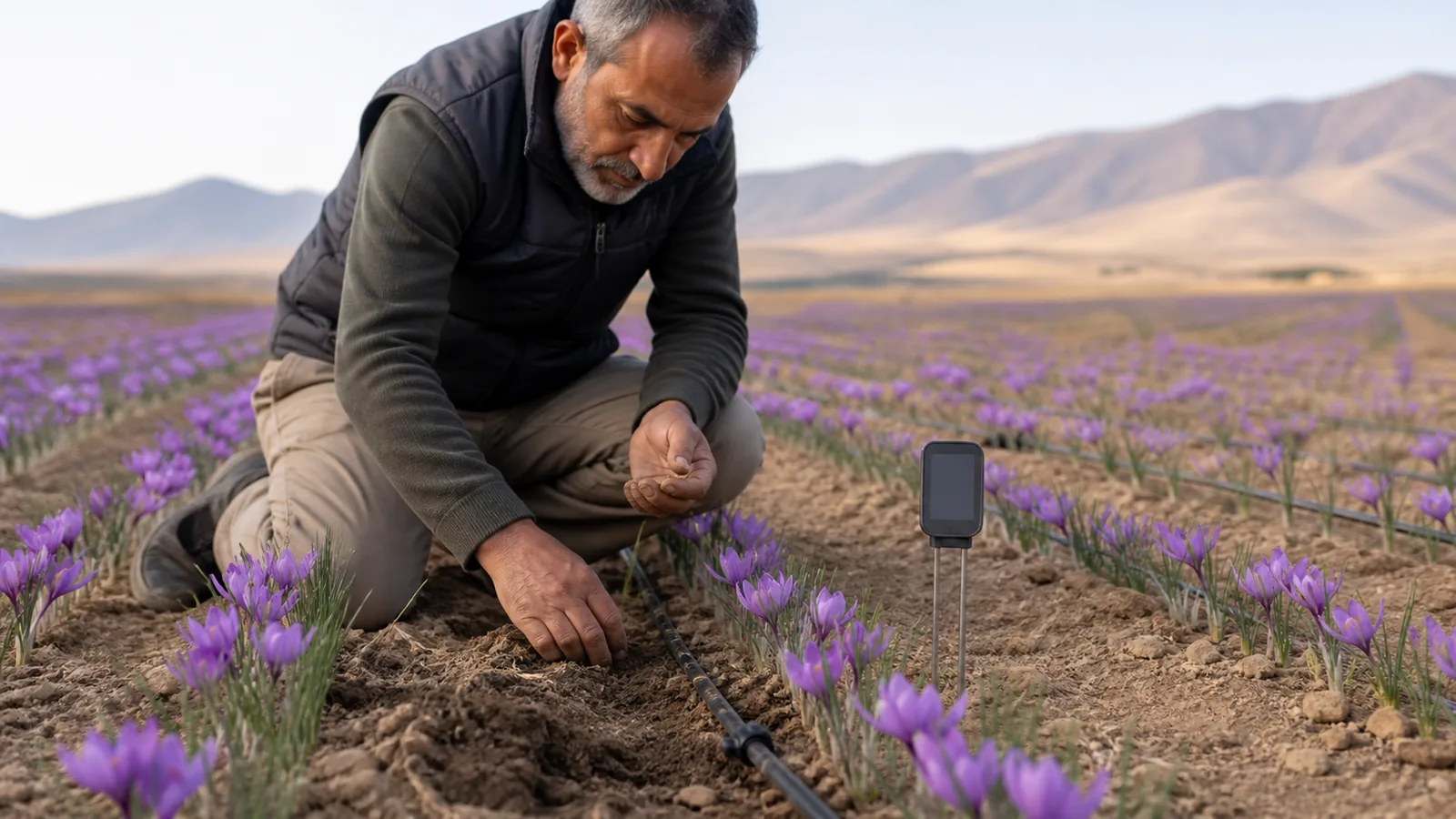
Use a field threshold instead. Check moisture at corm/root depth in several representative places, including a dry edge and a known low spot. Record rainfall and the depth applied. Irrigate when the active crop needs water and the soil can accept it without prolonged saturation. As foliage yellows naturally, avoid extending growth with unnecessary late water.
A Kerman study also found that changing the final irrigation cut-off affected flower and stigma yield in the following cycle, with April cut-off performing best in that particular Bardsir experiment. This reinforces the need to manage the final round deliberately; it does not turn one trial date into a rule for other climates.
Protect daughter corm development
The last useful irrigations support the daughter corms developing above the old mother corm. Adequate spring moisture helps the leaves continue photosynthesis and allows replacement corms to gain size. Water stress can limit that development, but wet soil after the crop has entered dormancy brings a different risk.
Do not remove green leaves to make the field look tidy. Wait until they yellow naturally. If some patches yellow much earlier than the rest, examine drainage, emitter performance, soil depth, salinity and corm health before assuming the whole field needs more water.
Match irrigation method to soil and field shape
Flood, furrow, sprinkler and drip systems are all used in saffron production. Each can work, but their management is different. Flood and basin irrigation require careful levelling and enough infiltration time to reach the root zone without leaving corms submerged. Furrows keep much of the surface drier but can distribute water unevenly on a slope. Drip offers control and easier measurement, provided emitters are correctly spaced and checked for blockage.
Sprinklers can provide even coverage, yet wind changes distribution and irrigation over open flowers can complicate picking and post-harvest hygiene. Apply water at a time that allows field access and protects the short harvest window.
Whatever the method, know the volume. “One irrigation” is not a measurement: it could mean a shallow pass or deep saturation. Flow rate, runtime and wetted area allow the grower to estimate depth and compare blocks.
Weeds, soil fertility and irrigation
Weeds compete with saffron for light, water and nutrients, obstruct harvest and may host pests. The original article calls for weeding whenever growth appears, with early attention after irrigation when weeds germinate. Remove them while small and before seed set, using shallow methods that do not harm corms.
Its translated sequence places a main weeding after the second irrigation and calls for another pass when new weeds appear. Treat that as a field-observation routine rather than a fixed two-pass quota: inspect after every water or rain, then intervene only where weeds are present and the soil is workable.
Do not irrigate extra simply to carry an untested fertiliser application. Water can move soluble nutrients below the active root zone or concentrate salts where drainage is poor. Soil and water analyses should guide fertility and identify salinity risk. Well-decomposed organic material can improve structure, but “organic” does not make an excessive or saline application harmless.
A practical irrigation check
Before each water, walk the field. Look at growth stage, recent rain, the soil below the surface, emitter or furrow performance, low patches, weeds and whether harvesters need access. After irrigation, check how deeply and evenly moisture moved. The next decision should come from that observation and the weather outlook.
For a related field example, our article on timely irrigation in organic saffron explains why a delay can affect flowers and labour. If you are still preparing the plot, begin with how to plant saffron corms, because drainage and bed design determine every later water decision.
Good saffron irrigation is therefore not the most water or the fewest rounds. It is even moisture at the right growth stage, followed by enough drying and aeration to protect the corm. Measure the field you have, keep a season record, and adjust with local agronomic advice rather than copying a calendar from another soil or climate.
Sources and further reading
- Conventional Saffron Production in Iran, University of Rhode Island presentation hosted by the University of Vermont.
- Irrigation interval and soil-texture study, FAO AGRIS record.
- Irrigation rounds and mother-corm size study, FAO AGRIS record.
- Final irrigation cut-off study in Bardsir, FAO AGRIS record.
- Qanat-based saffron farming system, Food and Agriculture Organization of the United Nations.