How saffron plant? The short answer is that saffron is planted as a corm, not seed. Choose a sunny site with freely draining soil, prepare the bed before the corms arrive, plant sound corms at a depth and spacing suited to your climate, then water according to soil moisture rather than a fixed calendar. The crop grows through the cool months, flowers in autumn and rests underground during summer.
That simple outline matters because many saffron failures begin before the first shoot appears. A wet site can rot the corms. Poor planting material may never establish well. Heavy fertiliser applied without a soil test can waste money or damage the crop. The right method depends on whether you are planting a garden bed or an irrigated field, but the same biological cycle underpins both.
Understand the saffron plant before planting
Crocus sativus is a sterile perennial crocus. It does not produce a useful seed crop, so growers propagate it vegetatively from corms—the solid underground stems often called “saffron bulbs” or “onions” in older translations. Each healthy mother corm can form daughter corms, allowing the planting to expand over time.
The plant’s active season begins as temperatures ease. Flowers normally appear in autumn, followed by narrow leaves that continue growing through the cooler months. The foliage feeds the developing replacement corms and should be left in place until it yellows naturally. During the hot summer dormancy, the bed should not remain waterlogged.
Saffron tolerates cold better than its delicate flower suggests, but flowering shoots and exposed growth can still be affected by severe weather. Local frost pattern, summer heat, rain and soil drainage all need to be considered together.
Choose a sunny, well-drained site
The original field note described the best Iranian sites as sunny, open land with mild winters and hot, dry summers. It also gave a regional working range of roughly 35–40°C for maximum summer temperature and 1,300–2,300 metres for elevation. Those figures describe conditions in successful growing districts; they are not universal limits. Saffron is also grown at other elevations and in cooler climates when drainage, exposure and winter protection are suitable.
Aim for at least five or six hours of direct light. Avoid a hollow where cold air or water settles, and give exposed plots some protection from damaging wind without shading the crop. The old text warned against humid northern areas such as Gilan and Mazandaran and very warm southern districts. The underlying issue is site fit, not a province-wide ban: growers in a wetter place need exceptional drainage, while a hotter dry site needs a realistic irrigation plan.
Saffron can grow beneath widely spaced barberry or almond trees, as observed around Birjand, but shade reduces the light available to the leaves. An open bed is easier to manage unless an agroforestry system has been designed deliberately.
Prepare soil that drains without drying instantly
Light to medium-textured soil is generally easier to manage than dense, persistently wet clay. Sandy loam or a balanced loam can hold enough moisture for active growth while allowing surplus water to escape. Good structure matters more than trying to reproduce one exact sand-to-clay ratio.
A soil pH near neutral to mildly alkaline is commonly suitable. The original recommendation placed it around pH 7–8, which is a useful starting range rather than a reason to add lime blindly. Test the soil first. The test should guide any pH correction and show whether phosphorus, potassium or other nutrients are actually needed.
Remove perennial weeds, stones and compacted layers before planting. Where drainage is doubtful, form raised beds or furrows that move water away from the corm zone. Incorporate well-decomposed compost or manure rather than fresh material that may heat the bed, introduce weeds or create uneven nutrient concentrations.
The old Iranian field instruction proposed 40–80 tonnes of manure per hectare and 200 kilograms of ammonium phosphate. Those are historical blanket rates, not a safe prescription for every field. Manure nutrient content, soil reserves, salinity, planting density and local rules differ. A current soil analysis and an agronomist’s field-specific recommendation should decide the amendment and fertiliser rate.
Prepare the bed before the corms arrive
For a field planting, deep cultivation is normally done while the soil is workable, well ahead of planting. The original calendar suggested autumn or winter ploughing, with late spring or early July as a fallback where weather or tractor access delayed the work. It then called for a lighter spring cultivation after rain, weed removal and final levelling in September.
The exact month changes with climate. What matters is the sequence: relieve compaction, allow the soil to settle, remove weeds, incorporate tested amendments evenly, and make a firm but friable planting bed. Do not repeatedly cultivate wet soil; that can destroy structure and leave a compacted layer below the worked surface.
In a home garden, the same job may require only a fork, compost and a raised bed. Test drainage by watching the bed after irrigation or heavy rain. Standing water around dormant corms is a warning to correct the site before planting.
Select healthy saffron corms
Buy true Crocus sativus corms from a traceable, reputable supplier. They should feel firm and dry, with intact tunics and no soft patches, deep wounds, mould or unusual smell. Larger mature corms generally have more stored energy and a better chance of flowering in the first season, although size alone cannot prove health.
Keep lots separate if they come from different farms. This makes it easier to trace a disease or performance problem. Do not confuse saffron crocus with colchicum, sometimes sold under the common name “autumn crocus”; colchicum is a different and toxic plant.
Traditional Iranian farms may lift corms during dormancy from late May into summer. The old article advised planting soon after lifting and avoiding unnecessary delay into September, when some corms may already be preparing to shoot. In cooler garden regions, reputable suppliers commonly deliver dormant corms in August or September. In either case, avoid long, warm, airless storage and plant during the locally appropriate dormant window.
How to plant saffron corms
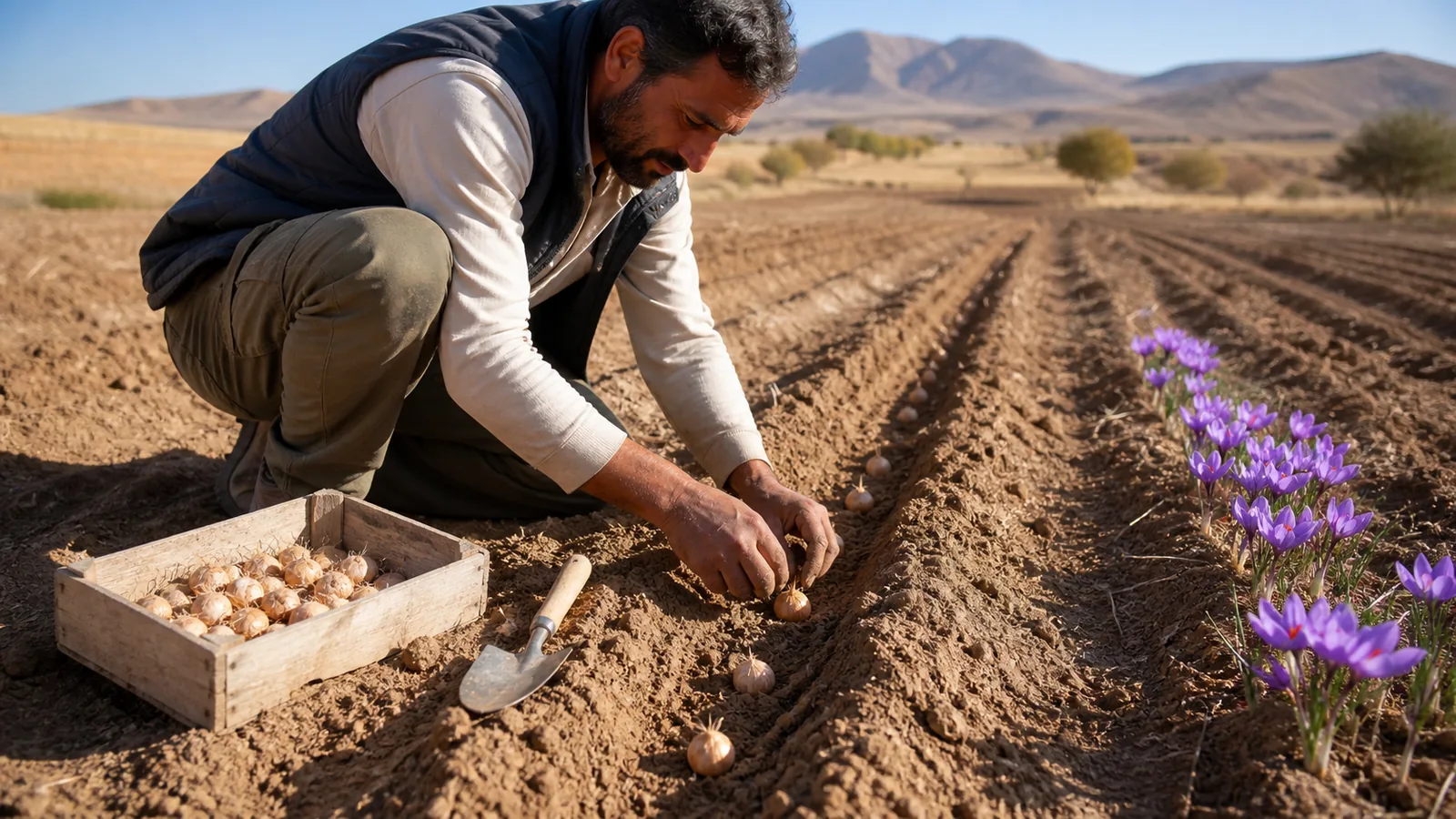
Plant each corm with its flatter root plate down and pointed growing tip up. A practical garden starting point is about 8–10 centimetres deep and 8–10 centimetres apart. Field systems often use different depths, row spacing and corm densities to suit machinery, irrigation, heat and frost. Research also shows that corm size and planting depth interact, so one number should not be treated as an international rule.
- Mark straight rows or planting pockets so later weeding and harvesting remain manageable.
- Open the furrow or hole to the chosen depth without glazing or compacting its base.
- Set only sound corms upright, leaving enough room for daughter corms to form.
- Backfill with loose soil and firm it gently; do not crush the corm or leave a deep air pocket.
- Water after planting only when local soil moisture and the production system call for it.
A planting can stay in the ground for several years; the original text expected roughly five to seven. As daughter corms multiply, crowding eventually reduces space and makes flowers harder to manage. Lift, sort and replant during dormancy when the stand needs renewal rather than disturbing it every year without a reason.
Water for the soil and growth stage
Saffron is associated with dry regions, but “drought tolerant” does not mean “never irrigate.” Water supports root growth, flowering, leaves and replacement corm development. At the same time, poorly drained or overwatered soil encourages rot. The correct interval depends on rainfall, soil texture, temperature, bed design and crop stage.
In a small garden, feel the soil below the surface before watering. In a commercial field, use soil-moisture observations and local evapotranspiration or agronomic guidance. Do not irrigate merely because a calendar says a week has passed. Summer irrigation is especially location-dependent: a dormant bed in a rainy climate may need protection from water, while some arid production schedules use a controlled pre-flowering irrigation.
Our guide to timely saffron irrigation explains why flowering and corm growth respond to the timing as well as the amount of water. For the full field sequence—from corm selection through drying the stigmas—see the saffron planting guide.
Care for the bed after planting
Keep weeds from competing with saffron’s narrow leaves, but work carefully so shallow replacement corms are not cut. Watch for missing shoots, yellowing unrelated to normal dormancy, soft corms and patches that stay wet. A problem confined to one lot or low spot can reveal planting-material or drainage trouble.
Harvest flowers promptly when they open and separate the three red stigmas cleanly. Drying is a separate quality-critical step; the planting method cannot compensate for slow, contaminated or uneven post-harvest handling.
Most importantly, keep the leaves after flowering. Cutting green foliage for a tidier bed removes the plant’s source of energy for daughter corms. Let it fade naturally, then clear dry material and maintain a relatively dry, well-aerated bed through dormancy.
The planting decisions that matter most
A successful saffron field begins with suitable land, sound corms and a plan that fits the local climate. Full sun, drainage and clean planting material are non-negotiable. Exact dates, fertiliser quantities, depth and irrigation frequency are management decisions, not universal formulas.
That is the practical answer to “How saffron plant?”: learn the plant’s cool-season growth and summer-rest cycle, prepare the root zone properly, plant healthy corms during dormancy, and manage moisture with evidence from the actual soil. The crop can remain productive for years when those foundations are right.
Sources and further reading
- Saffron: A Tale of Red Gold and How to Produce Your Own, Penn State Extension.
- Saffron Cultivation: planting guidance, University of Vermont North American Center for Saffron Research and Development.
- Crocus sativus Plant Toolbox, NC State Extension.
- Irrigation and soil-texture research record, FAO AGRIS.