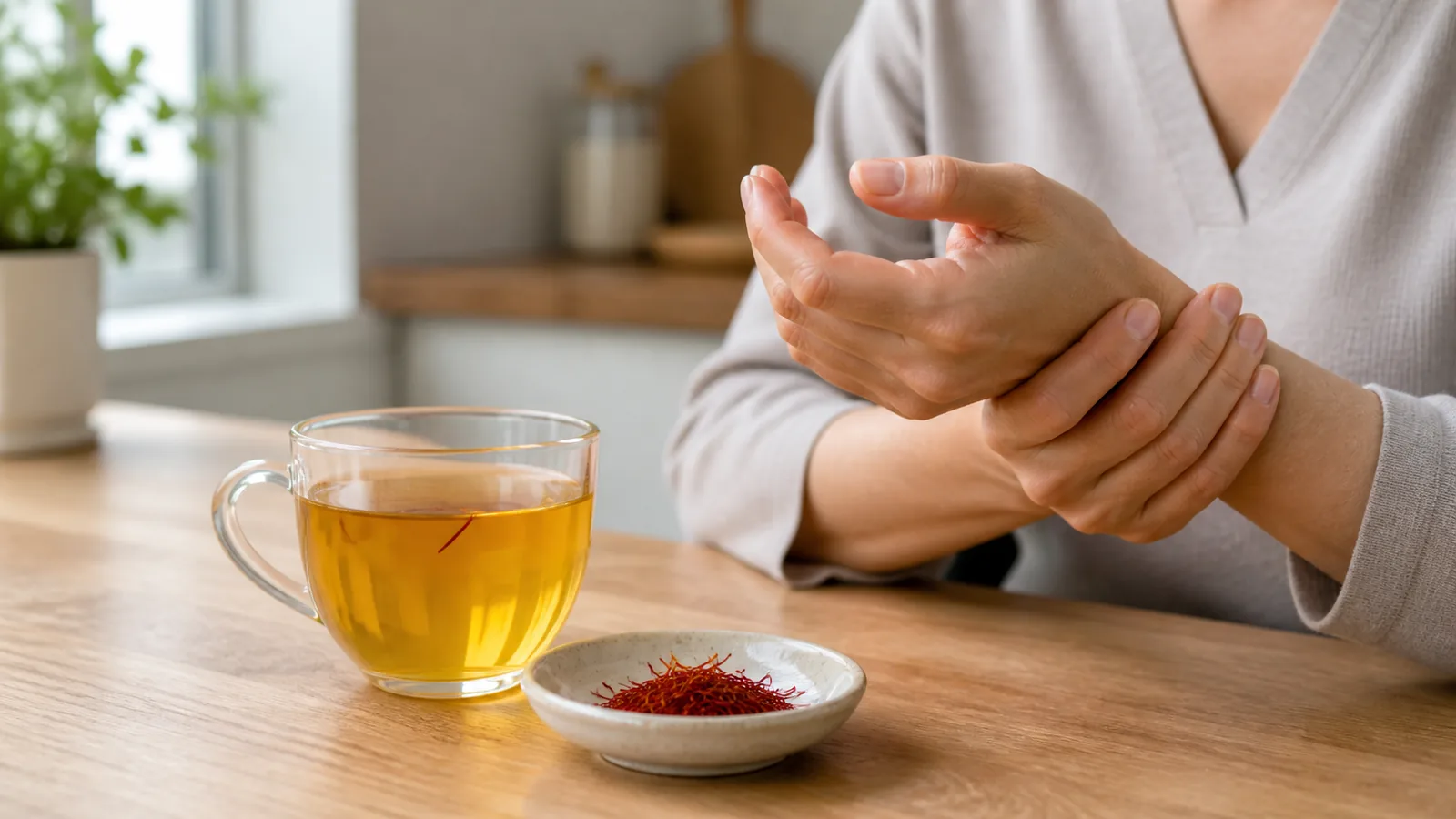
Saffron for skin is an appealing cosmetic idea, but the evidence is narrower than many beauty articles suggest. Saffron contains well-studied colour and aroma compounds, appears in commercial skincare such as Yves Saint Laurent’s Or Rouge range, and has been tested in a small number of topical studies. That does not prove that kitchen-made saffron masks treat acne, erase scars, heal sunburn or prevent disease.
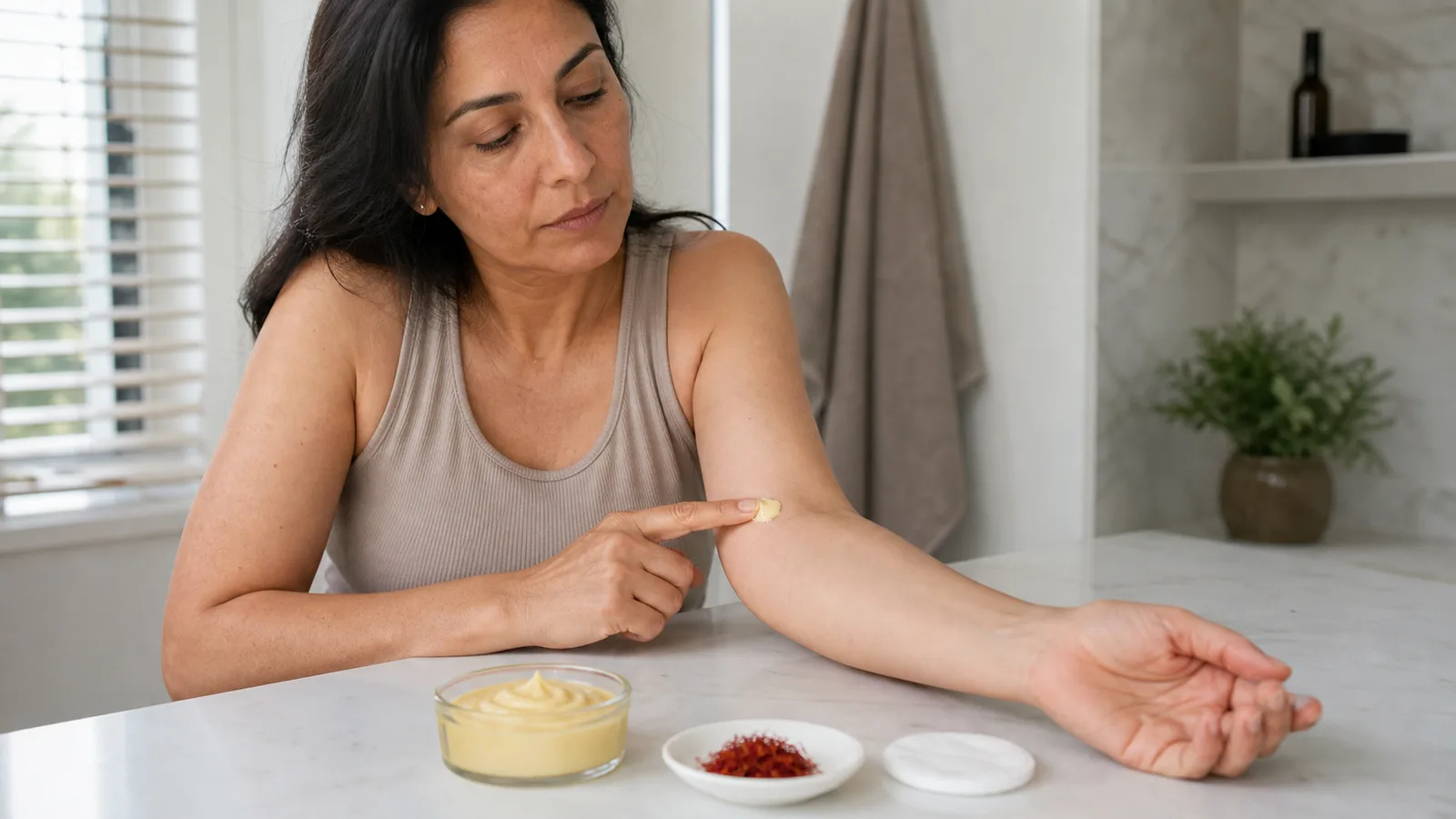
This guide explains why cosmetic formulators use saffron, what research can and cannot support, how the historical Or Rouge report fits the current product line, and how to approach five traditional home preparations without turning them into medical claims.
Why saffron appears in skincare
Saffron is the dried stigma of Crocus sativus. Its best-known compounds are crocins, associated with its golden colour; picrocrocin, associated with bitter taste; and safranal, a major contributor to aroma. Reviews also describe other carotenoids, flavonoids and volatile compounds.
Those constituents have shown antioxidant, antimicrobial, anti-inflammatory and pigment-related activity in laboratory models. This makes saffron interesting to researchers and cosmetic chemists. A laboratory result, however, is not the same as a finished cream working on human skin. Extraction, concentration, stability, delivery through a cosmetic base and the rest of the formula all matter.
A 2021 review summarized potential dermatological uses but drew from a mixture of laboratory, animal and limited clinical evidence. One small study applied a cream containing both saffron extract and avocado oil to 20 healthy volunteers for 12 weeks. Because the formula contained more than one active ingredient and the sample was small, it cannot show that raw saffron alone has the same effect.
The Yves Saint Laurent Or Rouge connection
The original version of this page reported the launch of Yves Saint Laurent Beauty’s Or Rouge skincare line—“red gold”—as an example of saffron moving from spice to luxury cosmetic ingredient. It listed a 200 ml lotion at $150, a 15 ml eye product at $240 and a 50 ml face cream at $420, with an England launch followed by a wider rollout.
Those are historical figures copied from the old report, not current prices or purchase offers. The article did not preserve a dated YSL price list, and product names, formulations, sizes and markets change. They should not be used to value today’s range.
There is also an origin correction. The old article described the line as using Iranian saffron. YSL’s current official Or Rouge pages describe saffron pistil from Morocco’s High Atlas Mountains and refer to saffron pistil extract or a combination of pistil and saffron water. That does not prove every past formula used the same source; it means the old Iranian-origin statement cannot be presented as current.
YSL markets Or Rouge for visible signs of ageing and identifies saffron as a key ingredient. These are the brand’s product claims, supported on its pages by a mix of self-assessments, instrumental tests and clinical tests for particular products. They are not proof that sprinkling culinary saffron into a home mask reproduces the finished formula.
What saffron has not been shown to do
The retired source articles made strong statements about saffron treating acne, healing wounds and scars, removing sunburn, curing cancer, lowering blood pressure and treating heart disease, asthma or depression. Those claims are not carried forward as facts.
In the United States, a topical product promoted to treat or prevent disease or change the body’s structure or function can be regulated as a drug, even when it is sold beside cosmetics. The FDA specifically distinguishes beautifying or cleansing claims from treatment claims. Calling a kitchen mixture an acne treatment, wound healer or cancer preventive therefore goes far beyond both the evidence summarized here and ordinary cosmetic use.
Active acne, persistent dark marks, an infected cut, a changing skin lesion or a significant burn needs appropriate care. A botanical mask can irritate skin and delay useful treatment. Sunburn in particular should not be scrubbed or covered with an experimental fragrant mixture.
Five traditional saffron face preparations, with safer limits
The following combinations preserve what the older articles proposed. They are presented as optional rinse-off cosmetic experiences, not proven treatments. Use clean utensils, make only enough for one application, keep the mixture away from eyes and lips, and do not apply it to broken, inflamed or sunburned skin.
Saffron, milk and sandalwood powder
The old method soaked a few saffron threads in milk until the liquid changed colour, then mixed in white sandalwood powder to form a spreadable paste. It was left on the face and neck for 15–20 minutes and rinsed away.
This may temporarily colour or soften the skin surface, but it has not been established here as a skin-lightening treatment. Milk and sandalwood can each cause problems for some users. Do not use the mixture if you have a relevant allergy, and stop immediately if it stings or reddens the skin.
Saffron and honey for dry-feeling skin
Another preparation mixed a few threads into one spoonful of honey, applied a thin layer and rinsed it off after 15–20 minutes. Honey can feel emollient, but the source’s promise of improved circulation and a brighter complexion was unsupported. Avoid this method if you react to honey, pollen or bee products.
Saffron steeped in milk
The source soaked saffron overnight in full-fat milk, then applied the coloured milk to tanned skin. It described the mixture as a way to remove sunburn marks. There is not enough evidence to promise that result.
Do not put it on an active sunburn. For a persistent change in pigmentation, a dermatologist can identify whether it is tanning, post-inflammatory hyperpigmentation or something else. Daily broad-spectrum sun protection addresses continuing ultraviolet exposure more directly than a milk mixture.
Saffron and rose water
The older cleanser soaked saffron in rose water, wiped it over the face with cotton, waited 10–15 minutes and rinsed with lukewarm water. Rose fragrance and botanical components can irritate sensitive skin. Treat this as a rinse-off scented preparation, not a cleanser proven to remove pollution or “toxins.”
Saffron and basil
The final recipe crushed saffron with basil into a paste, let it dry on acne-prone areas and rinsed it off. No reliable evidence in the source established that this combination clears acne or infection. Because inflamed acne is easier to irritate, a tested non-comedogenic routine or advice from a dermatologist is a more dependable choice.
Patch-test before the face
“Natural” does not mean non-allergenic. Contact dermatitis has been reported among saffron workers, and any added milk, honey, sandalwood, basil or rose water introduces its own potential irritants or allergens.
The American Academy of Dermatology recommends testing a new skincare product on a small area, such as the underside of the arm or elbow, twice daily for seven to ten days using the amount and contact time you plan to use. If redness, itching or swelling develops, wash it off and do not use it again. A severe or persistent reaction needs medical advice.
A homemade wet mixture has no preservative system or stability testing. Prepare it fresh, use it once and discard the remainder. Do not store a milk-, herb- or water-based mask for later use, and do not share it.
Topical use is not an oral dose
One source stated that “three grams per day” was an acceptable saffron amount and advised against eating saffron on the same day as using it on skin. It did not provide reliable evidence for either rule. A topical cosmetic mixture and an oral dose have different exposure routes and cannot be combined through simple arithmetic.
This page does not recommend medicinal saffron dosing. Normal culinary use and concentrated supplements are not equivalent. Anyone considering a supplement—especially during pregnancy, while taking medication, or with a medical condition—should discuss it with a qualified clinician rather than relying on a skincare recipe.
How to judge a commercial saffron cosmetic
- Read the complete ingredient list. “With saffron” does not reveal its concentration, extract type or contribution relative to the rest of the formula.
- Separate appearance claims from treatment claims. “Feels smoother” is not the same as treating acne, dermatitis or a wound.
- Look at the test behind a number. Note whether a result came from a clinical measurement, an instrumental test, a consumer self-assessment or an ingredient-only laboratory study.
- Check compatibility with your skin. Fragrance and other ingredients can matter more to irritation risk than the featured botanical.
- Keep sun protection separate. Unless a product is labelled and regulated for ultraviolet protection in your market, saffron content does not make it sunscreen.
A realistic conclusion
Saffron has credible chemistry and enough early topical research to explain why it appears in cosmetic formulas. The evidence does not support the sweeping home-remedy promises in the old articles. A professionally formulated product may offer moisturising or appearance benefits as a whole formula; a homemade saffron mixture may simply provide colour, scent and a pleasant short-contact ritual.
That distinction protects the useful part of the story. Saffron is a genuine cosmetic ingredient worth studying, and Or Rouge is a real commercial example. Neither fact turns pantry ingredients into proven treatment for acne, scars, burns or disease.
Sources and evidence
- YSL Beauty: Or Rouge Crème Riche and its current saffron description.
- Current Pharmaceutical Design: review of saffron’s proposed dermoprotective effects.
- Clinical, Cosmetic and Investigational Dermatology: 20-person study of a saffron-and-avocado-oil cream.
- Journal of Medicine and Life: updated review of saffron chemistry.
- US FDA: cosmetic labelling and treatment-claim distinction.
- American Academy of Dermatology: how to test skincare products.