


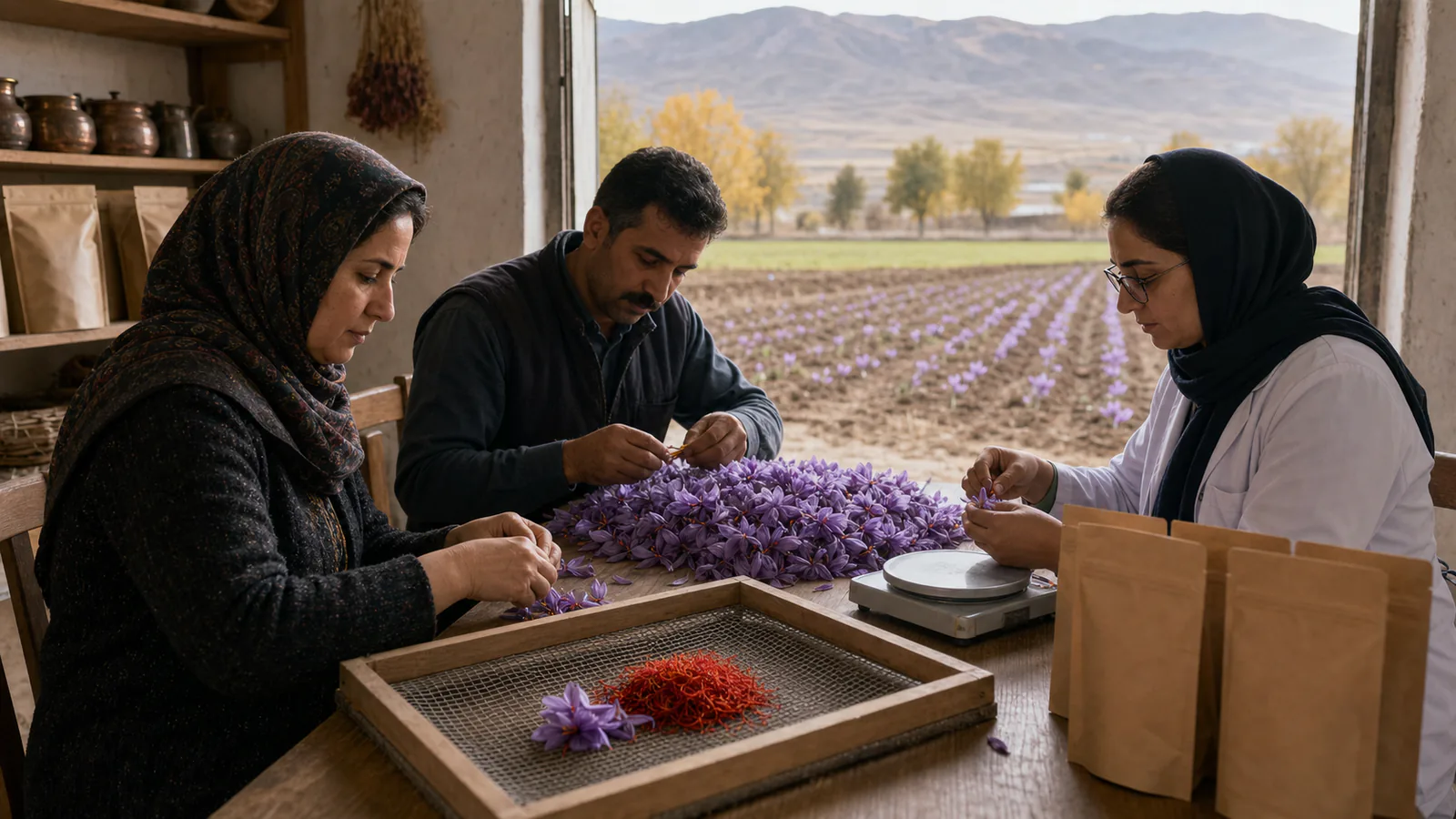
Saffron production in East Azerbaijan has grown from a small trial into an established regional crop, with Marand at its centre. A village project in Kermanshah shows the same movement farther west: growers are testing saffron where water is limited, then building the processing and sales work needed to keep value in the community.
These regions do not replace Khorasan, Iran’s traditional saffron heartland. They show how cultivation knowledge can travel. Success depends on local evidence, healthy corms, skilled labour, suitable winter and summer conditions, careful drying and a market that pays for consistent quality.
Saffron production growth in East Azerbaijan
The destination’s original report described an early expansion phase. Its surviving English text gives an average yield of 3.87 kg/ha, mentions three saffron cooperatives in Marand and records the hope that East Azerbaijan would eventually export its own product. One area sentence is too garbled to establish a reliable historical hectare figure, so it is not repeated as fact.
Later provincial reporting shows what happened next. In 2023, the Agricultural Information Network, IANA, reported more than 422 hectares and about two tonnes of annual saffron in East Azerbaijan, with over half the area in Marand. The figures belong to that year and should not be mixed with a different harvest.
A 2025 IANA update says Marand reached 263 hectares and harvested 1.9 tonnes. It traces local cultivation to a one-hectare start in 1993. That sequence is stronger evidence of growth than the broken numbers in the early translation.
What the regional figures mean
Hectares show adoption, not efficiency. Yield per hectare, dry-down consistency, grade distribution and grower return show whether expansion is working. A new field also changes as its corm population develops, so one season should not define its long-term potential.
Regional statistics should always carry a year and scope. Marand output is not the same as provincial output; forecast production is not harvested production; fresh flowers are not dried saffron. Keeping those labels clear prevents an impressive number from becoming a misleading sales claim.
Why Marand became the provincial centre
Marand has accumulated growers, field experience, seasonal labour and local packing capacity. A 2024 report recorded four locally branded packaging units buying, processing and packing saffron in the county. That matters because a crop can expand faster than the services needed after picking.
Saffron flowers must be collected and separated promptly. Stigmas need controlled drying and storage away from moisture, light and contamination. A region that grows good flowers but mishandles them can lose colour, aroma and commercial value before the buyer sees the product. Our saffron processing guide explains this chain.
The early East Azerbaijan article also listed familiar constraints: limited technical knowledge, few experienced specialists, inconsistent planting material, insufficient harvesting or processing equipment, grower concern about unfamiliar crops and weak access to finance. Expansion data do not prove those problems have disappeared.
Village-level saffron entrepreneurship in Shahini
Shahini, on the Kermanshah–Kamyaran road, offers a smaller-scale example. An archived report described a village of more than 540 residents whose established farming included wheat, canola, maize, sugar beet, tomatoes, chickpeas and barley. It said saffron had been cultivated there since the Iranian year 1390, roughly 2011–12.
The Omid Entrepreneurship Fund reportedly allocated 1.4 billion rials to saffron corm cultivation and production, plus 1.3 billion rials for processing and packaging. Those are historical nominal amounts; they are not current programme terms or a present-day valuation.
The report said the work had directly created about 25 opportunities. It later described 40 people covered across planting and harvest, plus one person working in processing and packaging. These figures refer to different measures and should not be added together as 66 jobs. “Covered by the plan” is not necessarily the same as full-time employment.
What the support model tried to solve
The fund’s model paired small producers with a sponsor who helped organise a cooperative, complete licensing, obtain health approval and reach a market. This recognises that corm finance alone does not create a viable saffron business. A village also needs:
- field training adapted to local soil and climate;
- a plan for the short harvest labour peak;
- clean separation and repeatable drying;
- batch records and suitable testing;
- compliant packaging; and
- buyers before production grows beyond local demand.
The source claimed Shahini’s packaging matched or exceeded leading provinces because producers accepted a lower margin to build a customer base. That is the programme representative’s assessment, not an independent quality test. Packaging should be judged by protection, traceability, compliance and customer use—not by appearance alone.
Is saffron automatically the right low-water crop?
Both regional stories were motivated partly by water scarcity. Saffron’s irrigation calendar and high value per unit of weight can make it attractive in dry areas. It still needs water, suitable soil, winter cold, a warm dormant period and enough labour during flowering.
The 2023 East Azerbaijan official estimated about 3,000 cubic metres of water per hectare in that local context. This is not a universal requirement. Rainfall, irrigation efficiency, soil texture, salinity and field age affect the total. Before replacing another crop, growers should compare water use, net return, labour and market risk with local measurements.
Our saffron planting guide outlines corm selection and establishment, but local agricultural advice remains essential in a region without a long saffron history.
Medicinal-plant diversity is an opportunity, not proof of a market
The original East Azerbaijan article placed saffron among the province’s medicinal and aromatic plants and referred to about 450 identified species. A later IANA report likewise records 450 medicinal-plant species and active processing units for rose water, distillates, herbal products, saffron and sumac.
Botanical diversity does not automatically create a profitable industry. Species identification, safe cultivation, compliant claims, processing standards and actual demand all matter. Saffron should be sold as a defined spice and agricultural product; its “medicinal plant” label is not permission to make unsupported treatment claims.
From local crop to durable business
East Azerbaijan shows the value of continuity: the area expanded, Marand became a production centre and packing facilities followed. Shahini shows the village version, where finance connected planting with processing and market support.
The next measure of success is not hectares alone. It is whether a grower can produce a consistent batch, document its origin, process it safely and sell it at a return that survives a difficult season. Buyers should compare the current harvest year, origin, test evidence, grade, volume and delivery terms. The saffron price guide explains how to make that comparison without relying on an old regional price.
Saffron production beyond Khorasan can strengthen rural economies when it is built on local agronomy and a complete value chain. The crop may be small in area, but its business system cannot be incomplete.

![Exporting Saffron to Turkey + Price Guide [Complete 0 to 100]](https://img.rowhanisaffron.com/20260827003933/saffron-export-turkey-quality-inspection.webp)



