


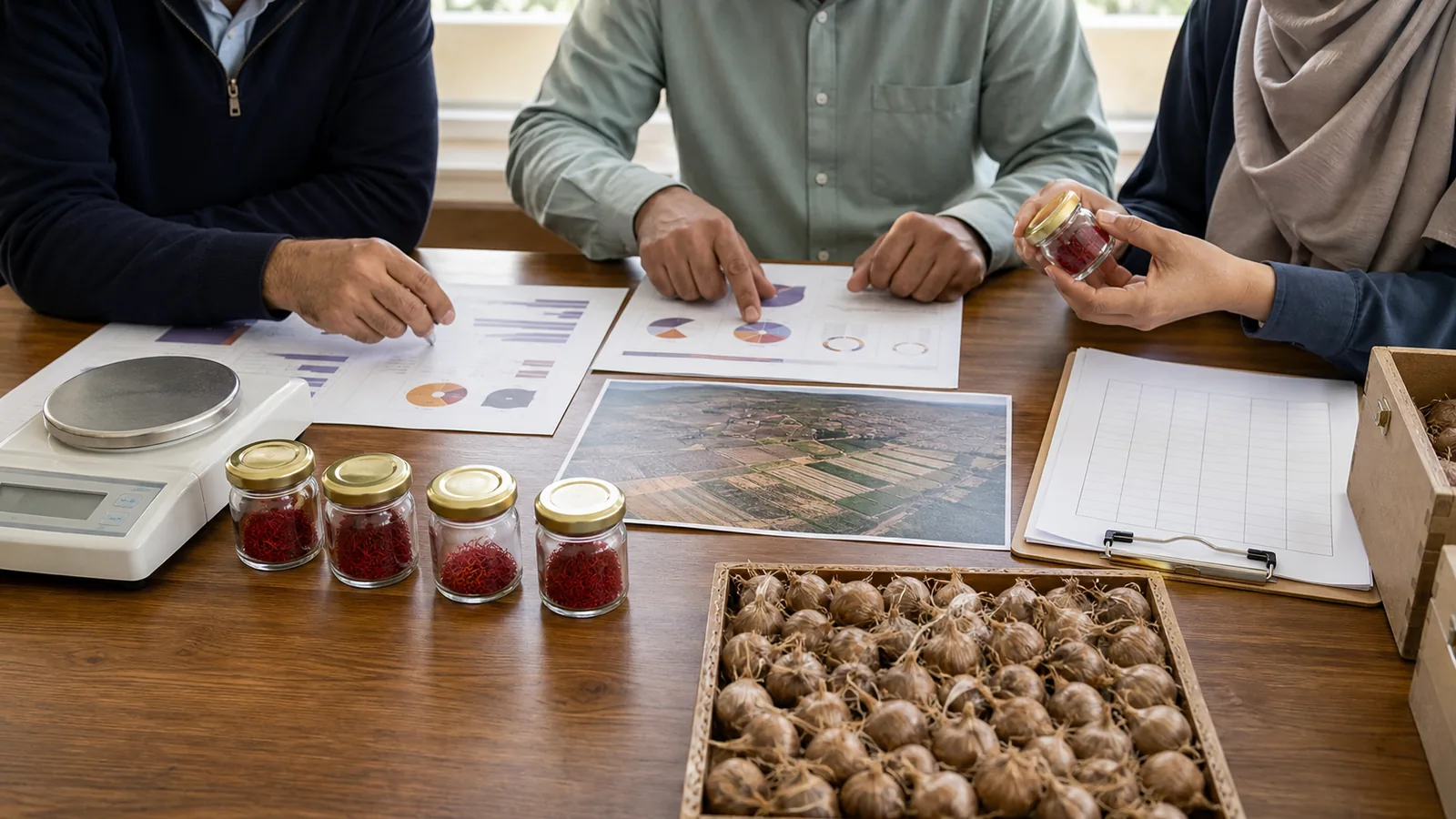
A credible saffron master plan has to connect the farm to the final market. Increasing planted area is only one part of it. Reliable crop statistics, healthy corm supply, practical yield improvement, consistent product standards, transparent trading and export brands all affect whether higher production creates durable value for growers.
The figures in this article come from historical statements by provincial agriculture officials. They describe different years and geographic scopes, so they should not be read as current production totals. Their value is in showing what planners were trying to solve: a highly concentrated crop with many farming households, expanding cultivation in other provinces and a trade system that did not always retain the value of Iranian saffron.
The original Khorasan master-plan proposal
The destination article reported an appeal for provincial officials to support faster approval of a national saffron plan and register the product in Iran’s name. An official from the Khorasan Razavi agricultural organisation described saffron as an economically important crop for the province and said more than 80% of Iran’s cultivated area was there.
For the year discussed, the official gave Khorasan Razavi figures of about 75,000 hectares, 280 tonnes of harvested saffron and 117,000 farming households, with an average yield near four kilograms per hectare. Those numbers are preserved as a dated provincial snapshot. They are not a forecast for today and should not be combined casually with national data from another season.
A master plan based on those conditions would need to improve farm income without assuming that more hectares automatically create more demand. It would also need to recognise the concentration of production described in our article about saffron in Khorasan.
Why historical saffron statistics appear to conflict
Saadallah Eskandari, identified in the source as an East Azerbaijan agriculture official, gave a different national snapshot. He cited 41,325 hectares and annual production of 150 to 170 tonnes, with buyers in 43 countries and much of the crop exported. The Khorasan statement, by contrast, later described 75,000 hectares and 280 tonnes in one province alone.
The figures cannot describe the same national crop at the same moment. Acreage expanded quickly during this period, and the source pages do not provide complete reporting dates, survey methods or final crop tables. The responsible way to use them is to attribute each set, retain its scope and avoid creating a false trend line.
That data problem is itself a planning lesson. A current programme should publish:
- the reporting year and geographic boundary;
- planted, flowering and harvested area as separate measures;
- estimated and measured production, not one blended number;
- yield distribution as well as a national average;
- export weight and value with a clear customs period; and
- revisions when weather or final field returns change the estimate.
East Azerbaijan and the Marand expansion
The second source records how cultivation developed outside Khorasan. Eskandari said saffron was first planted in East Azerbaijan in the Iranian year 1371, corresponding to 1992–93, on one hectare in Marand. At the time of his later statement, provincial area was reported at 135 hectares, including 90 hectares in Marand.
He attributed roughly 400 kilograms of production, about 300 jobs and expected grower revenue of more than 15 billion rials to the provincial crop. These are historical nominal figures, not present-day earnings. The article also reported that 17 hectares had recently been added and required about 50 tonnes of saffron corms, supplied mainly from existing Marand fields and partly from Khorasan.
Cultivation was said to have reached 18 cities in the province, with Sarab and Bostanabad named as exceptions. Local conditions vary within a province, so a city count does not establish that every field is suitable. Soil drainage, summer conditions, winter cold, corm health, irrigation timing, labour and a realistic market all need to be assessed before planting.
Long-lived fields and yield expectations
The source described saffron as remaining productive in one field for 10 to 12 years and gave a typical yield range of three to five kilograms per hectare. Field life and yield are not fixed guarantees. Corm density, age, disease pressure, soil, climate and management can shorten or extend the useful cycle and change output substantially.
Eskandari also said revenue per cubic metre of water could be more than ten times that of many crops. That was an attributed economic comparison, not a universal water-efficiency measurement. A fair comparison needs local irrigation volumes, yield, labour, corm costs and the actual selling price. Saffron can suit water-constrained areas, but it is not a crop that produces without water or management.
The proposal for a saffron commodity exchange
Mohammad Reza Qudsi, a Khorasan Razavi horticulture official quoted by ISNA, argued that national and international saffron transactions should move through the Iran Mercantile Exchange. He linked the proposal to sharp price movements, imitation products, unhealthy competition, limited international branding and emerging lower-cost production in Afghanistan and China.
Qudsi believed organised exchange trading could support an export market worth more than US$1 billion if it was paired with better yield, production planning and organised domestic and overseas marketing. The amount was an aspiration in a historical interview, not a verified current forecast.
The source also attributed a supposed World Trade Organization rule to Qudsi: that a country producing at least 58% of a product could host its international exchange and direct global production, pricing and marketing policy. We could not verify such a threshold in WTO primary material, and the WTO does not grant a producing country control over world prices on that basis. The claim is therefore preserved only as a statement made in the old interview, not presented as a trade rule.
Official WTO material does support the more general idea that an exchange can improve access to market information. Its case study of the Ethiopia Commodity Exchange describes real-time price distribution and a structured trading and payment system. That example does not prove that the same design will work for saffron; it illustrates the information problem an exchange may help address.
What organised saffron trading can and cannot do
Qudsi’s expected benefits included standardisation, price transparency, fewer unnecessary intermediaries, less speculation and fraud, stronger Iranian branding, new investment and a more efficient distribution network. Those are reasonable objectives, but they do not appear simply because a product is listed on an exchange.
For exchange trading to improve the market, the underlying system needs:
- clear deliverable grades and test methods;
- approved warehouses with sampling, security and lot segregation;
- published transaction data that distinguishes actual trades from offers;
- rules for weight, moisture, packaging and delivery;
- credible settlement, dispute and default procedures; and
- access that works for producer groups as well as large traders.
The current ISO 3632-1:2025 specification defines requirements for dried saffron, while the FAO/WHO Codex saffron standard CXS 351-2022 provides an international product standard. A market can use recognised specifications as part of its contract, but neither standard establishes a trading venue or guarantees a price.
Competition is a reason to improve, not to inflate claims
The source portrayed Afghanistan and China as future competitors with lower production costs. Production elsewhere can affect buyer choices, but describing another country as a threat does not build an Iranian brand. Buyers compare lot quality, documentation, consistency, delivery, price and service.
Claims that Iran produced 92% of the world’s saffron also belong to the historical interview. Global shares change as output estimates and production elsewhere change. A modern plan should publish a dated source for any market-share figure and avoid treating dominance in tonnage as proof of control over value.
Iran’s strongest position comes from making origin meaningful at lot level: traceable farms, healthy planting material, documented harvest and processing, reliable laboratory results, careful storage and contracts that match the delivered product.
A practical structure for a saffron master plan
Bringing the three historical articles together suggests six connected workstreams:
- Measure the crop. Produce timely, revisable statistics that farmers and buyers can understand.
- Improve yield safely. Support agronomy, corm health and soil-specific advice before expanding acreage.
- Protect quality after harvest. Define drying, handling, testing, packaging and warehouse responsibilities.
- Build transparent trading. Publish comparable lot and price information with enforceable contract terms.
- Develop market access. Address customs, finance, logistics and buyer relationships rather than relying on a production-share claim.
- Retain identity and value. Connect origin, grade and traceability to packaging and customer service.
The historical Khorasan and Marand figures show why national planning was requested. They do not, by themselves, constitute the finished plan. The useful master plan is a living system: it updates the numbers, tests whether interventions help growers, and adjusts production and trade policy when evidence changes.

![Exporting Saffron to Turkey + Price Guide [Complete 0 to 100]](https://img.rowhanisaffron.com/20260827003933/saffron-export-turkey-quality-inspection.webp)



