


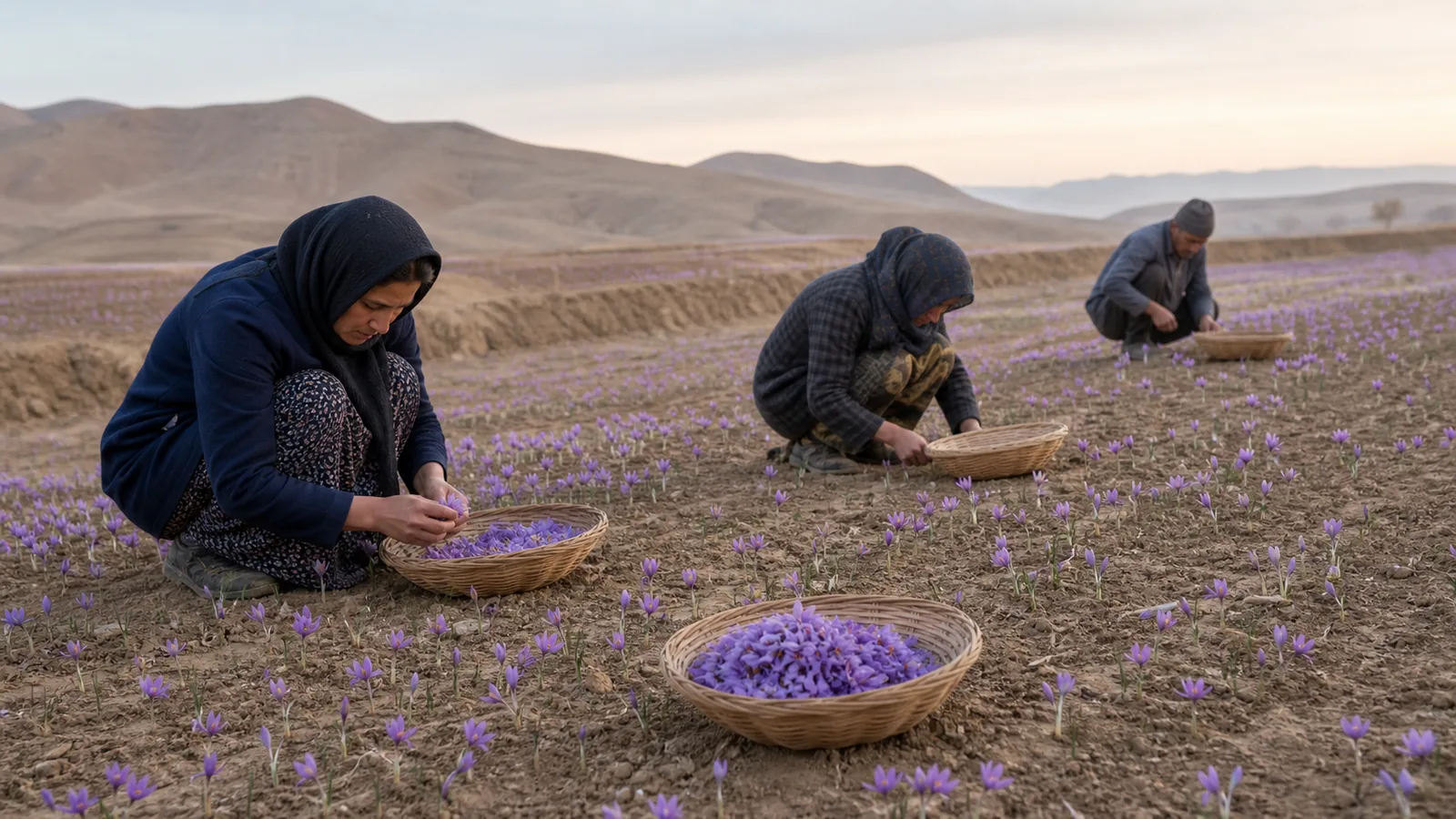
Khorasan saffron is the centre of Iran’s saffron story. Across Razavi Khorasan, South Khorasan, and North Khorasan, the crop shapes autumn work, household income, local trade, and the identity of farming towns. The region’s dry summers, cool flowering season, long experience with corms, and careful hand harvest have made it the country’s dominant production area.
The flower is only the beginning. What happens before planting, during the few intense weeks of harvest, and after the threads leave the farm determines how much value stays with growers and how Khorasan is represented in international markets.
Why Khorasan is suited to saffron
Crocus sativus grows from a corm and follows an unusual calendar. It rests through the hot, dry summer, flowers in autumn, grows narrow leaves through the cooler months, and forms daughter corms before returning to dormancy in late spring. That rhythm fits the arid and semi-arid conditions found across much of eastern Iran.
The three Khorasan provinces remain overwhelmingly important. A 2025 field-and-climate study reports that North, Razavi, and South Khorasan together account for about 93.3% of Iran’s saffron production. Its quality-zoning analysis also found the highest-suitability areas concentrated mainly in Razavi Khorasan, while showing that temperature differences can affect crocin and picrocrocin levels.
Gonabad illustrates how the crop and landscape work together. The Food and Agriculture Organization’s qanat-based saffron heritage system describes underground water channels supporting high-value farming where surface water is scarce. Local knowledge, rather than rainfall alone, makes the system productive.
The field cycle
Growers plant healthy corms during dormancy and keep a field for several seasons. Corm size, planting density, soil structure, salinity, nutrition, field age, and water timing all influence flowering. Older reports often say a Khorasan field receives only three irrigations a year and stays productive for seven to ten years. In practice, both figures vary by location and management, and neither should be treated as a universal prescription.
Pre-flowering water is especially important where autumn rain is not enough to trigger even emergence. After irrigation, growers may loosen a hard surface crust so shoots can reach daylight without being damaged. Later water supports leaves and daughter corms. Summer is the dormant period, not the time for routine heavy watering.
First-year stigma yields are commonly lower while the stand establishes. Production may rise as daughter corms develop, then decline when the field becomes crowded or old. Exceptional yields above 30 kg/ha have been reported, but they are not a normal planning assumption. Our broader guide to saffron production in Iran explains the agronomy and the evidence limits around record claims.
Harvest begins before sunrise
During the flowering weeks, new crocuses can appear every morning. Families and seasonal crews begin early, while the flowers are still relatively cool and often closed. The small blossoms are gathered into baskets and moved quickly to a clean separation area.
The source feature described this rhythm in Khaf: smallholders working their own plots, larger farms hiring seasonal pickers, and some workers being paid according to the weight of flowers collected rather than a flat day rate. One student, identified as Ahmad, described coming to Khaf for the season. His quoted toman earnings are now obsolete, but the account preserves an important point: a short harvest can become a concentrated source of rural work.
Harvest does not end when the basket is full. Each flower must be opened and the three red stigmas separated. This work often continues in homes and small workshops through the day. Women’s skilled work has long been central to picking, separation, coordination, and household processing; it should be recognised as productive labour, not casually described as spare-time help.
Why the flowers must be handled quickly
Fresh flowers deteriorate and become harder to separate when they sit in deep, warm piles. Clean shallow containers, prompt transport, hygienic work surfaces, and controlled drying protect the lot. A dryer can make temperature and airflow more consistent, while field preparation and corm lifting can also be partly mechanised. Flower selection and stigma separation, however, remain highly dependent on careful human handling in many operations.
The old feature suggested that fertiliser and pesticides did not affect the plant and that genuine organic production had disappeared. Neither claim is supportable. Nutrient management can influence plant and corm development, while unnecessary pesticides can affect workers, soil, beneficial organisms, residues, and buyer acceptance. “Organic” is a certification claim that requires compliant production and records; it cannot be judged from the flower’s colour or aroma.
Small farms, prices, and harvest-season pressure
A saffron farm may produce enough for household use, direct sale to acquaintances, or a larger commercial lot. The destination’s interviews show this range. One grower described cleaning, drying, and selling his own crop after the harvest, including direct orders carried between Khaf, Mashhad, and Tehran.
Other growers need cash as soon as the flowers are harvested. Supply is abundant at that moment, which can weaken their bargaining position. The source reported that some small farmers accepted prices 10–15% below nearby city markets. That percentage belongs to the period of the report, but the structural issue remains: a producer who cannot finance processing, storage, testing, and a later sale has fewer choices.
One village account described a community fund that bought members’ saffron during harvest and sold later, returning the capital to the fund for the following year. It is a useful cooperative idea, though not a guaranteed profit. Storage carries quality and price risk, and any pool needs transparent weighing, grading, records, governance, and payment rules.
Climate pressure is changing the calculation
The original feature said that favourable cultivation had shifted north from Qaenat and southern Khorasan toward areas such as Torbat Heydarieh. A single report cannot prove a regional migration, but the concern is credible. Temperature affects flower initiation, emergence, yield, and the compounds used to assess saffron quality.
A climate-modelling study for South Khorasan projected rising temperatures and a more fragmented pattern of suitable cultivation in future decades. More recent quality-zoning work also found higher late-summer temperatures associated with lower crocin and picrocrocin in sampled fields. Farmers need local monitoring and water planning rather than assuming that yesterday’s calendar and site will perform the same way indefinitely.
Where Khorasan’s saffron goes—and who profits
The source post adds the export side of the story. Abbas Hemmati Kakhki, identified as a faculty member of the Khorasan Razavi Food Science and Technology Research Institute, criticised “unhealthy competition” among Iranian exporters. He said traders undercut one another by selling large quantities in bulk and at low prices to Spain and Dubai, allowing more of the branding and retail margin to be captured elsewhere.
He also argued that Iranian saffron was being sold onward under Spanish brands and that a genuine exporters’ union could coordinate the trade and help Iran exceed Spain in value terms. These are attributed industry claims, not verified measurements of every trade route or brand. The source did not provide customs data, a price series, a list of companies, or the design of the proposed union.
The economic point is still sound: production share and final-market value are different. Cleaning, grading, laboratory testing, traceable packaging, brand development, distribution, and customer service all add cost and value after the spice leaves the farm. When exporters compete only on the lowest bulk price, those activities—and the margin attached to them—are more likely to happen somewhere else.
What stronger Khorasan branding requires
A regional name helps only when buyers can trust what it means. Stronger positioning for Khorasan saffron needs more than attractive packaging:
- lot-level traceability from grower or collection point to finished pack;
- consistent grading, moisture control, hygienic separation, and drying;
- test results tied to the actual commercial lot;
- honest origin and harvest claims;
- packaging that protects aroma, colour, and threads; and
- export coordination that does not erase legitimate competition or small producers.
An exporters’ association can help define shared specifications, pool market intelligence, and promote origin. It cannot create lasting value if members use inconsistent products or if the arrangement becomes a vehicle for price control without accountability.
Khorasan’s real advantage
Khorasan’s advantage is a complete human and agricultural system: climate, corm knowledge, water management, early-morning picking, rapid separation, drying skill, local markets, and families who know the crop. Its challenges are just as connected. Climate stress, harvest labour, access to finance, quality records, and export strategy all determine whether the region is paid fairly for what it produces.
The strongest future is not simply more bulk saffron. It is well-managed fields, recognised labour, measurable quality, transparent trade, and Khorasan brands that can explain and prove the origin behind the name.

![Exporting Saffron to Turkey + Price Guide [Complete 0 to 100]](https://img.rowhanisaffron.com/20260827003933/saffron-export-turkey-quality-inspection.webp)



