


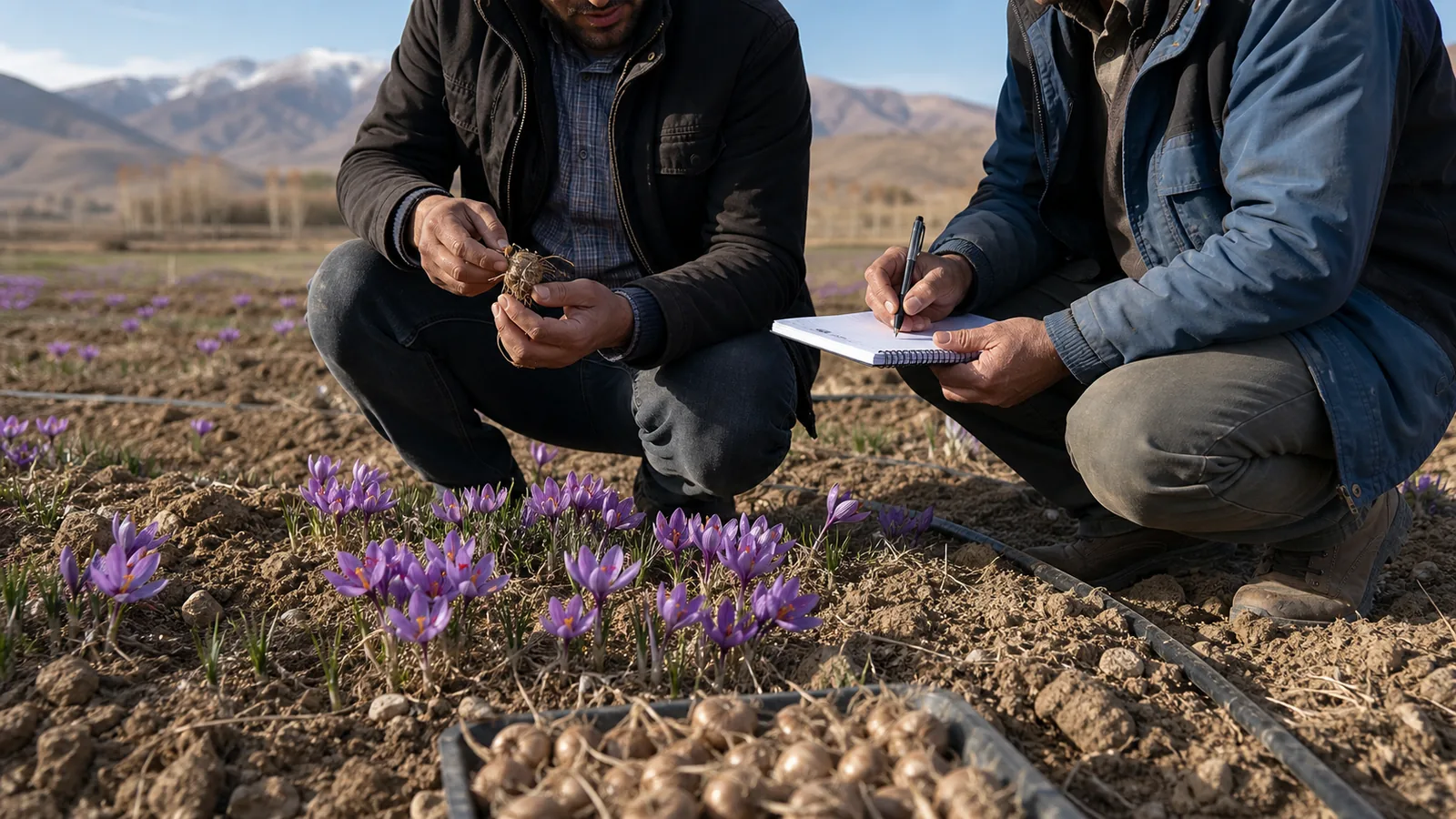
Saffron was planted in Ardebil as part of a broader attempt to diversify agriculture under water pressure. Historical pilot reports from Bam and Damavand describe the same idea in different climates: test saffron on a limited area, measure the local result, and build processing and marketing only if the crop proves agronomically and economically suitable.
These cases do not mean that saffron will succeed on every mountain or dry field. Climate, soil, water quality, corm health, field age and management all affect yield. A 2023 field study of saffron across different environments found that temperature, soil properties, irrigation events, growth period and field age were among the important yield factors. That is why a local trial is more useful than copying a figure from another province.
Why Ardabil tested saffron
Ardabil was widely associated with potatoes, but provincial planners were looking at other high-value crops as groundwater pressure increased. The historical Mehr report said excessive water use had pushed the Ardabil plain into a restricted category. Saffron was considered because its active growth cycle and irrigation demand differed from the dominant crops.
The report attributed several figures to Adil Sarvi, then head of the provincial agricultural organisation. It said 447 tonnes of saffron corms had been distributed in eight of the province’s ten counties and that the season produced 60 kilograms of dried saffron. A new cropping model had been prepared for all ten counties, supported by 450 extension activities.
Those are dated programme figures, not current acreage or production. The first harvest from recently planted fields also does not represent mature-field potential. It establishes that flowering and processing occurred; it does not by itself prove long-term profitability.
Water saving and value added were separate goals
The Ardabil programme had two stated aims: reduce pressure on agricultural water and create more value per unit of production. The second goal requires work after harvest. Five saffron-processing units had reportedly received operating licences, and provincial governor Majid Khodabakhsh argued that planning should extend beyond selling saffron as an undifferentiated food ingredient.
Processing does not automatically create value. A viable unit needs clean raw material, documented lots, appropriate drying and packaging, buyers, food-safety controls and enough throughput to cover its cost. The product’s intended use also determines which regulations apply; a food spice cannot be turned into a medicinal or cosmetic claim simply because a facility processes it.
Ardabil’s wider crop-diversification context
Saffron was one part of a wider provincial discussion that also included Damask rose, pistachio and rice. The source said about 110 hectares had been allocated to targeted cultivation of medicinal and aromatic plants and quoted an official claim that 500 such species had been identified in the province. It also described plans for a 5,000-tonne processing plant near the Khoda Afarin dam, with 11 trillion rials of private investment, 30% physical progress and a projected 340 jobs.
All of those figures belong to the historical report and should be checked before any current investment decision. Their relevance to saffron is structural: introducing a crop without a route to cleaning, testing, processing, packaging and sale leaves the value chain unfinished.
The same article discussed subsidised pistachio planting in Arshaq and rice under the Moghan name. Those crops have different water, soil and market requirements. They are not evidence that “Ardabil soil can grow anything,” as the older prose implied. Diversification succeeds when each crop is tested against the right location and business model.
The Bam pilot: a small mountain-area business case
In Bam County, Kerman, governor Reza Ashk described saffron as one of four crops considered for temperate mountain and foothill areas. Cultivation reportedly began on two hectares in Dayer village around Iranian year 1389, corresponding to 2010–11, and later reached eight hectares.
The pilot field was said to reach economic production after two years and yield about six kilograms per hectare. The report also said corm multiplication could supply later expansion. These results came from one local programme and should not be treated as a guaranteed yield for Bam or another region.
What the old Bam cost figures mean
Ashk gave a historical gross-income estimate of 25–30 million tomans per hectare and a first-year establishment cost of 20–24 million tomans. Around 18 million tomans of that initial figure was attributed to corms, which he expected to remain productive for about seven years.
He also associated each hectare with two or three people and roughly 200 temporary workdays across weeding, harvest and packaging. The wording does not support calling these permanent full-time jobs. It is better understood as a seasonal labour estimate.
Nominal toman figures from that period cannot be used as a current budget. Corm price, labour, water, land preparation, yield, grade, packaging, finance and selling price all need to be recalculated for the proposed year and field. Gross revenue is not profit.
Damavand’s experimental dry and irrigated cultivation
The Damavand source described trial rainfed and irrigated plots spreading across more than ten hectares. At the Hamand Absard agricultural complex, cultivation had reportedly continued for 11 years on about 1.5 hectares of sloping land.
Hamid Reza Khalili, a local agriculture official, said the trials had produced encouraging results for quantity, quality and aroma-related characteristics. Another official estimated potential output near five kilograms per hectare and said local snow and rain could reduce supplemental irrigation to two or three events in some fields.
These were local observations, not a universal irrigation schedule. A scientific review of saffron water requirements explains that timing, climate, field age, water quality and production system all matter. Saffron can use less irrigation than many conventional crops in a suitable environment, but water stress can still reduce growth and yield.
How saffron fitted the Damavand calendar
The report described saffron as a possible “second crop” after the apple harvest because its main autumn work begins when apple picking ends. That is primarily a labour-calendar comparison; it does not prove that a saffron field should be planted between established apple trees.
Small demonstration plots of 100–200 square metres were used in several villages, including Mehrabad, Mara, Jaban, Sarband and Garm Absard. One farmer had cultivated 100 square metres for three years. Another described a 1,000-square-metre trial that produced roughly half a kilogram in its fourth year. These small plots helped households learn planting, picking and stigma separation before committing more land.
The source also observed that flowering usually rises as daughter corms multiply, could peak around years five to seven and may decline later as the field becomes crowded. It separately said corms might remain in the ground for more than 15 years. Both statements need context. Productive field life varies; a long-surviving planting is not necessarily an economically optimal one.
What the three regions have in common
Ardabil, Bam and Damavand differ in climate and farm structure, but their pilot reports point to the same sequence:
- Select the site. Test drainage, soil, temperature pattern, water quality and access before buying corms.
- Start with traceable planting material. Reject wounded, soft or diseased corms and keep lots identifiable.
- Run a measured plot. Record planting density, irrigation, labour, flowering, dried-stigma yield and quality over several seasons.
- Calculate full cost. Include corms, land preparation, weeding, harvest, separation, drying, testing, packaging and finance.
- Secure a buyer and specification. A headline price is not useful unless grade, lot size and delivery terms are comparable.
- Expand only after evidence. One successful plot should lead to a larger controlled trial, not automatic province-wide planting.
Our saffron planting guide covers the crop cycle and establishment steps in more detail.
A regional success needs more than flowers
The three historical programmes treated saffron as a response to water scarcity and rural employment needs. Those are legitimate reasons to test the crop, but the harvest is only the beginning. The final product must be separated cleanly, dried consistently, protected from moisture and light, tested where required and sold through a market that values its documented quality.
Ardabil’s 60-kilogram report, Bam’s eight-hectare pilot and Damavand’s long-running experimental plots show that saffron cultivation was not confined to one traditional region. They do not make every expansion safe or profitable. The strongest lesson is the method: begin small, measure honestly, preserve crop and cost records, and let local results determine the next step.

![Exporting Saffron to Turkey + Price Guide [Complete 0 to 100]](https://img.rowhanisaffron.com/20260827003933/saffron-export-turkey-quality-inspection.webp)



