


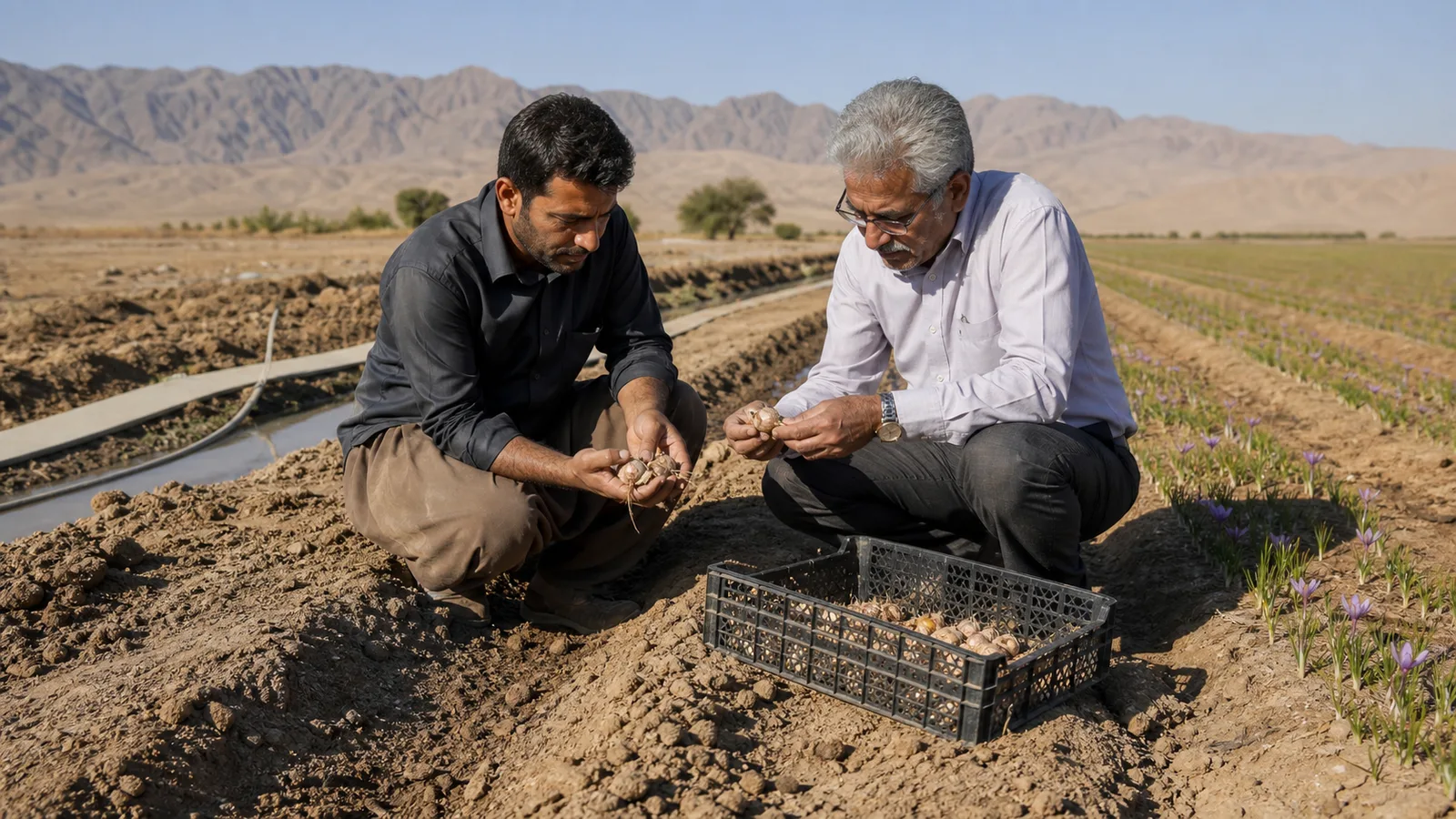
Planting saffron in Sirjan city expanded to a reported 83 hectares after local training and new-field support encouraged farmers to try the crop. The historical program recorded about 170 kilograms of dried saffron in Iranian year 1395, with field yields described as roughly three to five kilograms per hectare. It also exposed a practical barrier: many growers applied for agricultural finance, but very few received enough support to cover corms and land preparation.
Sirjan remains the main focus here. Historical harvest reports from Hamedan, Farsan and Meshgin Shahr are included as comparisons because they show how field age, short harvest windows, input support and unpaid incentives can change the outcome of the same crop in different provinces.
Sirjan’s 83-hectare saffron program
Mahmoodabadi, then director of Agricultural Jihad in Sirjan, reported 83 hectares under saffron, including 28 hectares of recent expansion. Planting was described as taking place from June to mid-October when local conditions allowed, with flowering and harvest beginning in early November.
The report put annual production at about 170 kilograms. It gave an average field yield near 3.2 kilograms per hectare and said individual fields ranged from three to five kilograms, with five kilograms the highest recorded result. Applying 3.2 kilograms to every one of the reported 83 hectares would produce a larger total, so the figures probably combine newly planted and productive fields. The archive does not separate them, and the article does not pretend that it does.
That distinction matters in saffron. Newly established land and mature, well-populated plots should not be placed in one yield calculation without recording field age. Corm size, planting density, soil, moisture and management also influence flowering. Research indexed in FAO’s AGRIS database confirms that corm weight and density can have significant effects on saffron yield.
Training created interest, but finance limited planting
Sirjan officials used group classes, individual instruction and written guidance to introduce farmers to saffron. Interest was strong enough that 78 applications covering 81.5 hectares were referred to the Agricultural Bank for National Development Fund financing.
Only five applicants were reported to have received facilities. Growers said instalment-based payments did not meet early costs such as preparing the field and buying corms. Interest charges, guarantor requirements and collateral added further obstacles. Local officials connected growers with people supplying corms inside Sirjan, but local availability alone does not establish plant health or suitability.
A sound budget should be settled before planting. It needs to include traceable corms, soil preparation, irrigation, weed and pest management, concentrated harvest labour, stigma separation, drying, testing and packaging. Saffron’s high retail value cannot compensate for an underfunded field or a poor route to market.
What Hamedan’s harvest figures add
A Hamedan provincial harvest report attributed to Rezvani Jalal recorded about 60 hectares and forecast roughly 190 kilograms of dried saffron. It described an average near four kilograms per hectare, with harvest beginning in early November and continuing to the end of the month.
Here again, the area, average yield and total do not all reconcile when multiplied. The likely explanation is a difference between total planted land and the area bearing a crop, but the archive does not state that directly. The program intended to add about 20 hectares each year and said saffron was present in every county, with Malayer holding the largest reported area at 25 hectares.
For a reader comparing Hamedan with Sirjan, the useful point is the shared November labour peak and the need to keep planted-area records separate from productive-area records. The old totals are not current provincial forecasts.
Farsan shows how short the harvest window can be
In Farsan, Chaharmahal and Bakhtiari, agriculture director Dehghan Shahrani reported 26 hectares under saffron, of which 20 hectares were bearing. He expected about 80 kilograms of dried saffron at an average of four kilograms per productive hectare.
Unlike the broader area figures in Sirjan and Hamedan, those numbers reconcile because the report identifies the bearing area. It also said harvest would begin after two irrigation rounds and last about two weeks. That schedule is a historical account of local practice, not a universal irrigation instruction, but the two-week window clearly illustrates why labour and drying space must be arranged before flowers appear.
Meshgin Shahr: support promises and an unpaid subsidy
The Arshaq district of Meshgin Shahr, in Ardabil Province, was described as an emerging saffron area with an estimated capacity of three to four kilograms per hectare. Agricultural officials said they were ready to distribute corms and offer low-interest facilities after evaluating applicants.
Growers also reported that a subsidy of 2,000 tomans per kilogram had not been paid. The amount is historical and should not be used in a current budget, but the problem is relevant to Sirjan: a support announcement has no financial value until a grower knows the eligibility rules, timing and amount actually received.
The Meshgin report discussed well-drained soil, careful corm handling, planting during dormancy and standardized packaging. These are useful principles, but its exact temperature, pH and calendar claims are not presented here as fixed requirements for every field. Site-specific advice should come from current local agricultural guidance.
The report also suggested that cultivation could preserve or increase saffron’s “healing properties.” That claim is not scientifically defined. Agricultural and post-harvest controls can affect identity, cleanliness and measurable quality, but a field practice should not be advertised as preserving treatment effects. The ISO 3632-1 saffron specification provides a more defensible framework for dried product requirements.
How to plan a Sirjan saffron field responsibly
The four regional records point to a practical sequence:
- Separate total and bearing area. Record the age and corm density of each plot before comparing yields.
- Inspect the site. Confirm drainage, soil condition and a realistic irrigation source.
- Buy traceable corms. Reject diseased, damaged or badly desiccated planting stock.
- Fund establishment fully. Do not assume a loan or subsidy will arrive after planting.
- Prepare for November. Organize pickers, clean separation space and controlled drying before flowering.
- Test and store the dried crop. Protect it from moisture, light and contamination and use named specifications for market claims.
The Sirjan program demonstrated that growers were willing to adopt saffron and that the crop could produce under local conditions. It did not prove a guaranteed yield or profit. Current input prices, finance terms, water availability, plant-health requirements and buyer specifications need to be checked afresh before a new field is planted.
References: FAO AGRIS: corm weight, density and saffron yield; FAO: Iranian qanat-based saffron farming; ISO 3632-1:2025 saffron specification. All Sirjan, Hamedan, Farsan and Meshgin Shahr numbers are historical figures preserved from the four local reports consolidated here.

![Exporting Saffron to Turkey + Price Guide [Complete 0 to 100]](https://img.rowhanisaffron.com/20260827003933/saffron-export-turkey-quality-inspection.webp)



