


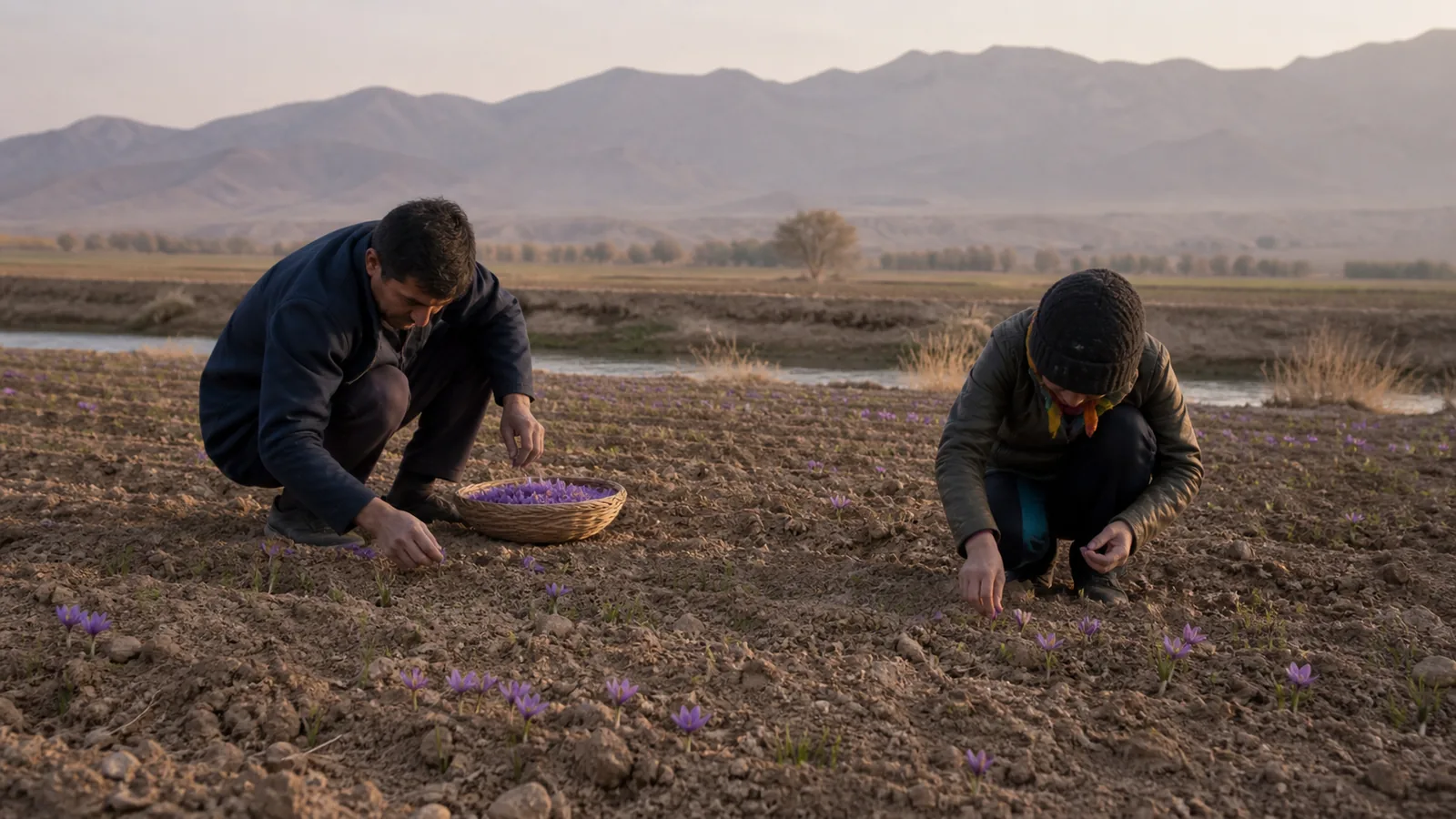
Golpayegan’s saffron harvest began across 50 hectares of mature fields within a total planted area of 60 hectares. The 2020 local forecast expected about 500 kilograms of dry saffron, supported by yields of more than 10 kilograms per productive hectare.
What the 60-hectare figure includes
The original translation blurred two different numbers. Golpayegan had 60 hectares planted with saffron, but only 50 hectares were described as fertile, harvest-ready farms. The remaining 10 hectares had been planted that year and were not included in the same production forecast.
This distinction is normal for a perennial saffron field. Newly planted corms can flower, but a young field should not automatically be assigned the mature yield of an established one. Field age, corm size and density, soil, irrigation timing and weather all affect the first useful crop.
The source was a dated harvest announcement, not a permanent area estimate. The Golpayegan Agriculture-Jahad report dated 27 October 2020 attributes the figures to department head Heidar Ali Golmohammadi. They describe that crop year and should not be read as today’s acreage.
When the Golpayegan saffron harvest took place
According to Golmohammadi, harvesting in the 50 productive hectares began in late Mehr and continued to the middle of Aban in the Iranian calendar. In an ordinary Gregorian conversion, that means roughly late October into early or mid-November.
The stored English article said the work started at the end of October and continued until the middle of October, which is impossible. The second month had been mistranslated. Correcting it to November restores the intended sequence without changing the reported season.
Daily timing matters too. Saffron flowers are normally picked early and handled quickly before the petals wilt. The stigmas then need careful separation and drying. Because flowering is concentrated into a short autumn window, labour and processing space must be ready before the first large flush.
How the 500-kilogram forecast was calculated
The local official reported a yield of more than 10 kilograms per hectare under that season’s weather and crop-management conditions. Applied to 50 productive hectares, 10 kilograms per hectare gives 500 kilograms. The area, yield and forecast therefore describe the same group of mature farms.
That was an expectation, not a certified final production result. The source said about 500 kilograms of high-quality saffron was anticipated; it did not publish a post-harvest weigh-in. “More than 10 kilograms per hectare” should also not be treated as a guaranteed yield for every Golpayegan farm or every year.
Growers reach the final dry weight only after thousands of flowers have been picked, the red stigmas separated and much of their moisture removed. Losses during handling and drying, as well as the share of each field that actually flowers, determine whether the forecast becomes saleable saffron.
The labour figure means person-days, not 200 people every day
The original translation said 200 people harvested saffron per hectare daily. The source statement used a different unit: each hectare generated about 200 person-days of employment for the harvest.
A person-day means one person’s work for one day. Two hundred person-days could be 20 people working for 10 days, 40 people working for five days, or another combination. It is a measure of labour input, not a claim that 200 workers stood on every hectare at once.
That labour is spread across picking, moving flowers, separating stigmas and related handling. It is one reason saffron can matter to small rural holdings even when the planted area is modest. The official also linked Golpayegan’s expansion to small farm parcels, the crop’s economic appeal and relatively limited irrigation requirement.
Golpayegan, the Qebla River and the surrounding landscape
Golpayegan is a county and town in Isfahan province. Its position between mountains, plains and drier country helps explain the old local description “the city of four climates.” The phrase is descriptive rather than a formal climate classification.
The Qebla River is also known as the Golpayegan River. Encyclopaedia Iranica identifies it as the region’s most important river, running through the county and supplying water toward Khomeyn, Delijan and Mahallat before the drainage system reaches the Gavkhuni salt marsh near Isfahan. The Golpayegan dam stands on this river near Akhtekhvan.
This is the same river that the old article called the “Qibla River.” Both Qebla and Qibla appear in English transliteration, while Golpayegan River is the clearest geographic alternative. It should not be confused with a reference to the qibla direction inside a mosque.
Official tourism information places Golpayegan 156 kilometres northwest of Isfahan, bordered by Khomein to the north, Khansar to the south, Aligudarz to the west and Meymeh to the east. The original article also gave 352 kilometres from Tehran. Road distance varies with the chosen route, so these figures work as orientation rather than farm coordinates.
A long history behind a newer crop story
Golpayegan’s agricultural identity sits beside a much older cultural history. Historical sources record several forms of the town’s name, and a tradition cited by medieval writers says it was founded by Samra, also known as Homay, the daughter of Bahman. That is a recorded foundation tradition, not an archaeologically proven date.
The original English text rendered this as Homay Dokhtar Bahman from the Kayanian dynasty and gave Wardpatkan, “Land of Red Roses,” as an earlier name. Those details belong to the town’s cultural narrative. They should be kept separate from the measurable 2020 harvest report.
The landscape also supports more than saffron. Golpayegan is known for plains, gardens, mountain vegetation, qanats, wells and springs. In the same 2020 statement, the agriculture department discussed bean harvesting as another important local crop, although its figures are not needed to understand the saffron forecast.
What the harvest report establishes
The beginning of saffron harvest in 60 hectares of Golpayegan farms was a specific 2020 event. Fifty hectares were mature enough for the forecast, 10 hectares were newly planted, and officials expected about 500 kilograms at more than 10 kilograms per productive hectare. Harvesting ran from late October into November and was estimated to create about 200 person-days of work per hectare.
Those corrected units make the report coherent. They also preserve the local context that readers search for: Golpayegan’s place in Isfahan province, the Qebla or Golpayegan River, its mountain-and-plain setting and the town’s historical identity. Future comparisons should use a named crop year rather than assuming the area and yield have remained unchanged.

![Exporting Saffron to Turkey + Price Guide [Complete 0 to 100]](https://img.rowhanisaffron.com/20260827003933/saffron-export-turkey-quality-inspection.webp)



