


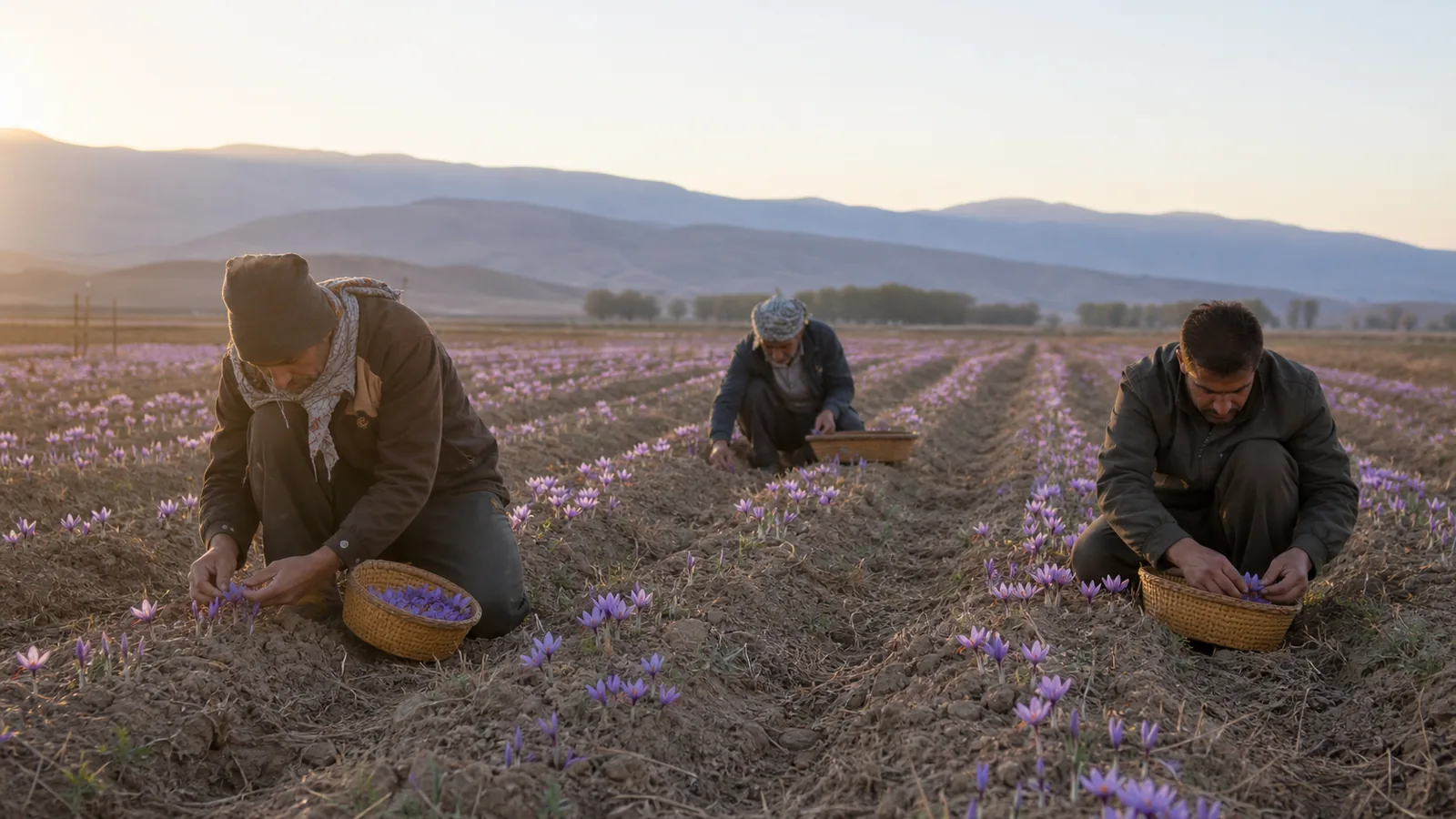
Harvesting saffron across roughly 90,000 hectares of Khorasan Razavi made the province the centre of Iran’s crop in the season described here. In Torbat-e Heydarieh and Zaveh, the short autumn flowering window brought fields, roads, markets and thousands of seasonal workers into the same demanding harvest.
Why the 90,000-hectare figure matters
The original report placed 90,000 hectares of saffron farms in Khorasan Razavi. A provincial Agriculture-Jahad statement published in 2021 gives a closely matching figure: 90,900 hectares and 302 tonnes in crop year 1399, with an average dry-saffron yield of 3.31 kilograms per hectare.
The same official quoted the province as producing more than 70% of Iran’s saffron. Those dated figures support the headline’s scale without turning 90,000 into a permanent number. Cultivated area, weather, corm age, water availability and farmer decisions change from one crop year to another.
Older national figures in the stored article do not add up cleanly. It said Iran had 108,000 hectares in total, then assigned 90,000 to Khorasan Razavi, 15,700 to South Khorasan and another 8,000 to other provinces. Those components total 113,700 hectares, not 108,000. It also paired the area figures with production shares of 78% and about 7%, which are different measures. They should be retained as a historical report, not presented as one internally consistent census.
When the saffron harvest begins
In much of Khorasan Razavi, saffron flowers appear as the weather cools from late October into early November. Exact timing shifts by altitude, local temperature, irrigation date and the season’s weather. Warmer districts may begin before colder fields, so the provincial harvest moves in waves rather than starting everywhere on one morning.
Along the road between Torbat-e Heydarieh and Zaveh, that change is visible. Fresh purple flowers move quickly from farms to collection points and flower markets. Picking normally begins early because open flowers are more exposed to sunlight, wind and handling. The red stigmas then need to be separated and dried promptly.
The brief flowering period concentrates work into a few weeks. A farm cannot simply delay picking until labour is convenient: unopened buds and newly opened flowers continue to arrive each day, and a missed harvest round can reduce quality.
Torbat-e Heydarieh and Zaveh saffron production
The archived forecast covered more than 22,000 hectares in Torbat-e Heydarieh and Zaveh and expected about 70 tonnes of dry saffron. It also gave a regional average of 4.2 kilograms per hectare and said some farms had increased yields as much as fourfold through modern and organic methods.
Those statements describe different groups of fields and should not be multiplied together. Seventy tonnes divided by 22,000 hectares is about 3.18 kilograms per hectare, so the forecast cannot have applied the 4.2-kilogram average uniformly across the whole stated area. The “fourfold” result also needs a farm-level baseline and season before it can be treated as typical.
Field performance really does vary within the region. A recent University of Birjand study indexed by FAO AGRIS compared three Torbat-e Heydarieh and Zaveh production areas. It reported dry-stigma yields of 5.7, 3.35 and 4.1 kilograms per hectare, linking the differences to climate, irrigation management and water conditions.
That range is more useful than a promise of one yield. Corm size and density, field age, soil, nutrition, irrigation timing, flower-picking speed and post-harvest loss all influence how much dry saffron reaches the final container.
How much employment does the crop create?
Saffron is central to income and employment in Torbat-e Heydarieh and Zaveh because much of the work is still done by hand. Picking, transporting flowers, separating stigmas, drying, grading and packing require labour in quick succession.
The original English text said more than 700,000 people worked in the two cities, but it did not define the year, geography or whether this meant workers, workdays or people supported by the industry. It should not be repeated as a verified headcount.
The 2021 Agriculture-Jahad statement provides a clearer unit: an average hectare of saffron needed about 210 person-days of labour, described as roughly one permanent job equivalent in production. That does not mean one person works continuously on every hectare. It combines many seasonal tasks and workers into an annual labour measure.
The flower market and the old price figures
Price was the farmers’ immediate concern in the season covered by the report. Fresh saffron flowers were said to sell for 300,000–400,000 tomans per kilogram, depending on quality. The article noted that prices could fall toward evening when a day’s flowers arrived together and supply temporarily increased.
Representatives of Torbat-e Heydarieh, Zaveh and Mahvelat, after consulting the National Saffron Council, were reported to have announced purchase floors of 450,000 tomans for fresh flowers, 20 million tomans for a dry grade translated as “jewellery,” and 16 million tomans for a grade translated as “straw.” The stored report said those floors were not evident in the market.
These are historical nominal prices. They should not be used as a current saffron price or converted at today’s exchange rate. The translated grade names are also uncertain; they appear to refer to dry-saffron trade grades, but the source-language notice is not available here, so silently replacing them with a modern commercial grade would risk changing the record.
What determines the value of the harvest?
A farmer’s result depends on more than the price per kilogram of dry saffron. Flower yield, stigma-to-flower ratio, labour cost, drying loss, grade and the timing of sale all matter. A high flower-market price helps a grower selling fresh flowers, while a producer who separates and dries the crop faces additional labour and quality-control costs.
Speed must be balanced with care. Flowers need gentle transport rather than compression in deep sacks. Stigmas should be separated in clean conditions, dried evenly and protected from moisture, light and contamination. Poor handling after a successful field season can lower the grade that buyers are willing to pay for.
Reliable market information is equally important during the rush. Farmers need to know whether a quoted price applies to fresh flowers or dry saffron, which grade and moisture condition it describes, whether the buyer is paying immediately, and whether an announced support price is actually operating at a named purchasing centre.
A regional harvest with national importance
Harvesting saffron in Khorasan Razavi is both a farm operation and a regional mobilisation. The 90,000-hectare scale is supported by the nearby official figure of 90,900 hectares for crop year 1399, while Torbat-e Heydarieh and Zaveh remain central to the story through their fields, labour force and flower markets.
The older report’s area, production and price numbers are valuable when they are dated and kept in their proper units. They show how large the harvest had become, how sharply work was concentrated into autumn, and why market prices worried growers. They do not form a current forecast. For anyone comparing seasons, the crop year, hectares, dry yield, grade and source should always travel with the number.

![Exporting Saffron to Turkey + Price Guide [Complete 0 to 100]](https://img.rowhanisaffron.com/20260827003933/saffron-export-turkey-quality-inspection.webp)



