


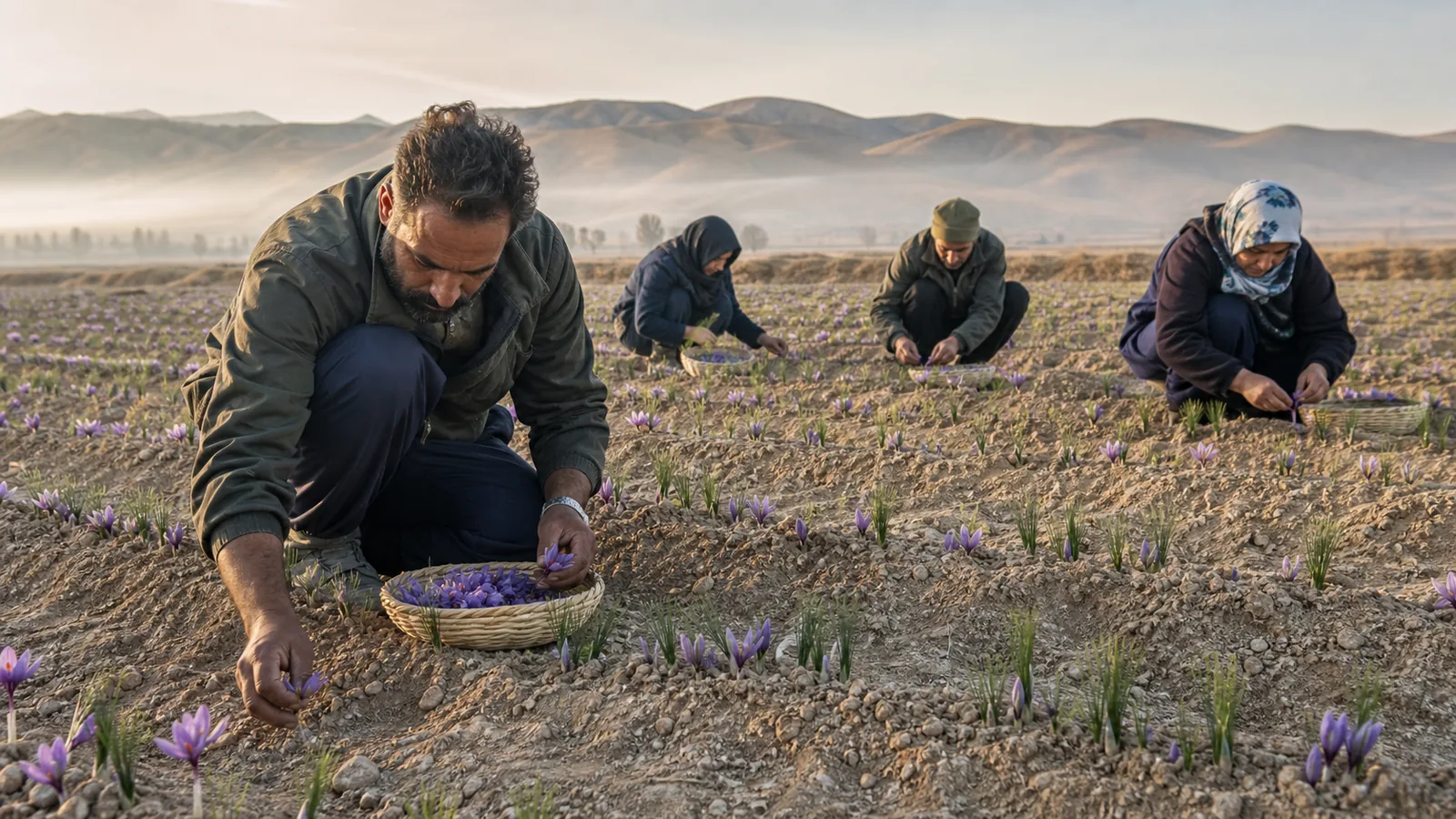
Saffron harvest had finished on about 60% of farms in Khorasan Razavi when this seasonal report was issued. Colder districts were nearly done, while warmer areas, including parts around Mashhad, still had flowers to collect; the province-wide harvest was expected to continue through the end of December.
What “60% of farms” actually tells us
Hashem Nagibi, then director of horticultural affairs at the Khorasan Razavi Agricultural Jihad Organization, described a harvest moving at different speeds across a large province. Temperature and flowering time vary by district, so one area can be separating and drying its final stigmas while another is still picking.
The 60% figure referred to farms reported as complete. It should not be read as 60% of the season’s final saffron weight, 60% of the planted area or proof that 60% of the crop had already reached the market. Fields differ in size and yield, and the announcement did not publish a measured tonnage alongside the percentage.
This distinction also corrects an awkward line in the older English text. Nagibi was discussing the progress and economic importance of saffron harvest, not saying that the harvest had been abandoned. The remaining work was continuing in the province’s warmer locations.
Why the area was reported as both 92,000 and 93,000 hectares
The announcement referred to roughly 93,000 hectares considered for saffron cultivation in Khorasan Razavi and said the resulting harvest would depend on weather. Elsewhere in the same body of reporting, the provincial area appeared as 92,000 hectares and Iran’s total as about 120,000 hectares.
These are best understood as rounded estimates drawn from nearby reporting points, not three measurements taken on one day. An official July 2020 value-chain report used approximately 93,000 hectares for the province and 120,000 nationwide.
A separate 2020 support-purchase report used 92,000 hectares, compared with more than 87,900 hectares in the preceding year, and counted 129,000 agricultural producers in the province’s saffron sector. Keeping the source and date beside each number is more honest than forcing them into false precision.
Saffron harvest is labour-intensive, but the unit matters
The original account assigned about 200 working days to one hectare across planting, crop care and harvest. It said roughly 65% of that work was concentrated in picking flowers, cleaning or separating the stigmas, and drying the saffron.
That means about 130 person-days per hectare for the harvest and initial processing stages, if the stated proportions are applied. It does not mean that each hectare creates permanent jobs for 200 different people. A person-day is one person’s work for one day; the same seasonal worker may account for several days.
The correction is important because saffron’s employment effect is real without needing an inflated description. Flowers open over a short period and are normally collected promptly. The stigmas then need careful separation and controlled drying. A farm may require many hands during this peak even though it does not employ those people throughout the year.
Farmers, households and livelihoods are different counts
The article cited 129,000 agricultural producers involved with saffron in Khorasan Razavi. It also included a broader country-level estimate of 130,000 farming households, of which 109,000 cultivated less than one hectare. Those categories may overlap, and “producer” is not necessarily identical to “household.” They should not be added together.
A further statement said around 600,000 people in Khorasan Razavi depended on planting and collecting saffron for some part of their livelihood. That is a broad economic estimate that may include growers, seasonal workers and members of their households. It is not evidence of 600,000 full-time saffron jobs.
What the figures do show is the prevalence of small holdings. When most households cultivate less than a hectare, decisions about labour availability, drying space, pooled processing and access to a buyer can matter as much as the provincial acreage total.
Why harvest timing affects quality and the market
A province-wide harvest does not arrive as one uniform lot. Colder areas can finish before warmer fields around Mashhad, while daily flowering creates a repeated cycle of picking and processing. Delays at any stage can make it harder to keep lots clean and consistent.
The seasonal concentration also affects the market. Large quantities can reach buyers in a short period, just as growers face labour and processing costs. The support-purchase arrangements described in the second official source belonged to that particular season; they are useful historical context, not current programme terms.
Weather adds another layer of uncertainty. The area planted can be known more confidently than the final dried output because temperature, moisture and the timing of flowering still influence how much usable saffron is produced. That is why the announcement qualified its acreage figure rather than presenting it as a guaranteed harvest.
Reading the Khorasan Razavi snapshot safely
This report is most useful as a picture of harvest logistics in a province where saffron supports many small farms. Its 60% marker shows the season in progress; the 92,000-to-93,000-hectare range shows the scale being reported at the time; and the labour figures explain why picking, separating and drying shape local employment.
None of those numbers should be carried forward as current without a new dated source. Acreage, weather, household participation and programme rules can change. The durable point is simpler: finishing harvest on 60% of farms did not mean the season or its economic work was 60% complete in every other sense.

![Exporting Saffron to Turkey + Price Guide [Complete 0 to 100]](https://img.rowhanisaffron.com/20260827003933/saffron-export-turkey-quality-inspection.webp)



